Used BMW X3 (Mk2, 2010-2017) review
The BMW X3 Mk2 is a competent and practical SUV that’s great fun to drive, although some alternatives surpass it for comfort and versatility.
Verdict
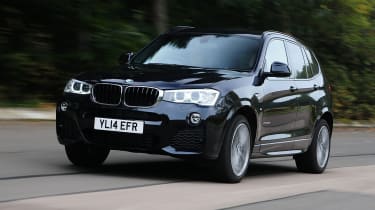
While it had far more opposition to fend off than its predecessor, the BMW X3 Mk2 was still able to follow in the first-gen car’s footsteps in being a capable and well-rounded premium SUV. The involving handling was one of the X3 Mk2’s big plus points, as was its practical cabin and efficient range of engines. It’s not perfect, though – the trade-off for that behind-the-wheel poise and control is a fairly firm ride (in particular, on models that are riding on the larger-diameter alloy wheels), and the diesel-only engine options means the X3 Mk2 won’t be for you if you’re specifically after a petrol-powered premium SUV.
Which one should I buy?
- Best BMW X3 Mk2 for low running costs: sDrive18d SE manual
- Best BMW X3 Mk2 for families: xDrive20d SE auto
- Best BMW X3 Mk2 for performance: xDrive35d M Sport auto
The BMW X3 Mk2 went on sale in the UK in November 2010, and initially launched in a limited specification. The only engine option was the all-wheel drive 20d diesel, and the only available trim level was what would end up becoming the entry-level SE grade. More variety would come in the following months: in March 2011, an M Sport trim level joined the range, and the 30d and 35d diesel engines were introduced to the X3 Mk2 in August 2011. The following year, an efficient 18d diesel engine was added to the line-up.
More reviews
Little else of note happened to the BMW X3 Mk2 until June 2014, when the car was given a mid-life facelift that updated the styling, tweaked the efficiency of the engines and updated the standard equipment levels. As part of the facelift, the SE and M Sport trim levels each had slightly plusher ‘Plus’ counterparts, and a new xLine trim level was added to slot between the SE and M Sport grades. In this configuration, the BMW X3 Mk2 remained on sale until the third-generation model was introduced in November 2017.
There isn’t a bad spec of BMW X3 Mk2 to go for, although the one we reckon makes the best all-rounder is the 20d. It has a bit more power than the 18d, which makes it a bit more flexible in day-to-day driving and when overtaking on motorways, yet still has enough oomph for general driving duties. Fuel economy is also pretty good and, because the 20d was one of the more popular choices with buyers when the car was new, it means you’ll have a decent selection to choose from on the used market
If you do lots of towing, then the 30d and 35d models may be more suitable for you, due to their better performance and stronger power and torque figures. Conversely, the 18d will be the pick for efficiency-focused buyers who are willing to sacrifice a bit of performance for fuel economy.
The SE trim was officially the entry-level grade on the BMW X3 Mk2, and it’s still a decent spec to consider – especially on post-facelift cars, because they came with a few more bits of equipment than pre-facelift versions. Indeed, the more expensive xLine and M Sport trim levels didn’t come with that many additional features; instead, they sharpen the car’s looks up a bit with their redesigned bodykits, larger alloy wheels and new interior trim pieces, such as sportier steering wheel designs.
What are the alternatives?
The BMW X3 Mk2 dates back to a time when family SUVs were beginning to explode in popularity, so there are lots of alternatives to the BMW, from premium brands and more mainstream car makers. Few of these alternatives were as fun to drive as the BMW, although some of those that could hold a candle to the BMW in the handling department were the Jaguar F-Pace and Porsche Macan.
At the premium end of the spectrum, there are a plethora of options that are worth having on your radar in addition to the BMW. The Audi Q5 and Mercedes GLC were some of the X3 Mk2’s direct rivals when the car was new, as were the Range Rover Evoque and Volvo XC60. The Land Rover Discovery Sport is a worthy shout, too, and it also has the selling point of having an extra row of seats over the BMW.
If the badge on the bonnet of your used SUV isn’t a primary concern, there are also worthwhile options to consider from mainstream and mass-market car makers. For instance, while cars such as the Hyundai Santa Fe, Kia Sorento and Skoda Kodiaq can’t match the BMW X3 Mk2 for fun handling or a premium feel, they’re in the same ballpark as the BMW in areas including equipment and practicality. If you’re on a tighter budget, these cars also have the appeal of being a fair bit cheaper to buy than the X3 Mk2.
Should you want something a bit more visually distinctive than the BMW X3 Mk2, then there’s always the first-gen BMW X4 to consider. Both cars were very similar mechanically, sharing engines, gearboxes and technologies with each other. The only real difference between the two is that, whereas the X3 was a conventional shape, the X4 had a coupe-like roofline that gave it a more striking profile, at the expense of rear seat headroom and outright boot space.
BMW X3 vs Land Rover Discovery Sport vs Jaguar F-Pace
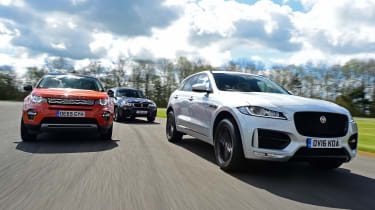
We pitted the BMW X3 Mk2 up against two of its main competitors, the Land Rover Discovery Sport and the then-fresh-faced Jaguar F-Pace, in our premium SUV group test from July 2016. Despite being the oldest car here, the BMW X3 Mk2 impressed with its interior build quality and strong engine. However, because it wasn’t as comfortable or as practical as the Jaguar or Land Rover, we decided to rate the BMW in last place. Read the full test here...
BMW X3 vs Audi Q5 vs Mercedes GLC
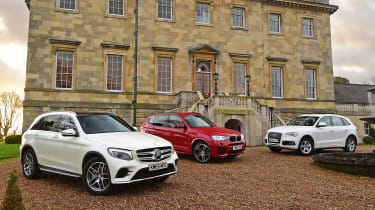
In February 2016, the BMW X3 went up against two of its chief competitors: the Mercedes GLC and Audi Q5. Overall, we were very satisfied with the BMW’s grippy handling, good fuel economy and high-quality interior, and felt the X3 Mk2 was a better car overall than the Audi. However, the BMW didn’t quite have enough up its sleeve to beat the Mercedes GLC to the top spot in this group test. Read the full test here...
BMW X3 vs Land Rover Discovery Sport vs Hyundai Santa Fe

For this group test from March 2015, we decided to do things a little bit differently. As well as comparing the BMW X3 Mk2 with an upmarket rival (in this case, the then-new Land Rover Discovery Sport), we also featured a mainstream alternative in the form of the Hyundai Santa Fe. The BMW put in a good showing with its sharp handling and roomy interior, which was enough to help it beat the Hyundai, though the X3’s firm ride and noisy engine contributed to it losing out to the Land Rover. Read the full test here...