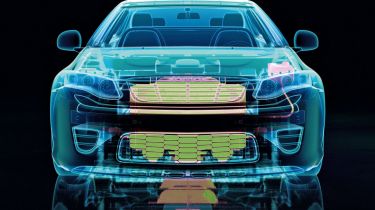
The next generation of petrol engines will offer the same fuel economy as hybrids without the extra weight and cost. So say engineers at US technology company Delphi, who’ve worked out how to incorporate the direct-injection method of ignition used in diesels into petrol engines. And the potential benefit is staggering.
Harry Husted, Delphi’s chief engineer for advanced powertrain development, told Auto Express: “The results of initial simulation work show this technology could improve engine efficiency by up to 50 per cent.”
In conventional petrol engines, a spark ignites the mixture of fuel and air. But in diesel engines, it’s the heat of compression that ignites the fuel and air mixture without the need for a spark. This allows the fuel to burn faster and more efficiently.
Until now, though, engineers have been unable to use the direct-injection method with petrol, because it’s too volatile to effectively control.
Delphi’s gasoline direct-injection compression ignition system overcomes this problem by using sophisticated valve timing, intake and exhaust tech to inject petrol in precisely controlled bursts. The company has successfully developed and tested a single-cylinder engine prototype and is already working on a more advanced system.
Husted added: “A multi-cylinder engine is being developed and will be ready to test later this year. It’s going to be a very torquey engine, with a similar feel to a diesel.”
And the new engine will have an immediate advantage over a diesel – and extra appeal to manufacturers: as unleaded fuel burns more cleanly than diesel, petrol engines don’t need an expensive and highly complex particulate filter. The new engine could be on sale by 2020.
Disqus - noscript
It's the compression ignition part that's new, not the direct injection part; for example, BMW has been using direct injection on petrol engines with a conventional spark plug since at least 2006...
Hi, I agree, I already have a car witha Direct Injection engine in it. The Ford ecoboost engine shares much with the diesel engine including mpg...
@seanblee 100% agree.
I remember Mitsubishi releasing them branded on Charisma GDI's as far back as 1997, so it's 15 years old!
(This not only makes me feel old, but very sad for remembering such useless trivia)
Interestingly without a spark plug, is this really a diesel engine just one that happens to utilise a cleaner fuel ?!
A better description for the article would be new technology allows petrol to be used in a diesel engine ;)
I recollect that when the Vauxhall Insignia was launched a 2.2 petrol engine with compression ignition up to 3,000rpm and spark ignition over 3,000 rpm and during hard accelaration was projected as being available within a year. This was claimed to give economy as good as the 2.0 cdi diesel with better performance.
Mercedes were also rumoured to be working on similar technology.
Three years on and nothing has appeared, which suggests the concept isn't easy to put into production. Given Vauxhall's problems with Insignia diesels exploding in flames, as featured on BBC's watchdog, and the reported premature failures of Astra, Vectra, Signum and Insignia automatic transmissions through coolant contamination, perhaps its just as well.
I remember 15 - 20 years ago engineers saying that petrol and diesel technology would constantly leapfrog each other. If, say, diesel technology became the clear leader, money would be invested in petrol engine research and development to overtake diesel. And vice versa. Chances are, we'll never see 'a winner' - the race will continue for ever.
So this news doesn't come as a shock.
But, as far as I know, there's more energy in a litre of diesel than in a litre of petrol. And the high compression ratio used for diesel improves the thermodynamics of the engine. So diesel will always have a slight head start.
Standard petrol engines are inherently inefficient because it takes a relatively long time for the fuel to burn after the spark. This is why ignition has to be so far advanced before TDC. During the combustion process, pressure increases dramatically, thus leading to changes in burn rates in the combustion chamber. One way of reducing the combustion time is to use 2 spark plugs which is what Honda do in some of their engines. It would be interesting to know what influence this has on actual engine efficiency.
Is there not a conflict between petrol requirements for current engines and this new technology? Petrol is formulated so that it will not pre-ignite (due to pressure and heat). The new technology surely requires this to happen.
Quote: One way of reducing the combustion time is to use 2 spark plugs which is what Honda do in some of their engines]
I also think Alfa Romeo did this with the twin spark, probably over ten years ago now.
Even if the technology is ready will they use it until they are pushed by legislation? Or, I suppose when one jumps they will all jump.
it will rev up like it's on nitric oxide ... air into the engine will have to be as precise as the fuel injection and maybe the volatility of petrol can be reduced and controlled by reducing the oxygen/ or bar pressure???
whatever every aspect of the combustion will need exact management and a real tough engine build to withstand the pressures and huge potential torque ... amount of fuel needed is tiny.. What a engine if it can be done? 1L could have as much power as a normal 3L engine with a probable better economic performance than a 1L
Current petrol engines are about 50% efficient while diesels manage 60 to 65%. A claimed improvement of 50% would take the new engine to 75% efficiency. Let us see some figures before we get carried away on hype.
I think your numbers might be a bit inflated there, Mike. Last I heard you'd be lucky to get 30% from a petrol engine, and high 40s from a diesel - a lot of the recent MPG improvements have actually come from advances in fuel metering, weight reduction, aerodynamics, rolling resistance and gearing. And even so, my current turbodiesel is only just my most efficient 4-wheeler, run a close second by a slightly smaller, somewhat lighter (and rather less powerful, admittedly) and much much older petrol powered one.
Therefore if you take this and chop the claims into a more real-world 25% (still more than the advances made by still-quite-exotic stuff like Multiair hydraulic valves and 6-stroke cycles; but not quite as much as the difference between my TD and its similar-HP, non-turbo petrol siblings...), we might see petrol engines which nudge past 40%. Being able to achieve the same efficiency and power/torque output as a TD in a NA petrol engine (therefore with less weight, less complexity, and less internal air-drag), using the lighter, more versatile, cleaner-burning fuel would be quite a coup. I like mine for its efficiency and its grunt, but it's still fairly large-capacity for its HP, does smoke something chronic if you have to floor it whilst cold (and still noticeably if idling when cold or flat-out when warm) - a lot of which ends up sticking to the paintwork - has complex and often expensive service requirements, had to have a heavy-duty battery fitted in order to even reliably start in (a british) winter, and doesn't have the sharpest everyday driving characteristics thanks to a relatively high-boost, fixed-vane turbo that takes a good second or so to spin up when transitioning from low to high load. The contrast vs my old NA petrol one is very marked in that regard, as that car's throttle response was pretty much at "the speed of thought", rather than feeling like it has a slinky spring for a throttle cable.
Two of the main reasons, not stated in this article, that you get an efficiency improvement are also the real reasons you see it in a diesel engine (which does away with the spark plug largely because it would be pretty ineffectual unless it was enormous, and would rapidly end up being fouled anyway - not because it's an efficiency sink!)...
First: much higher cylinder compression ratios. The greater volatility of petrol meant you couldn't go much beyond 10:1 (in europe, less in the USA) thanks to the typical fuel mix suffering damaging and power-sapping pre-detonation (pinking ... aka "dieseling"!) from *unwanted* compression-ignition in carburetted and indirect injection engines. Hence having to use "super" (simply a slightly less volatile mixture, the added cost coming largely from it having lower sales volume) in sports cars with highly tuned engines to avoid this problem.
Second: no throttle valve. Explicitly measured fuel and an engine designed from the outset for lean-burning (i.e. a very high air:fuel ratio, which burns a lot hotter than an "optimal" mixture and can be lethal to a petrol engine not built for it), with no additional restriction in the inlet pipe makes for better efficiency, particularly at part throttle, which is the state in which the vast majority of engines spend the vast majority of their time.
Older petrol engines were either carburetted, or had various indirect injection systems, similar to older diesels. No-one saw a need or benefit for the rather difficult issue of developing a direct injection system. Then the evolutionary drive to make diesels a bit more attractive to the common user (other than farmers and other people who had a need to focus on economy above all else) eventually led to the development of a working DI system. And one that'll work in diesels will, with the addition of suitable separate lubrication and other small tweaks, most likely work in a petrol engine that's been designed to cope with the greater detonation forces and the heat of lean-burn. Take one of those, add the DI system, remove the indirect injection and the throttle valve, ramp the compression ratio up closer to what diesels use, and suddenly you have a petrol/gasoline engine where predetonation is a thing of the past (as there's no fuel in the combustion chamber until it's squirted in JUST before, or even a little after top-dead-centre) and a previously troublesome phenomenon becomes the one that actually makes your engine run in the first place. With further adjustment you could probably even make it run on pure ethanol or other low-carbon, zero-nitrogen/sulphur/etc plant based fuel rather than crude oil fractions.
Oh and there's the added bonus that it already has much greater specific output, so a turbocharger is only an optional extra rather than pretty much a requirement (as it is on the latest downsized petrols, and very nearly all roadgoing diesels), and with the necessary tuning to use petrol as fuel it probably won't be able to run (either "very well" or "at all") on stray engine oil, so the frightening phenomenon of "diesel runaway" in compression-ignition motors either becomes a thing of the past, or something that's much easier to overcome by deliberate stalling. (For a diesel that starts to consume its own lubricant for some reason, it can end up producing more power and torque than it might have done even at normal full throttle, so it's quite difficult to shut them down with normal-spec clutches/brakes/transmissions; a petrol one may still run on it, but like they do with accidentally-added diesel, rather lumpily and without much power so rather easier to stall out, if in fact the problem doesn't just present as a rather high idle and a lot of smoke...)
Now, something like a big marine or locomotive diesel engine already DOES tip over the 50% thermal efficiency mark, but they're huge (and therefore intrinsically very well insulated) machines that run at quite low rpm, and are specifically built to provide the greatest work per fuel input at the expense of most other concerns because they don't need to worry about weight, size, responsiveness, noise or manouevrability the same way as in a passenger car. They also use much heavier, slower burning, and therefore rather easier to control (and easier to capture more work energy from) "bunker oil" fuel...
Captain caveman, meet the improvements in typical power output per litre between the mid-20th century and the present day. Heck, even since the early 80s and now.
1-litre engine using early 80s tech: about 40-45hp (or rarely 50) and 50-60 lbft. Which is alright for a pokey little hatchback with near-zero safety or added-comfort equipment, but won't do much for a larger, heavier car. Also, about 40 MPG or so...
1-litre engine using current tech: easily 75hp without turbo, more than 120hp with. In a mainstream application, not a tuned sports car or similar. And a bundle more torque. In fact, it's considered good enough to power a car TWO size classes above that pokey old hatchback EVEN BEFORE we consider how much the larger car has grown in size (and so aerodynamic cross-section) and weight in the intervening years. That's nearly your 3x improvement right there. Certainly if you wanted three-figure output in the early 80s you would almost certainly need more than a 2 litre displacement, if not a 2.3, 2.5, 2.8... Or at least, a specifically sports-tuned car with high-lift cams and altered ignition timing that ruined the low-load driveability, multi-barrel carburettors that ruined the economy, custom intake and exhaust that made a lot of noise even if you didn't want it to, extra high compression ratios that mandated use of expensive fuel, used fancy oil and had much stricter servicing regiemes, etc. And all that without the restriction of a catalytic converter, etc. The modern ones are exceptionally civilised and responsive across the entire rev and throttle-setting range, quiet, economic, determine their own service points (which can be 12 to 15,000 miles if treated kindly), and can run on very nearly anything that earns the title of "gasoline" or "petrol" and comes out of a branded pump. They do still use what would have been considered "fancy" oil, but it's a lot cheaper and easier to find these days, and still isn't really any higher grade than what I have to put in my otherwise fairly primitive motorbike...
(Also, early 80s diesel: about 45-50hp from 1.5 litres, and a fairly linear relationship between capacity and power at other displacements, hence that was about the smallest common size and most were 2L+.
The similar-displacement model of turbodiesel used in my (2003) car: 68, 80 or 100hp depending on ECU tuning, and therefore the CO2/km output, and therefore the amount of environmental sales tax applied at point of original sale (plus the quality of clutch/gearbox/suspension required, some optional parts of the intake tract, and tyre width), and therefore the price paid by the original owner to the new-car dealer...)
Nope. Think about it. You don't need to worry about predetonation because that's the exact phenomenon you're using to MAKE the engine run. The system can actually be very simple, and similar to a non-turbo DI diesel.
A filtered air inlet with a poppet valve (mechanical or maybe hydraulic; heck, maybe even an automatic one-way valve) to prevent the stuff backwashing on the other three strokes, a computer controlled injector in the place of the spark plug, a high pressure pump between that and the fuel tank, another poppet for the exhaust, the usual catalyser/muffler combo, the usual lambda sensor to check the oxygen content of the exhaust (and therefore double-check the fuel mixture strength), and a bevy of the other usual little fuel management sensors - TDC/rpm, MAP, inlet air temp and speed, fuel pressure, load, throttle opening, and if you want to be all fancy about it, some integration with the ABS sensors (and actuators) to provide multidisciplinary traction control. Oh yeah, and the ECU to look after it all in the first place.
Yes, it'll probably rev quite freely, but that'll likely be determined, as ever, by the torque it develops and the weight/size of the flywheel. We already have engines like that in the Lexus LFR that can go from idle to redline in less than a second, and they don't continually either explode from overspeed issues or stall out when declutching on the overrun, so I think we can probably deal with it OK.
Air input to the engine doesn't necessarily need tight control if it's measured properly and so fuel amount and timing can be adjusted on to suit. Options such as Multiair are available, but they (currently) deal with indirect injection (as well as multiple-spark ignition...) and may become redundant. This much can be seen in yer typical turbodiesel; again with the example of my own, there is no throttle valve (heck, worryingly there's not even a runaway-stop valve, though it's possible the ECU may activate the Exhaust Gas Recirculation passthru if a runaway condition is detected and cripple the engine output that way), and the air inlet valve to each cylinder is operated by a simple non-variable cam. The various little sensors on the engine supply relevant data to the ECU (air temp/pressure/flow, crank position, engine speed, coolant temperature, throttle position, load, turbo and fuel pressure, exhaust gas makeup), which is also preprogrammed with each fuel injector's unique and detailed characteristics, and decides how much fuel to sputter into the cylinder, in what pattern, and exactly when, in order to make the best power in the most efficient fashion without wasting a load.
(Unfortunately as my turbo seals are blowing, it's a bit smoky because the injected fuel is also joined by about 1% extra lubricating oil ... not enough to send it into runaway, but enough to gradually eat away the 10w40 I have to keep topping it up with, and enough to slightly upset the effective fuel-air mix, turning clear wide-to-full-throttle, medium-high boost exhaust (from the ECU keeping it *just* on the lean side of optimal) slightly smoky (from it tipping onto the rich side). Still not enough, however, to exceed the legal emissions limits! And it remains clear at part throttle and low boost thanks to just how lean the engine runs at low load...)
However, all that is mainly in the interest of achieving high power with low consumption. If there's a fault with a sensor or injector, etc, -the thing still runs-, and does so safely. Just unreliably, thirstily, and with rather poor power and responsiveness.
I had a TDC sensor fail about a year ago, sending the ECU into failsafe mode. It became very hard to start, and there was very little power available unless I revved the engine pretty hard (strangely the revcounter kept running - there must be a secondary sensor on the gearbox, then, and that gave the ECU -some- kind of usable info)... in fact, it was almost like the turbo had been disconnected, but you could still hear it spooling a little... BUT it kept going in this "open circuit" state, and I was able to limp to and from work, and then eventually get it to a specialist garage under its own power. Hell, I actually did a round trip all the way across Wales and back in the early stages of the trouble, and whilst it was (intermittently) exhibiting power-loss symptoms the car still made it over one of the steepest main-road passes in the country without holding up traffic for more than a few seconds, wound up to about 80mph flat-out on the motorway (it's normally capable of ~110 if you autobahn it, but 70-80 was perfectly sufficent), and even overtook a couple of true dawdlers...
I've heard similar stories from people whose MAP sensors and the like have broken. Perhaps if there were multiple failures it wouldn't be able to keep running, with the idea that partial failure could be compensated for and a simulatenous mass failure is highly unlikely unless the whole electrical system is fried... but I'd like to think it could still keep chugging along in some way, dependent only on throttle position and the high-pressure pump's output (it's mechanically driven off the cambelt as far as I know?) behaving rather weirdly as a result, eating fuel and chucking out tons of smoke as it kept a constant steady trickle of fuel flowing through the injectors regardless of cylinder stroke or camshaft phase... but still running sufficiently to limp to a garage.
It might be a bit more troublesome in a petrol car that suffered the more serious failures, as it would pink like crazy if indeed it ran at all, but these are relatively rare faults that, when they happen, usually happen to older cars and aren't too expensive or difficult to fix so long as the mechanic isn't a complete idiot. (My TDC was a while-you-wait job in the end, and cost £120, half of which was the part itself; the other half I gladly paid for it to be hammered into place by a man Who Already Knows Exactly Where To Hammer and earns his keep by getting oil on his hands instead of me getting it on my clothes) ... Really, it's not any better or worse than the "old days" where you'd end up with a cranky engine because of a faulty distributor, or points / condensors, or rotten HT leads, or, or, or...
"Could be in use by 2020" ... don't hold your breath then. Certainly, I'm not going to count on having a car that uses such technology until I'm well into my 40s (...31 right now), given how old my cars tend to be thanks to budgetary constraints...
Actually when doing the google search that landed me up here, I came across a very similar sounding article on the subject of DI petrol engines. From 2007. Yeah. There's going to be a bit of a delay, one thinks. We're in a heck of a transitory period right now, and it's hard to predict what will become the dominant automotive technology for the next quarter-to-half century.
I'd prefer to hitch my own star to hydrogen fuel cells, as they've already been demonstrated as practical, and reasonably easy to implement, plus the "fuel" is deliriously easy to produce. Grab a solar cell, hook it up to an electrolytic cell, a water pump and a compressor, and set the whole lot up by the beach with a hose running into the sea. Brine goes in; hydrogen (compressed in bottles), oxygen (either released to the atmosphere, or separately bottled), and potentially valuable mineral salts come out. Without a jot of fossil fuel being used to create it. The bottled fuel - with the bottles ranging from SCUBA "pony" tank (for, say, hydrogen-BURNING chainsaws and the like) to 40-ton tanker truck size - can then be distributed to the consumer through all the existing normal channels, including forecourt pumps to fill up fuel cell cars.
I'm amazed we're not already doing it, to be honest. The only explanation is to follow the money. There's much more cash to be made even from a battery-electric scheme like BetterPlace... despite the hydrogen being a drop-in replacement for petrol/diesel and a guaranteed steady revenue stream.
(Or is it? What's to stop me, other than draconian and big oil-funded lobbyist proposed legislation, from setting up my own roof mounted solar cell and rainwater collector, and making my own hydrogen? Domestic Solar PV is a hard point to argue at the moment for anyone who isn't dead-set on living in the same house for at least the next 15 years, which is how long it takes for an installation to become ultimately more profitable than just putting the cash in a high-interest long-term savings bond; but if I could instead turn the sun's energy into car fuel, it would make MUCH more sense. Motor fuel, certainly in the UK, is drastically more expensive in terms of cost-per-usable-kWh than electricity, which is why battery electric cars and plug-in hybrids are more attractive to us than in the states (and yet, we don't jump for them, as we already have diesels that offer a much better ROI for someone transitioning from petrol). Piped natural gas is even cheaper still, but converting a car to run on it then setting up a home refuelling station is the devil's own job... A solar panel or ten on the roof, a couple cables down to a small electrolytic cell, compressor and storage tank in the garage, and a car designed from-scratch to use that fuel... much easier. And the excess generation - even the excess hydrogen in fact - can be used to run the house. It in fact becomes a storage battery that can hold solar energy for nighttime use. It's brilliant...)
Yet, for some reason it's not happening. It should be the no-brainer choice, but the world just doesn't work that way - otherwise we'd have been using hybrid electrics throughout most of automotive history, since their invention in the early 1900s, instead of consigning them to railway and marine use only until the late 1990s. So what will actually come out on top? Radically more efficient ICEs, possibly using purer biofuels? Battery electrics? Hybrids? Maybe a late resurgence for hydrogen? Who knows.
But it'll be a few years coming whatever it is.
There's actually a relatively small difference in the specific energy content of the two fuels. Diesel DOES have a greater energy density, but it's so small as to be ignorable for rough calculations of relative efficiency.
Real-world example, comparing my diesel car to its petrol predecessor on terms of MPG. Oddly, at the moment, the price difference in the UK for the two fuels is about the same as the difference in energy density. I worked out that in order to get 50% more miles -per pound sterling- (and ergo per MJ of chemical energy) rather than simply -per gallon volume-, the new car would need to achieve 54MPG vs the old car's 34MPG. If the two fuels cost the same, and had the same energy density, it would have been "only" 51MPG. I generally get 53 to 56MPG driving the same route with about the same speed and vigour in the same traffic, with similar comfort, therefore I'm quite happy at my 1/3rd saving on fuel cost (and gross energy consumption...)
Compared to that improvement, the few percent discrepancy between 51 and 54 (that's ... what... a little under 6%?) is rather small beer. The efficiency in the engines is due to the higher compression, better metering, reduced inlet obstruction, and whatever thermal efficiency savings compression-ignition itself offers vs spark-ignition. Assuming a physics-lesson level of "all else being equal", if my current car was instead using a DI / CI petrol engine of similar weight, power and thermal energy efficiency as it's diesel, and was driven on a similar daily cycle, it'd still achieve about 50-53 MPG. Not quite the diesel's 53-56, but one mother of an improvement considering it runs on fuel that would work perfectly fine in a Model T, and is capable of shoving an otherwise not very well efficiency-optimised hatchback through the air at 110mph or launching it to 100km/h from a standstill in "just" 12 seconds.
(Which doesn't sound fast compared to your average sportscar, but is lightning quick vs how most people actually drive and what heavier vehicles and older cars can achieve, and trying either in front of a traffic cop would get you pulled over in short order. On a good day I can do my entire commute without going over 2000rpm at any point, rather than revving it to 4000+. The previous car could do 120 and do the sprint in 10 seconds, and when I loosened the reins it was basically a rocketship inamongst a flock of sheep being driven to market)
Eh, that's something of a strawman / false syllogism type argument. The diesel engines used in Vauxhalls/Opels at the time of that report were rather highly tuned and highly strung Nissan-Renault products. Not something Vauxhall made themselves. Having driven one of the Vectras in question as a hire car, and seeing the reports, one suspects N-R weren't exactly giving their customer/partner A-grade stock. It was fast when you opened the taps, yes, but was otherwise pretty horrible to drive. Some of it was down to the car's sheer bulk (bloody hell they've put on some pounds since the days of the Cavalier) and the crappy dashboard electronics, but a lot of it was due to the terrible engine dynamics. It was damn near undriveable at lower speeds, especially if you wanted to try and make headway in a busy city (I'd have happily ripped out that 130HP unit and replaced it with the 1.5L, 80HP N-R diesel from my Clio ... even keeping the rest of the Vectra the same, it would have been SO much nicer). I can easily see it being down to a faulty ECU that eventually gives up the pretence of liking humans entirely and makes the engine self-destruct...
Similarly, if the transmission came as part of a package deal, it would have been a Renault model (Nissan specialising more in CVTs for lower-powered engines). Quite possibly the notoriously under-specified, under-engineered DP0, which has a tendancy to overheat and eat its own guts when worked hard even by a lowly, low-torque 1.4L petrol in a lightweight hatch, let alone a beefy 2.2L TD in a somewhat heavier saloon. We can criticise them, then, for making rather poor choices and acceptance checks in terms of (major!) third party components, but it doesn't necessarily reflect on their own engineering prowess.
Other Vauxhalls I've driven, although petrol only, were a lot more staid, docile... and rock solid as if they were hewn from a granite cliff face. Their in-house diesels have a similar reputation for being dull as ditchwater, but utterly bombproof in their reliability.
I'd suspect that the non-launch of the engine was instead that they just found they could get similar performance and economy much more cheaply by buying in the (slightly dodgy) N-R engines instead of blowing a huge pile on R&D for what could be a dead-end tech just as GM were having a really rough financial patch. As well as there being UK and EU tax breaks for diesel cars for a period, to encourage uptake of the "more efficient" technology...
They have, however, never quite figured out how to make headgaskets work. It just came with the territory. If you owned an old Astra, you considered the oil leaking into the coolant as an extra bonus that kept the water pump lubricated and gave you a more easily checked visual indication that there was still oil in the engine vs the hard-to-reseat dipstick. They rarely actually failed outright (as I had happen on a VW but never on the Vaux), they just didn't seal 100% as well as they should have. Probably a tiny error in the spec or machining of the head, block or gasket itself (or head bolts?) that led to a tiny leakage channel forming. Given how certain parts can end up being re-used in engines for a surprisingly long time (e.g. Ford's 1960s-era Kent engine featuring, with various add-on improvements, in the Fiesta and Ka right into the 21st century), it's entirely possible those bits were draughted rather than CAD'ed, and the draughtsman sneezed at a critical juncture...
Mercedes also probably found it was just as easy and a lot cheaper to fit a regular engine with that trick "BluTec" stuff, even though it needs you to keep filling it with refined urine...
It doesn't mean the technology is worthless, or even their attempt at it was. It might just have been considered "not worth it" at the time, the same as disc brakes were for about another 20 years on passenger cars since their first introduction in the 60s (and earlier, for race cars), despite being about as complex and costly to manufacture as drums, the one slight "extra" being the need for a separate hub. Without consumer demand (or relevant legislation), and the vehicle speed and weight requiring it, there just wasn't any point putting R&D time and money into developing their own varieties, or even working out which third party type would fit best on your car. When it did start to make better economic sense, it turned out that largely they went for third party parts instead of making their own...
Heck, companies like GM were experimenting with Ampera-style hybrids way back in the 80s or even 70s, but there wasn't demand, and some parts of the accessory kit just weren't mature enough (batteries, for example - Lithium-Ion rechargeables were a mid 90s invention). VW had a small-displacement, 2 cylinder turbodiesel of sufficient power to punt a small city car around at motorway speed under test in the early 80s, but petrol was cheap enough (and their small-capacity petrols of similar power efficient enough, in such lightweight cars with no catalysers) that it just wasn't worth bringing to market and the best they did along the "Bluemotion" (or Fiat JTD and TwinAir) lines was to equip some of the 1.1L models with trick 4-speed wide-ratio gearboxes.
Seeing as the story's come around again, it presumably means either the technology's time may be coming at last ... or whatever dodgy, scamming venture capital company's behind the story has run out of speculators' money again. After all, the Moller Skycar and a bunch of other patently crazy engine or fusion-reactor designs keep doing the same...
Well remembered, and nice try, but a bare two minutes searching for and reading about the GDI would have shown you that it's not actually the same technology. Sure, there's a fuel injector, and it fires directly into the cylinder, but that's about it.
Most importantly, the GDI engines ran at normal compression ratios, still had a spark plug, and it was responsible for ALL ignition in the engine. Ignition-compression wasn't a feature - in fact, as the fuel was always injected BEFORE TDC on the compression stroke or even on the inlet stroke, the piston and combustion chamber design had various features to PREVENT C-I despite there being potentially a very lean fuel-air mix present. The main aim of the engine was to utilise lean-burn techniques whilst remaining compatible with regular catalytic converters and precluding the risk of predetonation that would otherwise have mandated either a poorer-than-normal compression ratio or higher-grade fuel.
You are however correct that it's basically adapting a current-state-of-the-art (but non-turbo) diesel engine to successfully run on octane fuel rather than decane. It's not quite as simple as all that though, as for a start you have to be a lot more careful about the injection timing to avoid some -serious-, potentially conrod-bending backfires. You can toss atomised diesel into the cylinder at pretty much any point in the otto cycle once the exhaust stroke finishes and it'll still run OK, as it would have done with indirect injection, the slower pace of decane C-I meaning it won't "catch" until after TDC unless you run it r-e-a-l-l-y slow (decidedly sub-500rpm, where an automotive "high speed" diesel runs the risk of violently stalling out due to backfire), but of course there are some times that are better than others for firing the injector. If you're using the more volatile octane(-heptane-hexane mix), then this strategy means you'll have to variously keep the mixture verging on the rich side, compression as low as practical without killing the reaction entirely, and the idle/low load revs so high (such that any predetonation that does happen still exerts at least 51% of its total force post-TDC and isn't strong enough to stop the engine dead with a single bang - otherwise known as "the way a model plane glowplug engine works") that a lot of the engine's flexibility and efficiency will be completely destroyed.
Better then to ensure you have utter control of the injection event, shoving all the fuel in at a much higher rate at a very precise point in the 4-stroke cycle (or heck, might even a twincharged 2-stroke be possible?), to both ensure C-I AND to make sure it only happens late enough to avoid pinking, backfiring, oscillation and general unpleasantness.
This, I fear, is the part that's causing everyone the worst trouble. The accuracy needs to be down way below the sub-millisecond level; even ignition timing, which controls the near-instantaneous arcing of an electrical charge rather than the physical administration of a measured dose of liquid, is accurate to within a few degrees of crank rotation, and even at just 1667rpm, one degree is equal to a mere 1/10,000th of a second... at 5000rpm, it's 1/30,000th. So 1ms accuracy would be a huge and uselessly imprecise 30 degrees. We're talking faster reactions than the typical inkjet nozzle here (which manages 1/10000th second accuracy if it's very lucky), but with a MUCH greater flow rate at full throttle... 5ml/sec or more, which would empty a hi-capacity printer cartridge in under 15 seconds.
This sub-millisecond accuracy needs to be maintained in a very hostile environment, pumping a less than friendly solvent liquid at super-high pressure up to 30 or maybe even 60 times per second, potentially for hours on end (and if on the autobahn, at maximum flow rate too), with a total service lifespan in the thousands of hours, with the outcome from any strange failures (other than outright loss of injection ability) being potentially quite serious. It's an engineering challenge another step along from making the GDI and our now-common direct-injection rail-based diesels.
Little wonder the GM idea was to switch to spark ignition above 3000rpm. One does wonder how they would manage that transition, though. You'd have to have a very carefully specified compression and fuel grade, one feels, so the fuel would start failing to catch (or at least, catching too late to be useful, and so need pre-empting by the sparkplug) at around that speed, and reliably both run in CI mode at lower speeds, and SI mode at higher speeds. It all strikes me as unneccessarily complicated, a bit like VTEC but way less flexible and potentially far more finicky, and time and resources would be better spent, for now, on refining the existing idea to provide the necessarily greater temporal control. It may be difficult, but it isn't impossible.
No you don't. At least, not this idea.
Ecoboost =/= compression ignition petrol.
As I noted in my above post, it'll share a combustion chamber injector, but it still has a spark plug and will most definitely be engineered to prevent compression-ignition at all costs rather than using it as the main motive force.
And the engines might be good, but unless you EITHER have one of the new super-trick-tastic 1-litre ones fitted to the Mondeo, OR can bring me properly conducted, notarised mileage test results between it and a similarly powerful turbodiesel showing that the MPG is within 10% on the same mixed-load course, I reserve my right to be exceptionally skeptical about your claim.
Especially at the time of your post I don't think they had even announced the 1-litre yet, let alone the rest of the line or started selling any of them.
And Mitsubishi since 1997. Do try to keep up with the rest of the discussion :)