Ford Ranger D. Cab Thunder
Pick-ups face an uncertain future. Tax breaks for company car users brought a new breed of motorists to the wheel, but that’s all set to change.
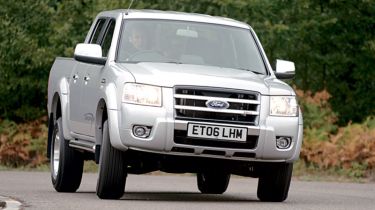

The Ranger’s ride and handling can’t match the latest SUVs. But in Thunder trim, standard kit is up to that of the best soft-roaders, and there’s a spacious cabin. Its chunky styling will appeal to buyers put off by Mitsubishi’s quirky L200 and, if a flatbed is essential, the Ranger won’t disappoint you.
Pick-ups face an uncertain future. Tax breaks for company car users brought a new breed of motorists to the wheel, but that’s all set to change.
From next April, contract drivers will be charged more to own a utility vehicle. They will still be more tax-efficient than conventional cars, but the next generation of flatbeds won’t be able to rely solely on financial incentives to lure buyers. So what are the manufacturers doing about it? To find out, we tried Ford’s new Ranger.
In double-cab Thunder form, the pick-up is an appealing proposition, offering plenty of space inside and out. Pronounced wheelarches, tubular sills and alloys emphasise its go-anywhere credentials, while the 2.5-litre TDCi engine produces 330Nm of torque.
Four-wheel drive with a low-range set-up completes the drivetrain. Take a look inside, though, and you’ll be forgiven for thinking you’re in an SUV. Standard parking sensors, air-con and a six-disc CD/MP3 player are more high street than builder’s yard, too. There’s even leather upholstery.
And the feeling continues behind the wheel, where you enjoy a commanding view with minimal obstruction from the upright door pillars.
The Duratorq unit provides impressive performance and, although the manual gearbox has a long throw, its action is light and smooth. Accurate steering also instils confidence when threading the wide Ranger down narrow lanes. But that’s also where the SUV comparisons start to fall down.
With old-fashioned cart springs at the back, the fidgety ride betrays its commercial roots, and there’s body roll in bends. These are compromises to ex-pect from a vehicle capable of a 1,075kg payload, but unless you really need a pick-up, an SUV is more comfortable.