Search Car Reviews


See all makes

Toyota Prius Plug-In

Hybrid top-seller is uprated to go further on electric power alone. Is it better than ever?
Toyota Prius

By Andrew English

December 2009

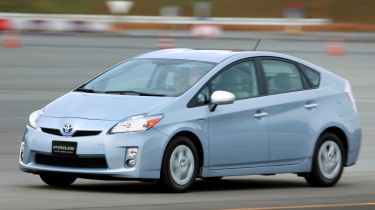
Since the 1997 launch, Toyota has sold more than 1.5 million examples of the Prius. It’s now the world’s most common hybrid – and boosted by fuel prices, legislation and eco issues, its popularity is unlikely to diminish.

This plug-in version is the latest development of the petrol-electric pioneer. Toyota admits the appeal of the regular Prius is restricted by its limited range on battery power alone. Its thinking is that, by fitting a larger cell, the plug-in car can go further on electric only, and the petrol engine need never start. The system can then be recharged at night on cheaper and greener mains electricity.

Video: watch CarBuyer's video review of the Toyota Prius


Initially, the firm will release limited numbers of lease-only vehicles so that it can monitor any problems, but we drove an early model to give our verdict. 

Under the skin, the main difference between the plug-in Prius and the standard hybrid is the bigger battery and boosted electrical system. The 98bhp 1.8-litre four-cylinder petrol engine remains the same.

It claims a 10.9-second 0-62mph time and a 106mph top speed, plus an electric-only range of 12.5 to 20 miles. Using a 200V supply, the battery can be recharged in 100 minutes, while the equivalent of nearly 100mpg should be possible.

Inside is an energy monitor, an orange charge lamp and a preheating/precooling system for when the car is plugged in. Pulling away is as simple as in the standard Prius: engage Drive and press the accelerator. Be careful with your right foot and stay below 62mph, and the engine shouldn’t cut in. Even if it does, the switch from battery to petrol power is very smooth.

The ride is soft and compliant, and the handling unaffected by the battery’s extra weight. The engine drives the Prius directly or produces electricity, which either propels the car or charges the battery. Under braking, the alternator generates current to extend the electric-only range. Plus, the new set-up gives more overtaking grunt, and minimises the ‘rubber band’ feel usually associated with hybrids.

What Next

Sponsored Results

5 Comments

Utilizing Electricity via Power Line: Where's the efficiency

This is not the way to go. Power losses over transmission lines makes this approach not only inefficient but just transfers the emissions to the power companies.

By kperez on 17 December, 2009, 12:49pm

GM has a much better option coming next year.

To me its astonishing that while Toyota was truly a pioneer by taking a risk and delivering the world's first mass-produced hybrid, they've been rather conservative with its progression. GM has the Chevy Volt , which will be sold as the Vauxhall Ampera in the EU coming out next year. It will run 40 miles on the battery before switching over to a small generator engine. What's more the wheels are actually driven by electric motors versus the Prius, which still uses a system where the electric motor is connected to a transaxle. Lastly, the Volt will be available to all consumers, not as a test fleet like the above car.

In regards to utilizing power from power grids, I think there's a few arguments for this system that are compelling. First of all, power plants (At least in the US) have strict emission requirements. So they burn fairly cleanly. In the US at least, only a handful of states require vehicles to be inspected. Thus imagine millions of cars in various form of disrepair, neglect, or age. Many of them pollute because their emissions are not monitored. With power coming from just a few plants versus millions of cars in questionable states of repair, the grid system would be cleaner.

Lastly, as a country that has more cars than anyone, we more than any country must reduce our use of crude oil if anything for the sake of global peace. Much of the oil we use today comes from the middle east. On the other hand we have over 300 years of coal in this country alone, over 100 years of natural gas, and legislation that is pushing all the time for more nuclear plants. That and solar, wind, and even biogas plants are growing more numerous. Combine all of those together and therein lies the real means to do away with crude oil altogether. Let's solve the immediate problems first then solve our environmental problems.

By setharp4 on 17 December, 2009, 4:11pm

Power Plant Fuel: Implications for electric cars

To setharp4, power plants burn coal mostly to run their generators which is much more inefficient than oil and more polluting. So emissions eminating from power plants are already quite significant. In addition, as I trust you are aware, the power companies cannot even keep up with the current demand during time of high power use vis., summer in Caly. How are they going to cope with the demand for charging cars then? In addition, transmission loss threw wire is large, very large. I do not have any figures but, I believe, they are >50%. In short, using power lines to charge the batterys of electric cars is impractical, and very inefficent as well as polluting.

By kperez on 17 December, 2009, 9:17pm

How does batteries powering all mod cons affect range ?

Is this prius also able to supply electricity to power a good heater system to keep the interior warm in the winter and also air conditioning in the summer ?
I would assume this would require a lot of electicity from the batteries, - Is that going to substantially reduce how far the car can go before the batteries run out ?

By jamesmclaughlin on 22 December, 2009, 1:06pm

RE:Power Plant Fuel: Implications for electric cars

kperez,
The argument you make assumes that suddenly everyone overnight will buy an electric car and thus overrun the power grid. The adoption of electric cars will be a slow process. The first generation of these cars are all going to cost around ,000 US dollars, which is basically the same cost as a fully loaded Audi A4. Not many will buy the first generation, or likely the second.

Additionally, none of these first gen electric cars use much power to charge. The Chevy Volt will use slightly less power than a typical home refrigerator, which is to say less than what your TV set uses. So we're not talking about a lot of strain on the grid.

Lastly, my argument for coal is that at least in the US, we have a 300 years supply of the stuff, there are plants including a TVA ( Tennessee Valley Authority) plant that burns it cleanly, and better technology is in the works. To me the important part is getting away from fuels that come from other countries and depend instead on our own. I in no way advocate the permanent use of coal. But for near-term peace and stability, you can't beat coal. Besides- oil is only going to get more expensive as China and India grows their middle class whom will buy more and more cars.

By setharp4 on 22 December, 2009, 6:01pm

You need to register to post comments. Existing members can log in below to comment, otherwise click here to join.


Sponsored Results

- Advertisement -

Pictures

Toyota Prius
Toyota Prius
Toyota Prius
Toyota Prius

Sponsored Results

Find New Cars

Find your new Toyota Prius with our new car search:

Find New Cars

FIRST OPINION

    THE plug-In Prius doesn’t answer many criticisms of the standard hybrid, but
    as it can run on renewable electricity, it’s a better option. Drivers can’t switch to battery-only running themselves to ensure the cell lasts as long as possible. But if this is the future, it’s much more viable than battery-electric – which could leave you stranded by the roadside with no chance of continuing your journey.


AT A GLANCE

    Price: £25,000 (est)
    Engine: 1.8-litre four-cylinder
    petrol; 345.6 volt electric motor
    Power: 98bhp/81bhp; total
    maximum output 134bhp
    0-62mph: 10.9 seconds
    Economy: 100mpg-plus 
    CO2: Below 75g/km
    On sale: 2010
     
    - Advertisement -