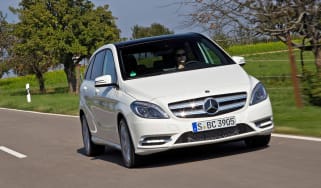
Mercedes B-Class review
It’s not a proper MPV, but the Mercedes B-Class boasts a spacious and classy cabin

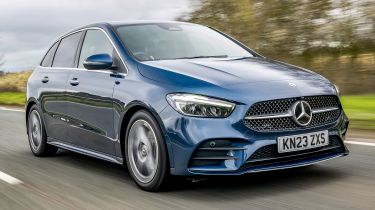

There’s a lot to like about the Mercedes B-Class, from its sharp looks and high-quality interior, to the big boot and excellent infotainment system. It also offers more cabin space than the closely related A-Class hatchback, particularly for rear-seat passengers.
But the lack of a clear distinction between the B-Class and A-Class means that the former fails to offer a real unique selling point. It’s not flexible enough to be a true MPV, while the A-Class edges it in terms of style, image and dynamics. In isolation, the B-Class is a good car; it’s just not entirely clear what it wants to be.
About the Mercedes B-Class
The Mercedes B-Class is a premium five-seat MPV that’s been around since 2005. We’re now on our third generation of the car and it seems it’ll be the last, because the company has confirmed it won’t be replacing this current generation once production comes to an end. Considering MPVs are something of a dying breed in 2023, with SUVs now the family car of choice, we’re hardly surprised to hear the B-Class will be laid to rest soon, but a series of updates for 2023 suggests it’ll be with us for a little while yet.
Underneath, the B-Class is based on the same platform as Mercedes’s premium hatchback, the A-Class. The pair look a lot alike too, especially following the recent facelift, and feature the same classy interior and MBUX infotainment system. The only advantages the B-Class has are its superior cabin space and extra luggage capacity, but that’s about it.
Used - available now

2013 Mercedes
B Class
97,000 milesManualDiesel1.8L
Cash £3,950
2019 Mercedes
B Class
20,720 milesAutomaticDiesel2.1L
Cash £13,500
2019 Mercedes
B Class
19,246 milesAutomaticPetrol1.6L
Cash £13,000
2021 Mercedes
B Class
14,590 milesAutomaticPetrol1.3L
Cash £19,495Ultimately the B-Class isn’t large enough, or versatile enough, to be considered a true MPV, and there’s no long-wheelbase seven-seat version, either. What’s more, despite using the same underpinnings, the B-Class isn’t offered with the same variety of engines and powertrains as the A-Class. Instead you get to choose between the diesel B 220 d and the petrol B 200, which now features mild-hybrid technology. That means there’s no plug-in hybrid or fully electric model offered to entice company car drivers or those looking to reduce their fuel consumption.
How much does the Mercedes B-Class cost?
The Mercedes B-Class currently starts from around £35,000 for the petrol-powered version, or just over £36,000 for the diesel. You have four trim levels to choose from – Sport Executive, AMG Line Executive, AMG Line Premium and AMG Line Premium Plus – with AMG Line models receiving sportier styling, larger alloy wheels and stiffer suspension. Standard kit on all models includes dual 10.25-inch displays, Apple CarPlay and Android Auto smartphone connectivity, heated front seats, keyless go and a powered tailgate.
Engines, performance and drive
On the road, the Mercedes B-Class feels like a slightly top-heavy A-Class rather than a traditional MPV. In fact, it’s easy to forget you’re not driving an A-Class. You do sit a little higher, which gives a commanding view of the road ahead, but it also creates a slight feeling of detachment that you don’t get in the A-Class. However, this is a small price to pay for the additional practicality and space over its premium-hatchback cousin.
There’s very little roll when cornering – body control is remarkably good for a car in this segment. A sophisticated multi-link rear suspension is fitted to the AMG Line models, which tightens things up even further and allows for hard cornering. In this configuration, the suspension is lowered by 15mm at the rear and 20mm at the front.
However, we did find that the stiffer suspension set-up gave the B-Class an unsettled ride, which doesn’t quite go with the practical nature of the family-friendly car. We feel that softer settings would be rather more welcome in a car that focuses on comfort for the most part.
The diesel B 220 d is fitted with an eight-speed DCT automatic transmission, but the B 200 uses a seven-speed unit and mild-hybrid technology. The set-up offers smooth shifts – helped by some electrical assistance from the mild-hybrid system – and there’s plenty of power on tap from the petrol engine. It can get a little raucous at higher revs, but it should be only an issue when you’re accelerating up to motorway speeds with all five seats occupied.
0-62mph acceleration and top speed
There aren’t as many engine choices in the B-Class as there are in the A-Class, with just two options to choose from. The B 220 d uses a 2.0-litre diesel engine, produces 148bp and 320Nm of torque, and will sprint from 0-62mph in 8.5 seconds, going on to a top speed of 136mph.
But the model we drove was the B 200 that features a 1.3-litre turbocharged petrol engine and mild-hybrid technology. Total power output is 161bhp and 270Nm of torque, 13bhp of which comes from the electrical assistance that fills in the power band when accelerating, so there’s a pretty consistent response even from low revs. But despite the extra oomph, 0-62mph is dispatched in 8.4 seconds and the top speed is 139mph.
MPG, CO2 and Running Costs
Unlike some of its rivals – most notably the BMW 2 Series Active Tourer – there’s no plug-in hybrid version of the B-Class available in the UK, which means you’re restricted to one traditional diesel engine and one mild-hybrid petrol engine. Not that this means anything other than impressive levels of fuel economy.
The diesel B 220 d uses a 2.0-litre engine and will return up to 55.4mpg while emitting 135-145g/km of CO2. Predictably, the petrol-powered B 200 isn’t as efficient, but Mercedes says you can expect fuel economy of up to 45.6mpg, with CO2 emissions standing at between 138 and 147g/km, depending on the trim level.
Entry-level versions of the B-Class will cost £180 per year in road tax, but go easy on the options if you want to avoid creeping through the £40,000 barrier, which would result in a £390 annual surcharge, bringing your total VED bill to £570. For company drivers, the B-Class attracts a Benefit-in-Kind (BiK) rate of between 32 and 34 per cent, compared with the plug-in hybrid BMW 2 Series Active Tourer, which sits in the much lower 8 per cent band.
Insurance groups
Both the petrol B 200 and diesel B 220 d fall into insurance groups 22 to 24, depending on your exact specification, which is a close match for the BMW 2 Series Active Tourer in insurance groups 22 to 33.
Check if your car needs an MoT and view its complete history with our MoT History Checker...
Depreciation
The previous Mercedes B-Class held its value better than the majority of its mainstream rivals, and our latest expert data suggests the recently facelifted MPV should retain around 53 per cent of its original value after three years and 36,000 miles of ownership.
To get an accurate valuation on a specific model check out our free car valuation tool...
Interior, design and technology
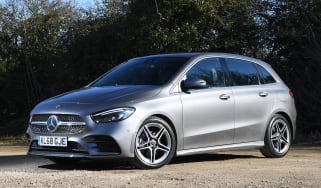
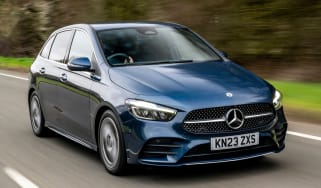
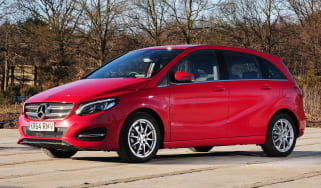
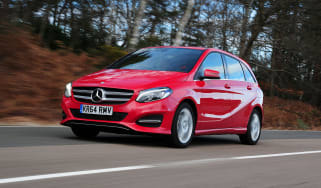
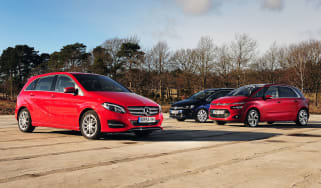
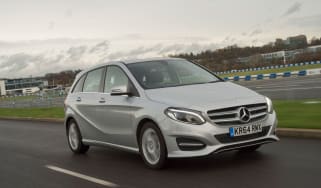
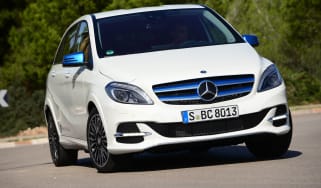
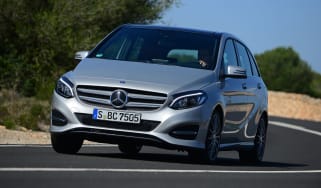
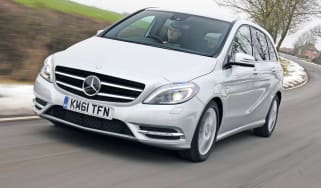
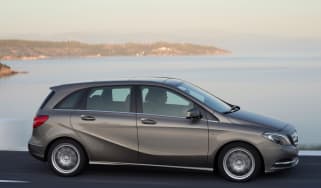
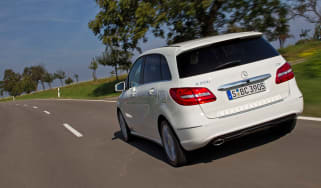
Beauty is in the eye of the beholder, and while it would be a stretch to call this generation of the B-Class ‘beautiful’, it’s certainly more attractive than the previous two iterations. Gone is the frumpy, very MPV-like exterior, replaced by something more cohesive and, dare we say it, sporty.
That’s no surprise, given the fact that the designers were told to make the B-Class stand out from the minivans of the world. The result is a car that’s lower than before, graced with shorter overhangs and a face that’s 100 per cent A-Class.
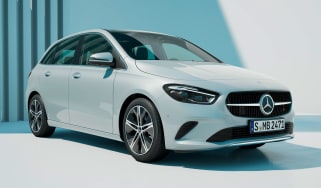
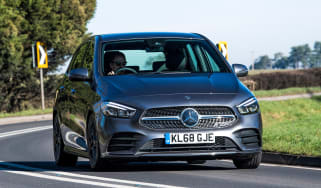
As part of its mid-life update in 2023, the B-Class received a subtle exterior facelift that included the addition of adaptive LED headlights on all models. Predictably, the B-Class looks at its best in AMG Line trim, thanks to a host of cosmetic trimmings, 18-inch alloy wheels and a distinctive chrome grille.
The big changes for the facelifted B-Class were reserved for the interior, however, where recycled materials are now incorporated into the cabin’s construction. But the B-Class is a premium product, so there’s still plenty of soft-touch materials and Merc’s upmarket metal switchgear. There are some harder plastics used for the lower door trims, but overall the B-Class’s cabin is a pleasant place to spend time.
We also like that the B-Class retains its bank of air-con controls below the trio of central air vents. There is a climate screen within the central display, but it’s nice to have a set of physical shortcut switches on dash for quick and easy adjustments when you’re on the move.
There are four trim levels to choose from: Sport Executive, AMG Line Executive, AMG Line Premium and AMG Line Premium Plus, as well as 10 exterior paint colours and a host of accessories. Alloy wheel sizes range from 17 to 19 inches, with entry-level models also featuring 64-colour ambient lighting, heated front seats, keyless go, wireless charging pad, a 10.25-inch central touchscreen and a 10.25-inch instrument panel.
Sat-nav, stereo and infotainment
The B-Class uses the Mercedes-Benz User Experience (MBUX) infotainment system and in our opinion it’s still one of the best systems on the market, but if you prefer to use your favourite smartphone apps, Apple CarPlay and Android Auto connectivity comes as standard.
The B-Class also comes with dual 10.25-inch displays, which offer crystal-clear, high-resolution graphics and plenty of functionality. The MBUX system can be controlled by tapping the central touchscreen or via the buttons on the steering wheel, but perhaps more impressive is the voice control. It uses the “Hey Mercedes” command, in much the same way you might use Apple’s Siri or Amazon’s Alexa personal assistants.
The majority of the infotainment functions can be accessed using voice control, including the sat-nav, phone calls or choice of music. You can even use indirect commands, such as “I feel cold” to adjust the heating. Over time, MBUX will adjust to your personal habits, such as your route to work and your favourite radio station.
Practicality, comfort and boot space
Despite its MPV-like appearance, the Mercedes B-Class feels very more like an ‘A-Class plus’ than a traditional people carrier. That means it’s only available with five seats – you’ll need to get a GLB or T-Class if you want a seven-seat Mercedes. However it does deliver some of the benefits associated with a MPV, including a raised driving position, which makes it feel markedly different from the A-Class and easier to get in and out of.
The B-Class’s cabin feels very spacious and features two sets of ISOFIX child-seat mounts in the back, plus the on-board systems can recognise if a seat has been fitted, and optimise the safety features accordingly.
Dimensions and size
The third-generation B-Class is 30mm longer than the old model, taking the overall length up to 4,419mm. It’s also 10mm wider, making the width 1,796mm, while the oversized hatchback stands at 1,562mm high. In comparison, the Mercedes A-Class measures 1,440mm in height, so you can see why the cabin feels more expansive. The A-Class is as long and as wide as the B-Class, though.
Leg room, head room & passenger space
Overall the cabin is very spacious, and despite the overly dark materials, such as the black roof lining, it still feels roomy inside. All five occupants will enjoy plenty of headroom and legroom, with passengers in the back free to stretch their legs in near-luxury saloon style.
Boot space
Boot space in the B-Class varies depending on which engine you go for. The B 220 d diesel offers 445 litres of luggage capacity, while the petrol B 200 has a 420-litre boot. That’s because the petrol engine now comes with mild-hybrid assistance, and the system’s location in the boot, cutting 25 litres from its carrying capacity. Either way, the load space isn’t worth writing home about, but there’s a level load lip, the back seats fold almost flat and a powered tailgate comes as standard.
The rear bench splits and folds in three sections to a useful 40:20:40 ratio, and with all three folded flat, the boot extends to 1,505 and 1,530 litres of space for the B 200 and B 200 d respectively. That’s between 50 and 80 litres more than you’ll find in the 2 Series Active Tourer.
Towing
The B 220 4Matic petrol is the best choice if you intend to do a little light towing, offering a braked towing capacity of 1,800kg. Other models offer between 1,400kg and 1,600kg depending on the engine size.
Reliability and Safety
The Mercedes B-Class was put through Euro NCAP’s litany of crash tests in 2019 and performed extremely well. It received the organisation’s maximum five-star rating, plus a score of 96 per cent for adult occupant protection and 90 per cent for child occupant protection.
There’s a generous level of standard safety equipment, such as Attention Assist, a reversing camera and seven airbags, including a driver’s knee bag, while an optional Driving Assistance pack can be added to top-spec models for £1,495. This includes blind-spot assist, emergency braking, steering assist, adaptive cruise control and route-based speed adjustment.
The Mercedes B-Class didn’t sell enough to make it onto the list of best cars to own in our 2022 Driver Power owner satisfaction survey, although the A-Class hatchback it’s based on did come a respectable 30th, ahead of several BMW and Audi products. Mercedes as a brand didn’t fare as well, however, finishing 23rd out of 29 in the best car manufacturers rankings, behind BMW and Audi, which came 16th and 22nd respectively.
Warranty
The B-Class is covered by a three-year/unlimited-mileage warranty, which is a match for the BMW 2 Series Active Tourer’s standard warranty, plus you get 30 years of pan-European roadside assistance and coverage against corrosion with the Mercedes.
Servicing
Mercedes Service Care packages are available for the B-Class, and these allow you to spread the cost of servicing. Prices start from £59 a month for the basic plan which includes two services, while the most comprehensive costs £136 a month, which includes four services and two MOTs.
Mercedes B-Class alternatives
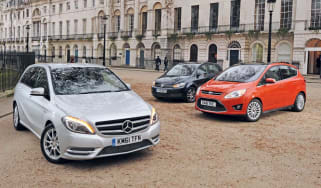
The B-Class is hardly swamped with rivals; instead it has more of an arch-rival: the BMW 2 Series Active Tourer, an all-new version of which was launched in 2022 and is offered with plug-in hybrid power. Other competitors in the MPV class include the Volkswagen Touran and Ford S-Max, but they feature seven seats, while the B-Class only gets five. That means the B-Class has to attract potential buyers looking at crossovers and small SUVs, of which there is no shortage in this price bracket.
More reviews
Car group tests
In-depth reviews
Road tests
Which Is Best