For more breaking car news and reviews, subscribe to Auto Express magazine. We'll give you 6 issues for £1 and a free gift!
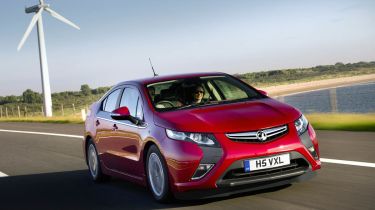
I realise that the batteries in these electric cars are enormously expensive, but from a practical viewpoint most people would be better off with a decent diesel for the time being. Early adopters will pay the usual premium for the exclusivity, but the rest of us need for the economies of scale from mass production to drive the price down before the Ampera becomes a serious contender.
What a pointless and useless "road test", I assume the PR department of Vauxhall wrote it.
I have to go to London on a regular basis which is a 160 mile round trip so I would need realistic running costs and not the fairytale figure quoted.
Why AE cannot do real and practical road tests of vehicles instead of these airy fairy pointless articles.
even with petrol at £6 per gallon how long is it going to take to make savings that will make inroads into the £28k price tag over a more conventional system, but I dont agree with AlanShaw's comments that this is a useless test. It clearly states that the battery is good for a normal commute, and when the battery needs a boost the petrol engine cuts in...what's the problem!!
Opel/vauxhall have done a good job with this car (unlike the prius).
The main thing is,its a start.
Things can only get better and cheaper.
The Government need to do even more to help the average buyer to afford this car.
Then again you can see the Government having a heart attack realising that it will hit their income...I can see a battery tax being levied !!!!
whether global warming exists is anyones guess, climatologists "forecast" global cooling in the 80s after a decade of bad summers (and some are again forecasting a mini ice age after 3 poor summers)
HOWEVER we are where we are, when cars "started" one had to get petrol from the chemist, the infrastructure slowly grows and no one can live without petrol/diesel powered cars - my point? er um :-))
In a more 'real world' test, Car mag got appalling consumption figures, coupled with real infrastructure issues for plugging in anywhere but at home. The small diesel is still the best bet for eco motoring at the moment.
Cars like the Ampera suffer because at the end of the day they are no fresh grounds-up design solutions specifically addressing fundamental electric transport constraints - for instance heavy battery load, . Merely integrating/grafting existing electric drive technology onto essentially stable ICE vehicle architecture, as is currently the practice with the main manufacturers, is not going to be the way forward, because it's inviariably an inefficient and expensive solution which is only being accepted because comparatively no better solution has emerged. We need revolutionary thinking right down potentially to how the electric car physically looks (ideally a hollow spherical mass of batteries!).
As an example, the greatest problem with EV is battery weight -at least is the main reason why EV's are so expensive (light but costly batteries have to be used). So you get rid of onboard batteries, immediately eliminating the wieght disadvantage, you get a far simpler, efficient and workable solution- moreover irrespective of the type of battery. Several other approaches can be addressed in this vein.
How to realise the above practically is merely a design challenge. It's suprising why no one with such means can come out with a viable solution, but keep pushing unworkable (since so expensive) evolutionary attempts as is the Ampera, Leaf, etc.
Cars like the Ampera suffer because at the end of the day they are no fresh grounds-up design solutions specifically addressing fundamental electric transport constraints - for instance heavy battery load, . Merely integrating/grafting existing electric drive technology onto essentially stable ICE vehicle architecture, as is currently the practice with the main manufacturers, is not going to be the way forward, because it's inviariably an inefficient and expensive solution which is only being accepted because comparatively no better solution has emerged. We need revolutionary thinking right down potentially to how the electric car physically looks (ideally a hollow spherical mass of batteries!).
As an example, the greatest problem with EV is battery weight -at least is the main reason why EV's are so expensive (light but costly batteries have to be used). So you get rid of onboard batteries, immediately eliminating the wieght disadvantage, you get a far simpler, efficient and workable solution- moreover irrespective of the type of battery. Several other approaches can be addressed in this vein.
How to realise the above practically is merely a design challenge. It's suprising why no one with such means can come out with a viable solution, but keep pushing unworkable (since so expensive) evolutionary attempts as is the Ampera, Leaf, etc.
Interesting comments, but the Ampera is good looking and that helps sell cars. No denying it's expensive but other costs are down. I wonder about the cost of servicing?
Hey, jossjjew, how about a system based on the dodgems used in fairground rides. No batteries used there and it is a proven system.
Run an Ampera on LPG and it all starts to make sense...
Whatever happened to Hydrogen? It's free and inexhaustible. Are the scientists deliberately dragging their feet or are the money-men (with interests in petroleum investments) nailing the scientists' feet to the floor ?
Hydrogen is far from free and is very costly to produce, and for the moment it has to be generated from fossil fuels, so all the massive amounts of energy required to make it, for now, is best put into charging batteries, as it's much more efficient.
By the way Auto Express, this is again another car you did not research properly, the engine in the Ampera drives (or partly drives) the wheels at higher speeds!
It's a good idea having the on board generator at this time as people get the best of both worlds.
I don't care about C02 but I do care about my bank account and this is where people fail to realise the importance of electric drive, it's far cheaper to run (not buy, at this time) an E.V. And as petrol and diesel goes up and the E.U Diesel tax comes into effect in a few years, it will all make E.V's seem the cheaper option!
Hydrogen is the future, it will cost more than electricity but hopefully it will be reasonably priced as it can be made locally.
Mercedes F-Cell coming in 2015, where is the hydrogen infrastructure?
L.F.T.R Nuclear reactors and Thorium I will keep pounding on the internet until people and Governments realise the potential, and ultra importance for this technology. (Only in L.F.T.R reactors) It can be used for all our energy needs and Norway has 10,000 years supply of it!
Energy crisis? where? we are forced to pay through the teeth for transport, we are denied the right to cheap energy and clean air and global warming is the greatest money making scam ever, designed to suck more money from you and I.
I should really get into politics, as I feel so strongly about it, but I bet I would be beating my head against the wall !
Aclaimed electric drive advantages are melting down when real life tests are properly done. Take a hybrid like the Prius on a long autobahn high-speed cruise and it will consume equal or more than a ICE-only car of simillar performance. I do not expect much better from the Ampera. Why does the engine have to assist the electric motor at higher speeds? Because electric drive is inefficient beyond start & stop regimes. So for city cars and short-distance hopping, electric or hybrids are OK. Diesel's are the most efficient all round, lighter than hybrids, cheaper and easier to maintain and recycle. Electric (including plug-in hybrids) and hydrogen options are not solving but shifting the problems from the vehicle to the infrastructure, nothing more. There is no free hydrogen or electricity around, they have to be produced using other sources and thus adding to the total bill. If fossil fuels like natural gas and petrolium are to be depleted, chemistry can produce synthetic liquid fuel from coal, the technology dates from WW II. This said, it is the remarkable progress in engineering of efficient ICE that has dominated the industry last years. Frankly, I'll stick to my turbo-gasoline car for the time being looking eventually for a diesel replacement when it comes to it.
This is the car that has been needed since the Prius teased those of us who would like to be green but don't want to drive a blancmonge. I'm a confused pertrolhead/ecoworrier, and this ticks all the boxes. By my calcs it will take 63,000 miles at current electric and diesel prices to recoupe the extra cost over a similar specced Diesel Insignia or 0 miles compared to a BMW 3series ;-). Even if the electricity comes just from a coal fired powerstation - the well to wheel efficincy is 35% greater than buring the smelly stuff. My 40 mile round trip commute - means only visits to family or holidays will need the tank filling. My calcs were based on diesel at £1.40 a litre and costing about 12p a mile for medium sized car doing 50mpg. 50 miles in this works out at 2.2p a mile at 7p/kWh (economy 7). I imagine it will have very long service interavals -too - depending on how much the petrol generator has been running. Depreciation - may be ultra low - I can see these selling by the train full, once people do the maths.
If you are a rep doing 60,000 miles a year - go and see your boss now and tell him to get on the waiting list! It's a no brainer.
ok.....sure electric and hybrid powerd cars are not to way to be is it......surly not. when the cost of petrol gets too high then u wont be albe to buy a hybrid car cause u need fuel to power it. and when u run out of electricity in your electric car u stop it could be in the middle of the road firdst of all thats dangerous and second of all the goverment said there will never be place where u can charge a electic car at every road and at every town and at every village. and plus if u run out of electricty it takes ages to charge up and th amount of enegy to charge themis astronomical so we are causeing the same amount of harm to the planet as we would in a petrol or deisel car. heres a bright idera if there are braineyackes who can work out all this stuff why dont u find away to make a car run on air or water or sunlight surely u would agree right
JJDude090 has spoken!!!!!
JJDude090, brilliant analysis and you hit the real issues spot on. People who should dont want to look at these issues head-on ; it would involve such drastic changes and cost economical and socio-political/infrastructural most Governments wont touch the with a long pole. Added to this is stong vested interests and opposition against electric motive power - simply would put Oil-based transport out of business. You probably have read the story 'who killed the electric car' . Etc, etc. It will only be as a last option sadly that we move away from the easy solution of oil to the hard but all-saving ones Solar and Wind energy as you suggest