Mercedes C200K
Want proof of how important the new C-Class is to Mercedes?

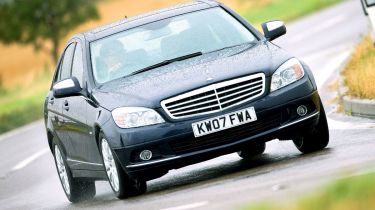
Want proof of how important the new C-Class is to Mercedes? Well, before launch, it completed the most comprehensive test programme in the company’s history. Over three-and-a-half years, pre-production examples clocked up more than 15 million miles across the globe.
Considering it’s the best-selling model in the firm’s line-up, with more than 1.4 million cars finding homes worldwide since 2000, Mercedes clearly had to get the new version exactly right, especially as it has to compete with ever-increasing competition in the compact executive sector.
In terms of looks, it echoes the luxury S-Class, with chunky wheelarches and a wedge-shaped front end. The short overhangs and bluff nose give it a more athletic profile than its predecessor – and the IS – while the rising swage lines on the flanks have echoes of the BMW 3-Series. We think it’s a real success, and should help the C-Class bring its image bang up to date.
There have been some sweeping changes inside, too. The C-Class is bigger than before and has a longer wheelbase than the Lexus, so it feels more spacious, particularly in the rear, with decent leg and headroom. The boot is also more generous and user-friendly than its rival’s.
Thanks to a superb driving position and plenty of adjustment in the seat and steering wheel, the cabin up front is also more spacious than the Lexus’s. But there are some criticisms. Considering it’s an executive saloon, we were disappointed by some of the plastics used. While the fit and finish is top notch, the cabin seems slightly utilitarian and lacks a sense of occasion. Overall, though, it’s a clean and unfussy design, while the switchgear has a quality touch to it.
The engine is a pleasant surprise. We’ve never been truly convinced by the supercharged four-cylinder Kompressor units that Mercedes has used for years, but this version of the 1.8-litre powerplant helps redress that. Modifications to the high-output motor now mean it has 181bhp, an extra 20bhp, and generates its maximum 250Nm of torque at 2,800rpm. Fuel economy and performance are also improved.
It feels punchy enough low down, and although lacking a decent engine note, it’s surprisingly responsive when mated to the five-speed auto gearbox. At the test track, it was a second behind the more powerful IS from 0-60mph, but a result of nine seconds means it’s no slouch.
Out on the road, the C200K is more willing than its Japanese rival and doesn’t have to be worked as hard as the V6 in the Lexus. Wind and road noise are impressively low at speed, but the best aspect of the Merc is its excellent ride.
Even over extremely rough roads it copes effortlessly, but that doesn’t mean it’s soft through bends. The standard Agility Control selective damping system ensures that body control and stability are both excellent without compromising comfort. It’s a shame, then, that the steering lacks sharpness and feels light at high speeds.
You would expect a premium brand such as Mercedes to charge high prices, but this mid-range C200 Elegance costs £26,407, which is £3,000 less than the Lexus. Standard equipment totals are fairly comparable, too, although our example did come with £4,000 worth of options, which took the final asking price above the £30,000 mark.
Details
Price: £26,407
Model tested: Mercedes C200K Elegance
Chart position: 1
WHY: With new selective damping and an improved engine range, the C-Class is more refined than ever.
Economy
Thanks to its smaller engine, the C200K is the more frugal choice. On test, it averaged 29.8mpg – about what we expected, given its claimed 35.8mpg. This provides a useful 433-mile range.
Residuals
A stronger image gives the Merc the upper hand residually, and after three years, the C200K will be worth 47.8 per cent of its list price. A diesel version retains 49.6 per cent.
Servicing
you pay a costly £1,125 for three services on the C200K. Yet the dealers don’t reflect the firm’s premium image; it finished a poor 18th out of 32 in our Driver Power 2007 survey.
Tax
The C200K has less power than the Lexus, but the trade-off is lower CO2 emissions. At 187g/km, it sits in the 27 per cent tax band; company car drivers will pay £1,569 a year at the standard rate.