Vauxhall Agila vs Suzuki Splash vs Hyundai i10: 2008 group test
The new Vauxhall Agila and Suzuki Splash claim to make urban driving easier. Can they beat Hyundai’s superb i10?

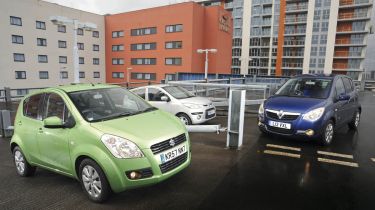
The city car market is really hotting up, with an explosion in the number of excellent models available. Those ranks are about to be swelled further with the launch of two newcomers: the Vauxhall Agila and Suzuki Splash.
As you’ve probably already spotted from the pictures, they are incredibly similar. General Motors and Suzuki have teamed up to build these latest small cars (the previous Agila was mechanically identical to the Suzuki Wagon R, too). But unlike their boxy predecessors, the new duo is designed to be far more stylish and youthful.
Both were engineered in Japan and are assembled at Suzuki’s plant in Hungary, alongside the Swift, SX4 and Ignis. Each claims to provide a practical and spacious interior, as well as being good to drive and cheap to run. However, Suzuki is looking to differentiate the Splash by offering more generous equipment, including stability control, as standard.
But these new models face an extremely stiff challenge in the shape of the superb Hyundai i10. It’s already beaten the excellent Fiat Panda (Auto Express’s 2004 Car Of The Year), and has a clear price advantage over its competitors here, too.
The Suzuki and Vauxhall are both slightly larger and more powerful, but does this justify their higher price? We tackled the urban jungle to find out.
Verdict
The Suzuki Splash is easy to drive, practical, spacious and great value. You can’t ask much more of a vehicle designed to tackle the urban jungle. So what puts it ahead of the Agila? Well, aside from the looks, the Splash is better equipped, cheaper to buy and should cost less to run, too.
Used - available now

2025 Kia
Niro EV
22,872 milesAutomaticElectric
Cash £18,200
2024 Honda
HR-V Hybrid
15,000 milesAutomaticPetrol1.5L
Cash £22,295
2023 Jaguar
F-Pace
31,381 milesAutomaticPetrol2.0L
Cash £30,790
2024 Volvo
XC60
15,043 milesAutomaticPetrol2.0L
Cash £36,990We’re surprised Vauxhall doesn’t offer the same standard safety kit, as in every other respect the Agila is just as good. Its cabin is well thought out, with lots of stowage, and the engine is decent. On the move, both are competent, offering reassuring handling, and on twisty roads each is surprising fun.
Due to its compact size, the Hyundai is more of a genuine city car, but it finishes last here because the automatic gearbox harms performance and increases running costs. The i10 is still a top choice: spacious, affordable and backed up by a great warranty. It’s just that we prefer the manual.
First place: Suzuki Splash 1.2 GLS
The Splash is Suzuki’s fourth new model in three years. That’s some product offensive, with the city car following on from the Swift, Grand Vitara and SX4. The brand’s latest generation of cars has clearly been styled to appeal to European tastes.
As with the Agila it’s sporty, but although the two models look similar at first glance, there are more differences than you’d expect. At the back, the Splash has its own distinctive tailgate and lights, although what really sets it apart is the front. The headlights, bumper, bonnet and grille are all unique to the Suzuki, and we think it has a cleaner look that echoes the Swift supermini.
The styling certainly comes across as more sporty, and due to the clever design, the Splash manages to hide its near-1.6-metre height even better than the Agila. But it shares the same well planted stance and wide track, and is just as easy to manoeuvre into small parking spaces.
Inside, the youthful feel continues. The car is built at Suzuki’s factory in Hungary, and so the cockpit has far more in common with the Swift than any Vauxhall. The large round speedo takes cues from the MINI, while the pod-style rev counter is clearly influenced by Smart.
Depending on the shade of paint customers choose for the exterior, they can also specify body-coloured seat and dash inserts. But surprisingly, black or grey upholstery are the only options in our bright Splash Green test car. The vibrant blue finish in the Agila is much more uplifting.
The quality of the cabin materials is good when you consider the price tag – the Splash feels very well put together indeed. Eagle-eyed readers will notice that the car in our pictures is a GLS+ rather than the GLS we tested. But there’s not a lot of difference between them; the latter does without privacy glass, as well as alloy wheels and front foglights, and saves you £500 in the process.
The boot features the same 36-litre underfloor compartment as the Agila, while the rear seats fold down in a similar way. As in the Vauxhall, passenger space is generous, while the wide-opening doors make access easy – useful if you have child seats to fix in place.
Under the bonnet, Splash buyers get the same engine options as those who go for the Agila – with the exception of the sluggish 1.0-litre. The 1.2-litre petrol in our car is smooth and refined, with decent low-end torque, while a precise action makes the five-speed gearbox enjoyable to use.
A heavier kerbweight meant the Suzuki was marginally slower than the Vauxhall at the test track – it covered 0-60mph in 12.9 seconds to the Agila’s 12.7 seconds – and trailed in our in-gear assessments, too. This is partly down to the fact that our car had barely any miles on the clock; nevertheless, it was far quicker than the i10.
As the Splash is built on a shortened version of the excellent Swift platform, it’s entertaining to drive. The newcomer is smooth and composed, and a surprisingly good motorway cruiser, while on back roads it delivers decent grip and body control. Under the skin, the Suzuki and Vauxhall are identical in terms of suspension, damper and steering set-ups, although we found the steering on our Splash a bit lighter.
While neither model can match the £7,900 i10 for price, the Suzuki is closer at £8,999. It doesn’t come with alloys or electric rear windows, but it wins hands down in terms of safety, with six airbags and stability control as standard.
Economy
There was less than 1mpg between the Vauxhall and Suzuki’s economy. Our Splash hadn’t racked up many miles, which goes some way to explaining its 39.8mpg return. But it was still more efficient than the Hyundai.
Residuals
Resale values have yet to be calculated for the Suzuki, although it’s likely to perform much better than the previous Wagon R, which retains only 34 per cent of its price new. The Splash should be more on par with the Agila.
Servicing
As the two cars are near-identical, we were surprised the Splash has shorter service intervals than the Agila – it needs attention every 9,000 miles. The Suzuki is also pricier to maintain, with three visits totalling £660.
Tax
As all three models sit in the lowest 15 per cent company car tax bracket, list price is the deciding factor in their annual bills. Lower-band business users who choose the Suzuki will have to shell out only £297 a year.
Second place: Vauxhall Agila 1.2 Design
Easy to drive, simple to park, affordable to own... that’s how Vauxhall describes its new city car. Of course, the same could have been said of the ungainly previous-generation Agila. That was labelled a mini-people carrier, but the idea never really took off in the UK. So it’s no surprise the latest model is far more stylish, and hopes to rival the likes of the Fiat Panda, plus larger cars such as the Nissan Note.
From the back, there’s a hint of the Japanese supermini-MPV, thanks to the vertical tailgate and the elongated light clusters built into the C-pillars. We’re big fans of the design, especially the rising waistline and angular rear windows, which along with the flared wheelarches and sharp nose give a sporty and distinctive profile.
It’s not identical to the Splash, as the front and back are different enough to provide the two with their own identities. In our opinion, the Suzuki is the less fussy car, and we prefer the simpler lines. Yet the Vauxhall certainly stands out with its teardrop headlights and chrome grille.
As with the Splash, the Agila hides its height well – it’s actually 50mm taller than the new Hyundai, but doesn’t look it. This has obvious benefits for rear passengers, with excellent head space. Surprisingly, legroom isn’t as generous as in the Korean car, despite the fact it’s 175mm longer overall – a figure of 640mm is 40mm down. Still, it’s well finished and the seats are very comfortable. The trouble is, Agila owners will have to make do with manual windows in the back – the i10 has electric operation all-round.
Up front, there’s plenty of light and space, and tall drivers will find the cockpit more comfortable than the i10’s. The Vauxhall and Suzuki share identical interior designs, and the centre console looks similar to that in the Hyundai, with a high-set stereo and three rotary ventilation controls.
The layout is easy to get on with and we like the high-mounted gearlever, too, although the toy-like tone that accompanies the indicators can be annoying. While the boot isn’t what you’d call cavernous – it’s very shallow – with 225 litres it’s bigger than a MINI’s and on par with the i10’s.
Vauxhall buyers can specify a 1.0-litre petrol engine, but that only comes with Expression and Club models. A diesel is also available, although the 1.2-litre petrol in our test car is set to be the biggest seller. With 85bhp it offers decent pace and will happily keep up with motorway traffic, although it can get a little raucous at high revs.
Still, in town it’s more than adequate, and the free-revving nature means it’s great for nipping in and out of traffic. Comfort is a big strength – ride quality is excellent, with the supple suspension soaking up potholes on rough city streets. The steering is light, for easy parking, and while on the open road it can feel remote, this doesn’t detract from the enjoyable driving experience.
At more than £9,500, the Agila is the most expensive choice here, although it’s worth noting that our test car comes in flagship Design trim. The mid-range Club weighs in at £8,895, while the entry-level 1.0 Expression is £7,595 – that puts the Vauxhall more on a par with the i10. An automatic box can be specified for £1,000 extra.
Yet whichever Agila you go for, the equipment tally isn’t as generous as in the Splash. There are only four airbags, while stability control is a £400 option. We would have expected Vauxhall to offer this as standard, especially as it’s included in the Suzuki. Could this affect the final verdict?
Economy
The lighter Agila was more economical than the near-identical Splash, returning 40.6mpg over our test route. That gives it a useful range of more than 400 miles. But this was some way short of Vauxhall’s claimed figure of 51.4mpg.
Residuals
The new Agila should prove a much better bet on the used car market than its predecessor. Our experts predict strong residuals of 42.9 per cent – which means that in three years’ time, the little Vauxhall will still be worth £4,116.
Servicing
With 500 outlets in the UK, Vauxhall’s network certainly has the quantity. But it needs to improve the quality of service: the firm came 23rd out of 32 in last year’s Driver Power dealer survey. Three check-ups on the Agila cost £442 – the least here.
Tax
None of these cars emits less than 120g/km of CO2 – a surprise given their small engines and low kerbweights. Yet this barely affects company car tax. Agila owners in the lower band will pay £317 a year – the most here, but not by much.
Third place: Hyundai i10 1.1 Comfort
While Kia has made a big impact with its Cee’d and Pro_cee'd, parent company Hyundai hasn’t been able to attract the same level of interest among UK buyers with its small cars. Take the i10’s predecessor, the Amica: it’s not a particularly common sight on our roads, unlike Kia’s Picanto.
Hyundai has already signalled its intention to change this by introducing a new naming system. We’ve been impressed by the Ford Focus-rivalling i30 (Issue 975), while the manual i10 claimed victory in its first UK test shoot-out, against the Fiat Panda (Issue 1,003). But can the auto take centre stage when facing two newer competitors?
From the front, there are clear similarities between the city car and its hatchback big brother, while the clean rear with its neat tail-lights provides a modern appearance. Yet the car doesn’t look so attractive in profile. Despite Hyundai’s attempts to give it a dynamic stance, thanks to that upswept waistline, it still appears tall, which only highlights how small the wheels are. The i10 is far less athletic than rivals.
Don’t be deceived by the low price, though – this is no bargain basement offering. The car is as solidly put together as the Suzuki or Vauxhall. So although it’s basic, it doesn’t feel cheap. The dash is modern, the instrument dials clear and the controls well laid out. We especially like the intuitive stereo, which comes complete with an auxiliary input for MP3 players.
So it’s a shame that the steering wheel – an important first point of contact – is made of such rough plastic. Had Hyundai spent some money here, it would have made a huge difference. Still, the boot is generously proportioned – with an identical 225-litre capacity to the Splash and Agila – and has a storage tray under the floor.
On the road, the car is superbly manoeuvrable, thanks to a tight turning circle and good all-round visibility. The revised 1.1-litre petrol engine is another strong point. It’s impressed us before, although that was with a manual gearbox. The automatic fitted to our test car severely hampers progress and saps what little power the i10 has.
The model delivers only 65bhp, and you’ll find it spends a lot of time at the top end of the rev counter, where it feels strained and noisy. While the auto is smooth enough between changes, it has a sudden action when trying to manoeuvre at slow speeds, making parking tricky. At the test track, it recorded a leisurely 19.2-second time for the 0-60mph sprint – more than six seconds slower than rivals. Opting for the manual brings this down to a more respectable 13.3 seconds.
Still, despite the limited pace, the i10 handles well, due to its responsive steering and decent grip, even with narrow tyres. Body control is better than in the Splash and Agila, but the ride isn’t as forgiving over potholes. On uneven city roads it doesn’t insulate bumps as well as its rivals, and can be a little crashy. Yet it’s just as stable on the motorway, where it’s a comfortable cruiser.
The i10’s biggest selling point is its price. At £7,900, it’s by far the cheapest choice here – and that’s with the auto box. Choose the manual and the figure drops to £7,095 – a bargain for such a capable city car, especially when it gets air-con, electric windows all-round and alloys. Then again, it has only four airbags, there’s no trip computer and stability control isn’t an option. That could harm the Hyundai’s chances in this company.
Economy
In terms of pace and driver fun, the auto box does the i10 no favours. And it hampers economy as well. Our car averaged 37.4mpg – 5mpg less than the manual version. It was the thirstiest car here, although only 2mpg behind the Suzuki.
Residuals
Expect the Hyundai to be the strongest residual performer of this trio, thanks to its low price. Our figures are based on the outgoing Amica, which holds to a superb 44.5 per cent. If it matches this, over three years the i10 will lose £4,384.
Servicing
Servicing costs for the i10 are slightly higher than for the Splash, at £668. But Hyundai’s UK dealers treat you better. The network was 7th in Driver Power 2007. Adding to the appeal is the five-year unlimited mileage warranty.
Tax
Opt for the auto box in the i10, and it pushes CO2 output up 20g/km, to 139g/km. But this makes no difference to company car tax. In fact, the Hyundai works out as the cheapest to run due to its price – lower-band owners pay £261 a year.