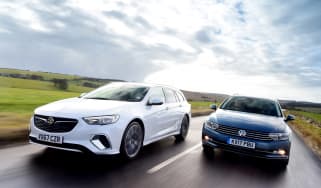
Volkswagen Passat review
Family car is now offered exclusively as an estate, but it remains an upmarket choice in the class
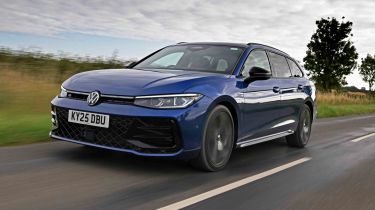

Our opinion on the Volkswagen Passat
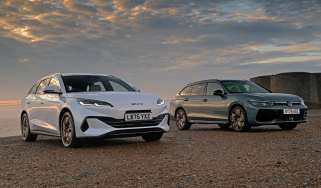
The Volkswagen Passat is a smart-looking estate car that delivers a good mix of comfort and handling, and it could well have enough appeal to steer buyers away from SUVs. The plug-in hybrid model will serve company car drivers well, but private buyers should consider the excellent mild-hybrid version. The Passat doesn’t feel like a cutting-edge machine in the way the all-electric VW ID.7 Tourer does, but it’s a well resolved package that will appeal to buyers not yet ready to make the switch to a full EV.
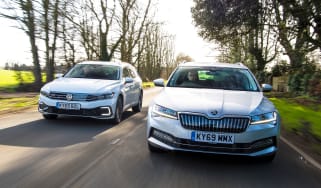
There aren’t many downsides to the Passat, but the Skoda Superb Estate shares the same running gear, is cheaper to buy, has a slightly more user-friendly interior and comes with a wider range of engine options. All of these reasons make it a more rounded choice than the Passat.
About the Volkswagen Passat
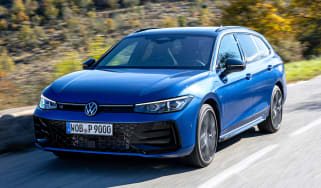
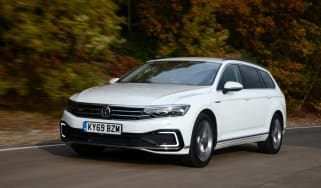
For its ninth generation, the Volkswagen Passat was launched exclusively as an estate car to satisfy the needs of buyers wanting a practical family model with carrying capacity to spare. It’s an antidote to the numerous SUVs that are claimed to offer just as much practicality for families; there’s no getting away from the fact that the Passat delivers lots of space in a package that will be better to drive than most SUVs.
Used - available now

2022 Volkswagen
Passat
22,324 milesAutomaticPetrol1.5L
Cash £16,399
2022 Volkswagen
Passat
67,980 milesManualDiesel2.0L
Cash £13,697
2024 Volkswagen
Passat
85,585 milesAutomaticDiesel2.0L
Cash £15,795
2017 Volkswagen
Passat
46,468 milesAutomaticDiesel2.0L
Cash £14,550Another significant step for the Passat Mk9 is the introduction of a hybrid-only engine line-up, with no diesel versions sold in the UK. Instead there’s a 1.5 eTSI mild hybrid and the 1.5 eHybrid, which is a plug-in model with a far larger battery that offers a generous all-electric range.
Model choice varies depending on which powertrain you’ve chosen. The 1.5 eTSI comes in Life and R-Line specs, while the plug-in eHybrid is available in Match, Elegance and Black Edition trims, with the latter two offered in two power outputs. All cars are front-wheel drive, with power transmitted via a seven-speed twin-clutch automatic in the eTSI, or a six-speed version in the eHybrid. Currently there is no 4MOTION four-wheel-drive option available on the Passat in the UK.
Volkswagen Passat prices and latest deals
Prices for the 1.5 eTSI model start from just under £41,000 in Life trim, while the sportier R-Line adds bigger wheels, a bodykit and more equipment for around £3,000 extra. The eHybrid starts from around £44,500 for the Match model, while Elegance is around £3,000 on top of that and the Black Edition is another £1,300 extra.
While the Passat is relatively pricey, there are plenty of savings to be found via the Auto Express Buy A Car service, where you can build your perfect VW Passat right now. We also have plenty of Passat leasing deals to choose from, as well as a number of used Passat models.
Performance & driving experience
Pros |
|
Cons |
|
Another change for the ninth-generation Passat is that it’s no longer built in Germany, but shares a production line with the Skoda Superb in Slovakia. That’s not the only thing it shares, because they’re based on the same MQB Evo platform, while the door skins, windows and some body panels are interchangeable between both cars.
This platform sharing is no bad thing, because the MQB architecture delivers a good mix of ride and handling that suits the Passat’s character.
| Model | Power | 0-62mph | Top speed |
| Passat 1.5 eTSI 150PS | 148bhp | 9.3 seconds | 138mph |
| Passat 1.5 eHybrid 204PS | 201bhp | 8.1 seconds | 137mph |
| Passat 1.5 eHybrid 272PS | 268bhp | 7.1 seconds | 140mph |
Performance, 0-60mph acceleration and top speed
With 148bhp and 250Nm of torque, the 1.5 eTSI version of the Passat has just enough power to keep pace with traffic, given its 9.3-second 0-62mph time. The seven-speed DSG automatic gearbox helps to keep the engine in the power band, and maximum torque is available from a low 1,500rpm, so it’s okay when unloaded, but it needs to be worked a bit to get up to motorway speeds with more than just the driver in the car. It can sound a little unrefined when stretched, which we reckon could be an issue with a car full of people and their luggage.
If you’re likely to have more than just yourself in the car, then one of the two eHybrid plug-in hybrids is a better bet. The performance figures for both the 201bhp and 268bhp versions are much better, at 8.1 seconds and 7.1 seconds, respectively. The 201bhp eHybrid has a maximum speed of 137mph, while the 268bhp version will reach 140mph.
With charge in the battery, the eHybrid system delivers smooth all-electric running as much as possible, and the instant torque from the electric motor moves the car along at a decent pace. The Passat’s set-up is biased towards the petrol engine when the battery is exhausted, so while there is still some electrical assistance, the system shunts between power sources, meaning it’s not as smooth as when the battery has charge.
Town driving, visibility and parking
The Passat is a big car, so it’s not the most manoeuvrable around town, but large windows and standard parking sensors front and rear help you to judge its extremities.
VW’s sophisticated adaptive suspension set-up, called Dynamic Chassis Control (DCC), is available on all models and standard for R-Line and Black Edition cars. The softest setting adds a floaty sensation to the ride, which can be unsettling over speed bumps; one of the firmer settings helps to improve body control.
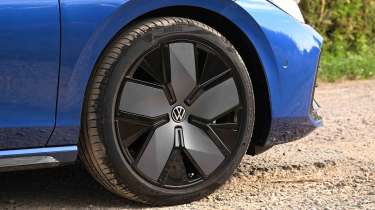
Large 19-inch alloy wheels are standard on Black Edition cars, and these tend to thud into potholes. Lower-spec variants with 17-inch wheels cope a lot better with big bumps.
Country road driving and handling
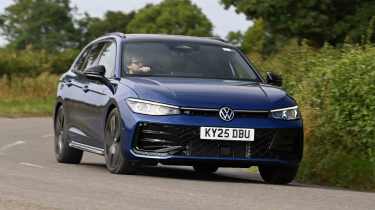
The Passat’s MQB underpinnings come into their own on twistier roads, and this is an estate car with a sporty edge that few SUVs are able to emulate. The steering is direct and accurate, with a pleasing weight to the wheel, although it’s a little lacking in feedback. Body roll is present, but well controlled overall, while decent suspension travel does a good job of ironing out bumps.
With DCC adaptive suspension fitted, you can customise the ride for a firmer, sportier setting on twistier roads, and we found it contributed to the car feeling nice and stable, with very good body control through the bends. You can also choose a softer comfort set-up on bumpier sections, and the latter certainly helps to avoid the annoying side-to-side head toss you might experience while driving down a cambered and undulating country road. Even better, there’s an Individual mode, allowing you to mix and match your preferred settings.
Motorway driving and long-distance comfort
General refinement is excellent, with good road noise suppression and very little wind whistle at speed – especially in Elegance trim cars and above, which feature laminated side windows and additional sound insulation to enhance refinement.
At higher speeds, a fully charged battery allows the electric motor to continue to do most of the work, unless you select the Battery Save option, which then forces the engine to fire up so you can keep electric energy for later. There’s a little more drone from the engine once it’s running, but it’s not an unpleasant sound: it simply hums in the background.
"I found I needed to use the auto hold function to help keep the Passat in place when emerging from junctions on an incline. I felt the seven-speed DSG gearbox was allowing the car to roll back more than a traditional torque converter automatic would as I moved from the brakes to the accelerator." - Max Adams, online reviews editor.
MPG & running costs
Pros |
|
Cons |
|
The Volkswagen Passat range begins with the 1.5 eTSI, which has a combined fuel economy figure of 51.4mpg, while a 66-litre fuel tank means a range of nearly 750 miles is possible if you can match that number.
Revisions to the way plug-in hybrids are tested mean that the eHybrid variants now have more realistic official fuel economy figures. The old test favoured battery driving, and saw both Passat models record a figure of 706.2mpg. Under the new test requirements, the figure has changed to 217.3mpg for both versions, although what you achieve in the real world will, of course, hinge on how often you’re able to charge the battery.
We drove the Passat eHybrid in Black Edition trim, and as part of our test we ran the battery down to see how fuel economy fared when there was no charge to rely on. We drove on a mix of motorway and country roads with a small amount of urban driving, and the Passat returned 44.1mpg. That’s a fairly decent figure for the performance on offer, although when we tested a BYD Seal 6 Touring on the same roads, it returned more than 50mpg because it relies on its hybrid system more frequently, rather than using it to back up the petrol engine in the manner the Passat does.
One handicap that the eHybrid has is a smaller fuel tank than the eTSI model, down from 66 litres to 45 litres. This offers a range of around 430 miles if you can match our test average, and demonstrates that VW expects eHybrid buyers to keep the battery fully charged to take advantage of the zero-emissions element of the car’s powertrain.
| Model | MPG | CO2 | Insurance group |
| Passat 1.5 eTSI 150PS | 51.4mpg | 122g/km | 25 |
| Passat 1.5 eHybrid 204PS | 217.3mpg | 29g/km | 31 |
| Passat 1.5 eHybrid 272PS | 217.3mpg | 31g/km | 34 |
Electric range, battery life and charge time
Both VW Passat eHybrid variants have a 25.7kWh battery with 19.7kWh of usable capacity, which delivers an official range of up to 83 miles, depending on specification. That’s a longer distance than the previous plug-in Passat, and in our tests (in cold weather) we saw a range of 60 miles from a 90 per cent charge, which is plenty if you’re only going to be doing a day of short urban trips.
Maximum charging speeds have increased from 3.6kW to 40kW, with the potential to top up the battery from five to 80 per cent (from roughly four to 66 miles of electric range) in 26 minutes. Rapid charging would be an expensive way to run an eHybrid Passat, so most will probably use a 7.4kW wallbox charger at home. Fully recharging an empty battery using this method should take around four hours.
The battery is covered by a warranty that states the pack should maintain above 70 per cent capacity over eight years or 100,000 miles.
| Model | Battery size | Range | Insurance group |
| Passat 1.5 eHybrid 204PS | 25.7kWh | 83 miles | 31 |
| Passat 1.5 eHybrid 272PS | 25.7kWh | 81 miles | 34 |
Insurance groups
Group ratings are reasonable, with the more complex and powerful eHybrid versions ranking higher than the eTSI cars. They are in a similar ballpark to the Skoda Superb, while the BYD Seal 6 PHEV has even higher ratings.
Tax
Much like other PHEVs, the eHybrids will be best suited to company car drivers, especially considering the much more affordable Benefit-in-Kind (BiK) company car tax bill compared with a regular petrol or diesel car. An equivalent electric vehicle will still be a lot cheaper, though.
The 1.5-litre petrol’s relatively low CO2 figure of 125g/km beats many of its similarly priced premium petrol rivals, such as the BMW 3 Series Touring and Mercedes C-Class estate.
Depreciation
According to our data experts, the Passat will retain between 47 to 49 per cent of its resale value over a typical three-year/36,000-mile ownership period. The slightly cheaper Skoda Superb Estate is expected to hold on to between 46 and 53 per cent of its value over the same timeframe.
It’s worth noting that SUVs, which have helped to effectively kill off the estate car market, are likely to be worth more than the Passat over time. Over the same ownership period, the Volkswagen Tiguan will maintain between 52 and 58 per cent of its resale value, while the Skoda Kodaiq (which is available with seven seats) should be worth between 53 and 57 per cent after three years.
Interior, design & technology
Pros |
|
Cons |
|
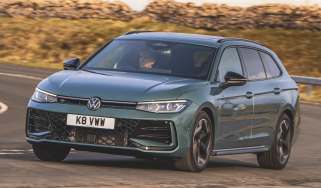
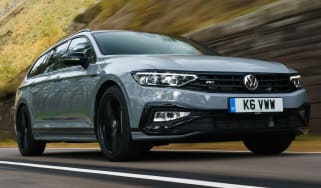
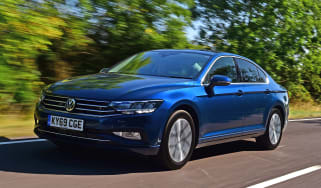
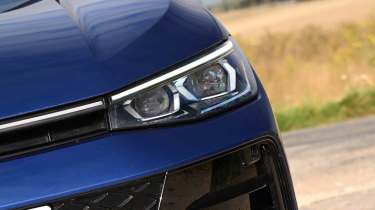
The Volkswagen Passat’s exterior design has been made sleeker and less boxy than that of its predecessor, while R-Line and Black Edition cars add a subtly sportier look. Overall it’s a handsome car, especially in the Reef Blue and Mariposit Green metallic paint options, or you could really stand out by choosing Chilli Red metallic. You can also upgrade the look of R-Line cars with the rather expensive Signature pack (£2,765) that adds different 19-inch alloys and extra black exterior trim details (among numerous other interior upgrades).
Interior and dashboard design
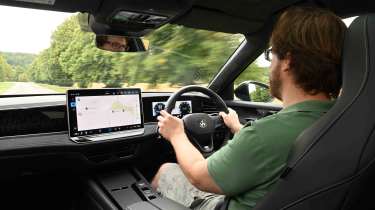
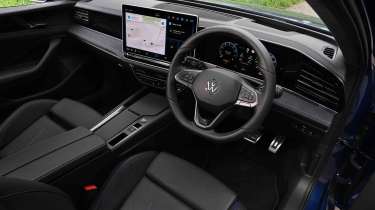
Volkswagen has added its touch-sensitive climate control system to the latest Passat. It’s been improved over earlier incarnations, with the larger touchscreen allowing frequently used functions to be on permanent display at the bottom of the screen. But we’d still prefer physical controls, such as the ones in the Skoda Superb, because they’re much easier to use on the move.
Thankfully, the controls on the steering wheel are physical buttons, so there aren’t any accidental presses when turning the wheel, as can often happen in cars with touch-sensitive switches.
Those steering wheel buttons control the standard digital driver’s display, which isn’t quite as easy to navigate as the equivalent Audi Virtual Cockpit system.
Materials and build quality
Inside, build quality is more in line with its Passat predecessor than with VW’s more recent electric cars; there are plenty of high-end materials and a general sense of solidity. A few hard plastics remain in the lower areas you rarely look at or touch, but the bits you do see regularly remind you that the Passat has moved upmarket in recent years to offer a more premium experience.
However, the Skoda Superb has also made significant strides in this area, and apart from its slightly loose-feeling rotary dials, it is a match for the Passat inside. Given that it is less expensive than the VW, we would have expected a little more from the Passat.
Infotainment, sat-nav and stereo
Inside, the digital interfaces are VW’s latest units, with a 12.9-inch screen taking care of all the major functions. The Black Edition upgrades this to a larger 15-inch version and adds a head-up display (it’s available for £1,950 on Life and Match trims, or £870 on Elegance and R-Line). The head-up display is useful because it projects important information, such as speed and navigation directions, onto the inside of the windscreen within the driver’s line of sight.
All models come with wireless Apple CarPlay and Android Auto smartphone connectivity, as well as a wireless charging pad to keep your device fully charged. The standard audio system is an eight-speaker set-up with DAB radio, but for £1,420, you can upgrade to a 700-watt, 10-speaker Harman Kardon package.
"Provided you’re in the IQ Drive section of the digital instrument cluster, you can push the ‘OK’ button on the steering wheel to bring up a small driver assist menu, where you can turn off the speed limit warning and lane keep assistance. I think that’s quite handy, because it saves you having to use the central touchscreen." - Max Adams, online reviews editor.
Boot space & practicality
Pros |
|
Cons |
|
The previous-generation Passat saloon sold in low numbers in the UK, so this time around, the ninth generation comes exclusively as an estate. If you have some sort of aversion to estates, then you could always choose the Skoda Superb instead, because it is also available as a hatchback.
Dimensions and size
The Passat is a large estate car at 4,916mm long, 1,849mm wide, and 1,521mm tall. That makes it over 200mm longer than a BMW 3 Series Touring, and only 32mm shy of the pricier Mercedes E-Class Estate.
| Dimensions comparison | |||
| Model | Volkswagen Passat Estate | Skoda Superb Estate | BYD Seal 6 Touring |
| Length | 4,916mm | 4,902mm | 4,840mm |
| Width | 1,849mm | 1,849mm | 1,875mm |
| Height | 1,521mm | 1,482mm | 1,505mm |
| Wheelbase | 2,839mm | 2,841mm | 2,790mm |
| Boot space | 510-1,920 litres | 510-1,920 litres | 500-1,535 litres |
Seats & passenger space
Access to the Passat’s interior is easy because the doors open wide, although an SUV will be even more straightforward, because the taller ride height places the seats at a higher position. The Passat has a wide range of wheel and seat adjustment, so getting comfortable is never an issue, and if you like a sporty driving position, the seat adjusts low. Spending a long time behind the wheel of the Passat is no hardship, courtesy of ErgoComfort seats that are designed to promote healthy backs.
Storage is good, with a large centre console armrest bin and a long tray with a two-part sliding cover and cup-holders beneath. There are signs of the parts sharing with the Skoda Superb here, with the dimpled bottom of one cup-holder designed to grip a bottle so you can open it one-handed. This is a good idea in principle, but on right-hand-drive cars, it’ll be easier to do if you’re left-handed.
Other additions from the Superb/Passat crossover include an umbrella in a slot in the door and a USB-C socket next to the rear view mirror for convenient mounting of a dash cam. However, other useful items, such as the ice scraper in the fuel filler flap, haven’t been carried over.
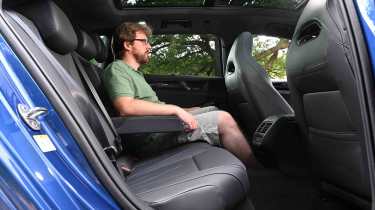
The generous space up front is matched in the back of the Passat, with even taller adults being able to sit behind similarly-sized adults. Those front seats are high enough off the floor to give you room to slide your feet under to stretch out. A panoramic glass roof is available, but we didn’t find headroom restricted by its presence. Our only disappointment is that there’s a large central tunnel in the floor that the middle rear seat occupant will have to straddle.
A pair of Isofix points are mounted on the outer positions of the rear bench, and they’re easily accessible behind a pair of plastic tabs. Black Edition trim has standard heated outer rear seats, which can be added as an option to the rest of the range as part of a Winter Pack.
Boot space
The Volkswagen Passat’s huge 690-litre boot is 40 litres larger than before. With the split-folding bench folded, this increases to 1,920 litres – 140 litres more than in its predecessor. The plug-in eHybrid has a smaller capacity of 510 litres with the rear seats up and 1,760 litres with them down, but that’s still a decent amount of space when compared with other plug-in hybrid estates.
Non-plug-in models feature an adjustable height boot floor, allowing the load area to be level with the tailgate opening. The eHybrid variant, however, has a fixed-height boot floor, with a smaller compartment below to store the charging cables.
Towing
The 1.5 eTSI mild-hybrid has the lowest braked trailer rating of 1,600kg, with the 204 eHybrid able to haul 1,800kg. Towing capacity tops out at 2,000kg for the 272 eHybrid, which is a healthy number.
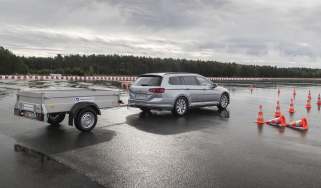
The Passat makes for an excellent tow car, having won out against all other entrants in the 2026 Tow Car Awards. However, it’s worth noting that the model tested was the now-discontinued 2.0 TSI. It proved to be a refined and comfortable tow car, with the added benefit of having a huge boot that can swallow all manner of camping equipment, which is a feature that applies to the whole range.
While the Passat doesn’t provide the instant power delivery of an EV, and its lack of four-wheel drive meant it struggled on our steep hill start test, the latter is a pretty extreme undertaking and shouldn’t prove to be a major issue in everyday life. If that does worry you, then take a look at the Passat’s Skoda Superb Estate sibling, which, in four-wheel-drive equipped petrol and diesel forms, can tow up to 2,200kg.
Fitting a tow bar to your Passat is fairly pricey at around £1,000.
"While it sounds like a cliche, I’ve used the Volkswagen Passat Estate for tip runs, and it’s easily big enough to take a double mattress (admittedly folded over) and a dismantled set of drawers with space to spare." - Max Adams, online reviews editor.
Reliability & safety
Pros |
|
Cons |
|
The latest Volkswagen Passat is likely to sell in too few numbers to appear in the Driver Power customer satisfaction survey. However, Volkswagen needs to do more to improve its customers' ownership experience. The brand ranked a lowly 27th out of 31 manufacturers included in the latest survey, narrowly ahead of stablemate Cupra in 28th place. Embarrassingly, VW finished behind Audi (19th), Skoda (12th), BMW (eighth), and Mercedes (second).
Safety expert Euro NCAP awarded the latest Passat the maximum five-star rating, a result it shares with the Skoda Superb. The Passat did better in the adult and child occupant protection categories than the far pricier BMW 5 Series, which is good going. If you want something even safer, the Volkswagen ID.7 (also available as an estate in VW ID.7 Tourer form) has superior scores in the adult, child, and vulnerable road user categories.
As with the ID.7, the Passat has all the latest safety assistance features. One is autonomous emergency braking (AEB) to mitigate or avoid low-speed collisions with other vehicles or pedestrians. There’s adaptive cruise control to keep you at a safe distance from the vehicle in front, plus a lane departure and lane keep system to keep you within your lane on the motorway. Blind spot monitoring is also standard, warning you of vehicles in your blind spot when you attempt to change lanes on the motorway.
Additional side airbags for rear-seat passengers are a £400 option that’s bundled in with the addition of a tyre pressure monitoring system. A full-size spare wheel is available for £350.
Volkswagen persists with a basic three-year/60,000-mile warranty when rivals from Korea and China offer longer terms. VW has three levels of extended warranty at extra cost, if you want added peace of mind.
There are two types of service available for the Passat. If you mostly drive around town on short journeys, then the more frequent fixed service plan is for you, which requires yearly trips to the dealer for servicing, or every 10,000 miles. Anyone driving more on the motorway will be on a variable service scheme, with longer two-year maintenance visits, or every 18,600 miles.
| Euro NCAP safety ratings | |
| Euro NCAP safety rating | Five stars (2024) |
| Adult occupant protection | 93% |
| Child occupant protection | 87% |
| Vulnerable road user protection | 82% |
| Safety assist | 80% |
Buying and owning
- Best buy: Volkswagen Passat eHybrid 204 Elegance
We’d pick the plug-in model if you’re able to keep the battery charged and reap the benefits of the Passat’s zero-emissions driving. The Elegance version is pricey, but offers a good balance between comfort and good handling.
Volkswagen Passat alternatives
High prices have moved the Passat into executive territory, so if you’re looking for better value, then the Skoda Superb Estate is going to deliver it, whether you want a hatchback or estate. Cheaper still is the BYD Seal 6, which comes as a plug-in hybrid and has the option of a Touring estate body, although it’s nowhere near as enjoyable to drive or as comfortable as the Passat.
Then there are the executive options from the big three German brands in the form of the BMW 3 Series Touring, Audi A5 Avant and Mercedes C-Class Estate. The Passat comes close to matching them for quality, but offers a more practical cargo area.
If you’re willing to go fully electric, then the VW ID.7 Tourer is the enemy within, or there are numerous plug-in hybrid and electric SUVs that could fit the bill.
Frequently Asked Questions
It’s a strong performer in many areas, with excellent boot space, plenty of room in the cabin, an upmarket interior and a good mix of handling and comfort. It’s a bit pricey, though, when you consider that the Skoda Superb does a similar job for less money.
Deals on the Passat and alternatives