Vauxhall Astra review
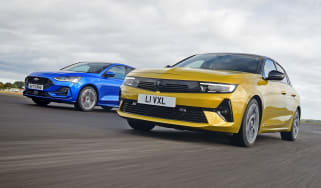
Stylish looks, impressive technology and a wide variety of engines make the Vauxhall Astra a convincingly good family hatchback

Our opinion on the Vauxhall Astra
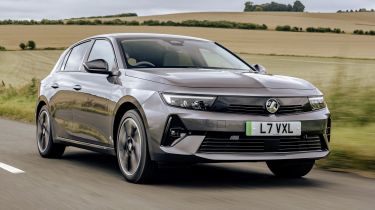
The eight-generation Vauxhall Astra has been transformed into a smart-looking family hatchback that delivers good practicality, strong infotainment and a decent drive. Efficient petrol engines provide excellent fuel economy, while the plug-in hybrid and all-electric models add a breadth of ability that might persuade business users into the sharp-suited Astra.
There are a few quibbles; interior quality could be a little better in places, and space in the rear seats is a little tighter than we’d like, but as an overall package, the Vauxhall Astra is a strong contender in the family hatchback class.
About the Vauxhall Astra
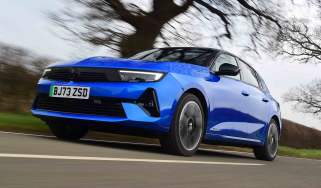
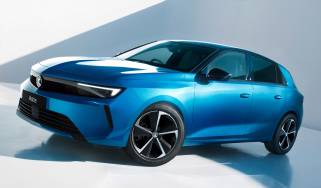
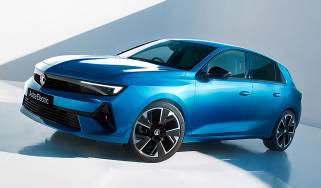
The Vauxhall Astra had a bit of an image problem over recent years with bland styling, dull engines, and little flair to excite buyers looking for a capable family hatchback. However, this household name has been completely reinvigorated at long last.
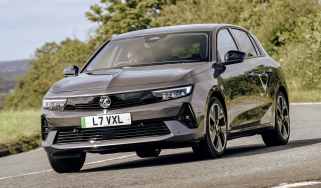
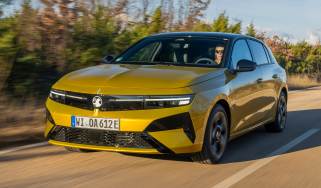
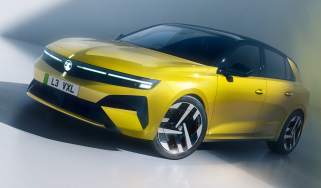
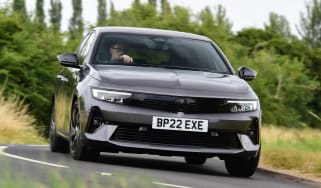
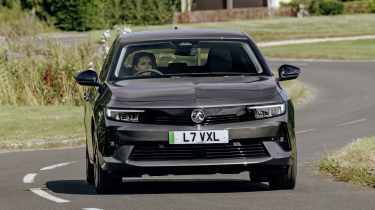
We first saw Vauxhall's Griffin style approach with the launch of the second-generation Mokka. Its sharp styling introduced the distinctive ‘Vizor’ design as the face of all Vauxhall models, and this has since made its way to the Astra.
While the Astra is now much smarter and unique to look at, there have been a number of changes underneath, too, with impressive on-board technology and electrified powertrains adding to the appeal.
Used - available now

2023 Vauxhall
Astra
33,200 milesManualPetrol1.2L
Cash £14,299
2014 Vauxhall
Astra
87,689 milesManualPetrol1.6L
Cash £2,695
2025 Vauxhall
Astra
14,057 milesAutomaticPetrol1.2L
Cash £17,300
2025 Vauxhall
Astra
32,405 milesAutomaticPetrol1.2L
Cash £14,600Buyers have a choice of petrol, plug-in hybrid or electric power and, unlike the myriad choices offered with previous generations, the latest Astra comes with four trim level options that are pretty easy to understand: Griffin (entry), GS (sporty), Ultimate (luxury) or GSe (sporty with a plug).
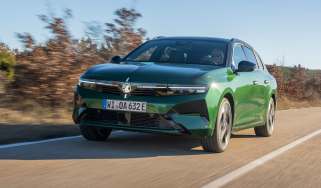
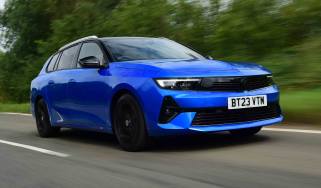
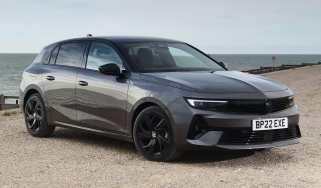
This review focuses on the Astra line-up in general, but we also have dedicated reviews on both the Astra Sports Tourer and the Astra Electric, so you can find more in-depth information about these particular models if you wish to by following the links provided.
Vauxhall Astra prices and latest deals
There’s no shortage of variations, so the Astra’s final price can vary quite a bit. If you opt for the entry-level Griffin model with a petrol engine, you’ll be looking at the starting lowest price at around £21,200. At the other end of the scale, an Astra Electric in GSe trim will set you back at least £37,900.
Build your perfect Vauxhall Astra with the Auto Express Buy a Car service, though, and you can save an average of £5,000 to £10,000. We also have a wide selection of new Astras in stock as well as plenty of used Vauxhall Astra deals. We can also help you sell your car.
Performance & driving experience
Pros |
|
Cons |
|
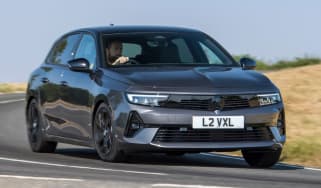
The Astra sits on the same platform as the Peugeot 308 and DS 4 hatchbacks. However, Vauxhall has applied numerous tweaks to ensure that it offers up its own driving character, such as adjustment to the steering, suspension, and anti-roll bars. All of these give the Astra a sportier feel than its French stablemates.
| Model | Power | 0-62mph | Top speed |
|
Astra 1.2 Griffin
| 130bhp | 9.7 seconds | 130mph |
|
Astra 1.6 Plug-in Hybrid Ultimate
| 195bhp | 7.9 seconds | 140mph |
| Astra Electric GS | 156bhp | 9.2 seconds | 105mph |
Performance, 0-60mph acceleration and top speed
If you’re prioritising outright pace, it's the plug-in hybrid Astras you'll want to go for. The regular Astra PHEV produces 178bhp and 360Nm of torque, enough to accelerate from 0-62mph in 7.9 seconds and hit a top speed of 140mph. However, the plug-in Astra GSe, with its 222bhp and 360Nm of torque, only needs 7.6 seconds to go from 0-62mph.
The 1.2-litre turbocharged petrol unit is available in 109bhp or 128bhp forms (the latter benefits from mild-hybrid tech). The pure-petrol manages the 0-62mph sprint in 10.5 seconds, while the MHEV shaves this down to 9.7 seconds, whether it’s equipped with the six-speed manual or eight-speed automatic.
Despite the additional weight, the Astra Electric manages the landmark sprint in 9.2 seconds, and it feels nippy around town. Head further afield, and the instant EV punch trails off at motorway speeds, but it can still hold its own with the traffic flow.
Town driving, visibility and parking
The Astra’s 1.2-litre petrol engine is refined around town at low revs, and suspension noise over potholes and speed bumps isn’t intrusive. Of course, for maximum refinement, you’ll want to look towards the Astra Electric, because there’s no engine noise to interrupt the peace.
The six-speed manual gearbox in the petrol Astra is fine rather than great, but it is easy to use even when driving in urban traffic. However, the optional eight-speed automatic gearbox is a little slow-witted and simply can’t compete with the keen responses of other hatchbacks with hybrid technology like the Honda Civic.
The Astra Electric has a keener accelerator response, and because there are no gear changes, the overall experience is a lot smoother. Dialling in Sport mode provides a keener throttle response, but adds too much artificial weight to the steering, so we’d stick with the standard ‘Normal’ driving mode.
Country road driving and handling
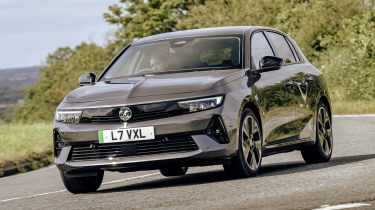
Top-spec Ultimate cars (as well as all Astra Electrics) come with 18-inch wheels as standard, but the Astra is firm-riding even when equipped with the smaller 17-inch alloys of the mid-range petrol GS. It’s not uncomfortable, though, and this firmness adds to a sense of driving engagement, making the Astra adept through twisty B-roads, with little body lean and accurate steering.
The electric motor and battery pack of the Astra Electric means it's around 400kg heavier than the lightest 1.2-litre petrol, so it doesn’t handle quite as keenly. It will also push wide in corners much sooner.
Motorway driving and long-distance comfort
The base 1.2-litre turbocharged petrol engine is capable enough and doesn’t feel overly strained at motorway speeds, although it becomes noisy under hard acceleration. A low drag coefficient of 0.269 helps the Astra cut smoothly through the air, while Vauxhall has introduced weight-saving ideas (the boot lid is made from thermoplastic) to boost performance and overall efficiency.
Perhaps unsurprisingly, though, the near-silent running and instantaneous acceleration of the Astra Electric make it the best motorway cruiser of the bunch.
One thing we particularly like is that every Astra comes with a special noise-reducing windscreen, so every model is reasonably quiet on the motorway.
“Turn into a corner, and it’s clear that the Astra has been set up to feel secure rather than fun. It is, however, fine for all but the keenest of drivers and the Vauxhall feels very stable on the motorway.” -Alex Ingram, chief reviewer.
MPG & running costs
Pros |
|
Cons |
|
While the latest Astra will doubtless attract attention for its striking looks and impressive infotainment set-up, its fuel efficiency is also a major selling point. The petrol models all offer around 50mpg on the WLTP combined cycle, according to Vauxhall.
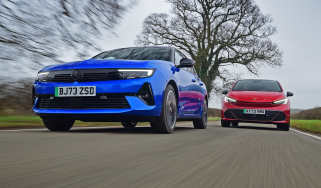
The Astra has proven itself to be a fairly economical family car during our own testing, too. After covering over 5,200 miles in our Astra 1.2 Turbo petrol long-term test car, we averaged 49.3mpg. However, hybrid rivals such as the Honda Civic and Toyota Corolla are even more frugal, and during some of our group testing, we’ve seen 50.3mpg from the Civic, and an even more impressive 54.2mpg from a 1.8-litre Corolla.
| Model | MPG | CO2 | Insurance group |
|
Astra 1.2 Griffin
| 50.4mpg | 126g/km | 17 |
|
Astra 1.2 Hybrid Griffin
| 58.9mpg | 108g/km | 20 |
Electric range, battery life and charge time
If you fancy a plug but don’t want to give up on an internal combustion engine, the Astra PHEV claims up to 52 miles of fully electric range. When the engine does kick in, the official stats claim up to 122.8mpg.
The petrol and PHEV are reasonably efficient, but the Astra Electric is undoubtedly the best of the bunch in this regard. The EV can cover up to 260 miles on the WLTP combined cycle, and if you can find a rapid charger capable of supplying 100kWh of charging speed, you can charge from 20 to 80 per cent in less than half an hour. Refilling a flat battery at home using a 7kW wallbox will take around eight hours.
| Model | Battery size | Range | Insurance group |
|
Astra 1.6 Plug-in Hybrid Ultimate
| 17.2kWh | 51 miles | 28 |
| Astra Electric GS | 54kWh | 259 miles | 26 |
Insurance groups
Insurance premiums for the Astra won’t be particularly cheap, because even the entry-level 109bhp Griffin model sits in group 17 out of 50. However, the base Toyota Corolla Icon also resides in the same group.
Moving through the Astra line-up, the plug-in hybrid and electric models will be costlier to cover, as these range from group 26 to 28.
Tax
There aren’t any major tax breaks for EVs any more, but company car buyers will at least benefit from low Benefit-in-Kind tax rates if they opt for the Astra Electric. The PHEV also brings a reduced rate, but the savings will be much smaller.
Depreciation
According to our expert data, the eighth-generation Astra isn’t the strongest performer on the used market. After a typical three-year/36,000-mile ownership period, it’ll retain around 34-41 per cent of its original list price in petrol form. The PHEV, meanwhile, holds on to just 32 to 36 per cent, while the Astra Electric manages around 37 per cent. It’s the same story regardless of whether you opt for the hatchback or estate.
The Toyota Corolla is a much better performer, retaining 48 to 50 per cent across the board.
To get an accurate valuation on a specific model check out our free car valuation tool...
Interior, design & technology
Pros |
|
Cons |
|
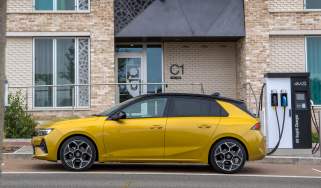
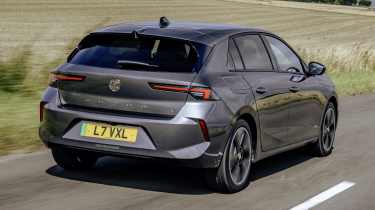
Vauxhall has done a great job moving the Astra more upmarket, because the previous model suffered from a dowdy and anonymous image that left it struggling well behind the class leaders. It’s now a modern, striking family hatchback with strong lines that complement the manufacturer’s Vizor front-end design.
Interior and dashboard design
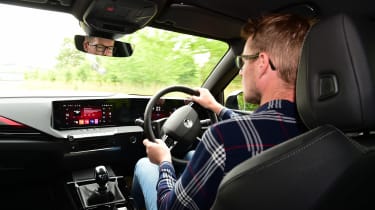
Much like the exterior, there are plenty of angles to be found with the Astra. These give the cabin a pretty unique feel, but it does come at a slight ergonomic cost. The high-sitting dashboard (a consequence of the car’s Peugeot DNA) means seeing the road ahead can be a bit challenging if you don’t raise the driver’s seat. We also found the steering wheel adjustment to be too restrictive, which didn’t help matters.
Materials and build quality
The latest Astra’s cabin includes a more generous amount of plush materials than any of its predecessors. This is especially the case with higher-spec cars, which add Alcantara into the mix. There are still some cheaper plastics in view on the centre console and lower door cards, though, which is disappointing.
Infotainment, sat-nav and stereo
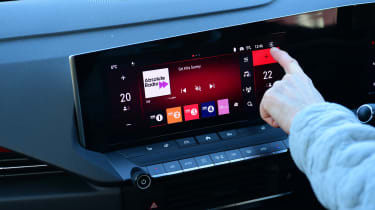
All Astras feature Vauxhall’s Pure Panel infotainment set-up as standard, but higher spec models feature an upgraded Pure Panel Pro system. Both consist of two 10-inch screens; one covering media functions and the other a digital instrument display providing information for the driver. Wireless Android Auto and Apple CarPlay are both included, along with a natural voice recognition system that we found to be both intuitive and accurate. However, loading times are a little slow, with some noticeable lag after selecting functions.
The dual-screen set-up looks great, and the Astra’s graphics look sharp. The reversing camera has great definition, too. We also like that Vauxhall has stuck with physical shortcut buttons and climate controls that are easier to use when on the move than touch-sensitive sliders, which have been a real bugbear of the VW Golf.
“Much like with the new Civic, the Astra’s cabin is a vast improvement over the model that came before it. Most obvious are the strides forward in both tech and quality; this really feels like a product that’s creeping closer to premium alternatives.” - Alex Ingram, chief reviewer.
Boot space & practicality
Pros |
|
Cons |
|
It’s important for a family hatchback to be able to take care of the little things that help to make day-to-day life easier and more comfortable on the move. The Vauxhall Astra is good in this area with plenty of storage options in the cabin and lots of useful standard kit.
There’s a big cubby located between the front seats, two trays with sliding covers and a fold-out section below the central air vent that could be used to store a phone or sunglasses.
Dimensions and size
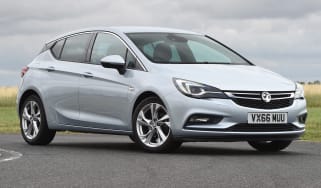
The eighth-generation Astra has increased in length by a few millimetres over the previous model and now measures 4,374mm from front to back, which is 90mm longer than a Volkswagen Golf.
| Dimensions comparison | |||
| Model | Vauxhall Astra | Volkswagen Golf | Toyota Corolla |
| Length | 4,374mm | 4,284mm | 4,380mm |
| Width | 1,860mm | 1,789mm | 1,790mm |
| Height | 1,441mm | 1,491mm | 1,460mm |
| Wheelbase | 2,680mm | 2,630mm | 2,640mm |
| Boot space | 352 to 1,339 litres | 273 to 1,270 litres | 313 to 1,052 litres |
Seats & passenger space
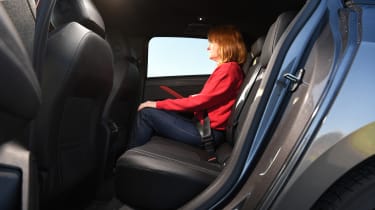
While room up front is good, passengers travelling in the rear seats will find things a little tighter; head room is fine, but more leg room would be welcome. Those likely to put tall teens or adults in the back regularly should look at a Skoda Octavia instead.
There's plenty of room for passenger's feet under the front seats, though, and the central hump in the floor is much lower in the Vauxhall than in the Golf. If you’re using the Astra as a family car, two Isofix points are provided on the outer rear seating positions.
Boot space
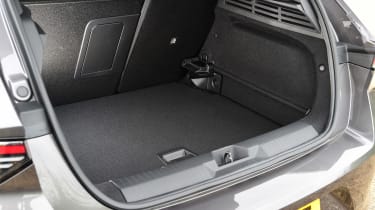
The Astra hatchback has a 422 litre boot, which easily outshines the load space provided by the Golf. Fold the rear seats, and the hatchback's luggage capacity expands to 1,339 litres. Of course, if you need even more space, the Astra Sports Tourer estate boasts 597 litres of boot space or 1,643 litres with the rear seats folded down.
However, these figures only apply to the petrol versions. The Astra Electric and plug-in hybrid models lose 70 litres of space in the hatchback, and over 80 litres in the estate.
Towing
The 1.2-litre petrol Astra with a manual transmission can tow a braked trailer that weighs up to 1,250kg, while those equipped with the automatic gearbox can haul up to 1,400kg if you get the £605 optional tow bar.
Plug-in hybrid models can cope with a little more weight and are rated to tow up to 1,450kg.
These are all competitive numbers, but if you need even more capacity, you’ll need a Skoda Octavia in 2.0 TDI 150 DSG auto form, as this can lug up to 1,600kg.
“While the Astra only just pips the Civic for overall volume, the space is flatter and better shaped, so it’s easier to load plenty of items on board.” - Alex Ingram, chief reviewer.
Reliability & safety
Pros |
|
Cons |
|
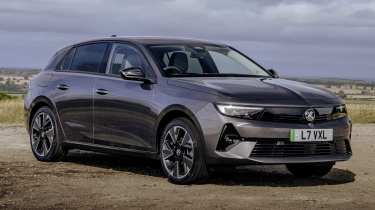
Vauxhall has equipped all Astra models with its PureSense suite of active safety kit, with every model getting lane departure warning with lane-keep assist, speed sign recognition, a driver drowsiness alert and automatic emergency braking (AEB). Adaptive cruise control comes with mid-range GS trim, along with a more advanced collision alert system that works at higher speeds, while top-of-the-range Ultimate and GSe add blind spot monitoring and a lane position assist feature.
Unfortunately, the Astra stopped short of getting a five-star Euro NCAP score like its rivals, the Honda Civic, Renault Megane E-Tech, and VW Golf. The safety experts awarded the Astra (and the Peugeot 308 upon which the Astra is based) four stars out of five, criticising the lack of a central airbag to protect front seat occupants in a side-on collision, and the emergency braking system for its poor response in recognising pedestrians.
The Astra performed outstandingly well in the most recent Driver Power best cars to own rankings, finishing in third place out of 50 cars. The brand as a whole is clearly making efforts to improve its reputation with customers, too, as Vauxhall bagged fourth place in the best manufacturer rankings.
| Euro NCAP safety ratings | |
| Euro NCAP safety rating | Four stars (2022) |
| Adult occupant protection | 80% |
| Child occupant protection | 82% |
| Vulnerable road user protection | 67% |
| Safety assist | 66% |
Buying and owning
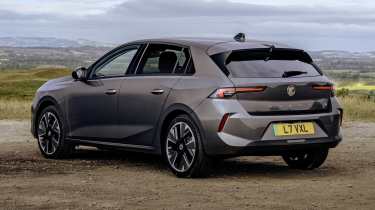
- Best buy: Astra 1.2 GS
Plug-in and electric power are great for the eco-conscious as well as company car drivers, but these cars come with quite a premium price-wise. For the majority of regular buyers, the petrol-powered Astra will provide enough power, efficiency and value for money. Moving up to GS trim adds a few elements of luxury, too, without causing too much damage to the bank account.
Vauxhall Astra alternatives
The Vauxhall Astra’s former arch-nemesis was the Ford Focus, but this car is no longer in production. However, there are plenty of other cars for this car to face in both its hatchback and estate forms. Its own sibling, the Peugeot 3008, offers a similar level of powertrain and body shape choices. Elsewhere, the Toyota Corolla, Volkswagen Golf and Skoda Octavia are other highly familiar names in the family car sector.
Frequently Asked Questions
All Vauxhall cars are covered by a three-year/60,000-mile warranty, which matches the coverage you get with a Volkswagen Golf, but lags behind the seven-year warranty offered by Kia, or the ten-year warranty package provided by Toyota. Plug-in hybrid and Astra Electric owners have a separate eight-year or 100,000-mile policy for the battery pack. If the battery’s usable capacity drops below 70% during that time, Vauxhall will replace it for free.
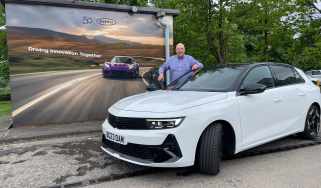
Vauxhall Astra GSe long-term test
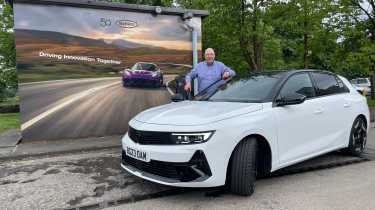
Our former products editor Kim Adams lived with a plug-in hybrid Vauxhall Astra GSe as part of our long-term fleet. While it’s far from a full-fat hot hatch, the GSe does boast a decent 222bhp and Kim was impressed with how quick the car felt when driven hard.
However, life with the Astra GSe wasn’t without its disappointments. Keyless entry with a mind of its own and some overly intrusive driver assistance systems were just two of the reasons that this hatchback regularly put Kim’s patience to the test. A number of additional electrical gremlins only managed to rub salt in these wounds, too. You can read the full long-term test here…
Deal on the Vauxhall Astra and alternatives