Ford Kuga (2008-2012) review
Smart-looking Ford Kuga 4x4 drives as well as it looks, but it could be more practical

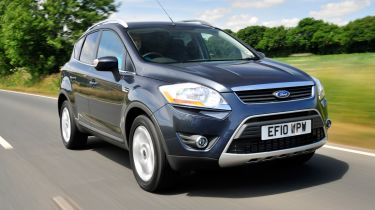

The blue oval was late to the SUV party, but the Ford Kuga is good fun to drive, has a stylish body and a well made cabin. It is more fun to drive than a Volkswagen Tiguan, although it doesn't have the space of a Nissan X-Trail. Don’t bother with the thirsty five-cylinder petrol, instead go for the Zetec-trimmed 138bhp 2.0-litre diesel. If you don’t think you’ll be off-road very often you can go for the front-wheel-drive version, which is cheaper to buy and run.
Engines, performance and drive
The Ford Kuga is by far the best compact SUV to drive, as it feels like a raised Focus, with a sharp turn-in to corners, accurate, well-weighted steering and decent agility. The ride is reasonably firm, but it’s not uncomfortable, and the pay off is limited body roll in corners. Four-wheel-drive versions are capable on slippery surfaces like the odd grassy car park and snowy track. But this is not a Land Rover Freelander and it’s more suited to tarmac. Front-drive models are very good and well worth considering if you’re not likely to get stranded come winter - but the economy gains are minimal. As for engines, the 2.5-litre five-cylinder is very thirsty and not much faster than the 161bhp 2.0 TDCI, but our pick is the 138bhp diesel. which strikes a great balance of pace and frugality.
MPG, CO2 and Running Costs
It doesn't benefit from stop-start like more modern Fords, but diesel Kugas are still economical, with the 138bhp returning 47.1mpg and emitting 159g/km of CO2. Go for the front-wheel-drive version and you’ll see returns of 47.9mpg and 154g/km. Tyres are likely to be more expensive to replace than on a regular hatchback, but apart from that running costs should be reasonable. The Kuga is pricey, but you do get some nice kit, with things like keyless start, MP3 connector and alloy wheels standard on all models. Titanium cars add leather trim and dual-zone climate control.
Interior, design and technology
The Ford Kuga was one of the first good-looking SUVs, combining a modified Focus-style face with a pretty shape. Alongside the comparatively conservative Nissan X-Trail is certainly stands out and a minor facelift in 2010 improved things further. There are plenty of colours to choose from and even base spec cars get 17-inch alloy wheels and quick-clear heated windscreen. The cabin of the Ford Kuga is a pleasant place to be, even if it’s been superseded in styling terms by newer models like the Focus and C-MAX.
Practicality, comfort and boot space
The Ford Kuga's driving position is raised enough to give you a commanding view, but you still feel cocooned, so it’s quite sporty too. As for space, this is where the Kuga surprisingly falls down a little: don’t expect it to be much more flexible than a regular Focus hatchback. Rear seat space is only average for the class and the boot measures just 360 litres – about the same as its hatchback cousin. Folding the seats down extends this to 1,355 litres, although it’s clear rivals like a Nissan X-Trail are bigger and more practical. Interestingly, the Kuga replacement will be slightly larger, addressing the only serious complaint customers have with the current car.
Reliability and Safety
Like every other member of the Focus family, the Kuga gets traction control and electronic stability control as standard, plus front, side and curtain airbags, while a five-star maximum score in the Euro NCAP crash test underlines its safety. Build quality is very strong, and owners rated the Kuga highly in our 2012 Driver Power survey - finishing a satisfactory 44th. Some early cars have suffered from a hard brake pedal during warm-up, but this is a problem which should have been solved by a safety recall in 2009.