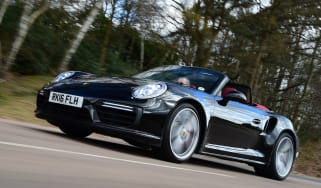
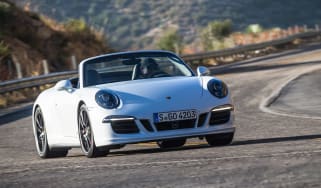
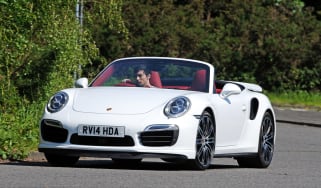
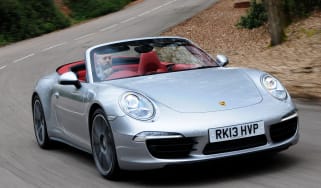
Porsche 911 Cabriolet review
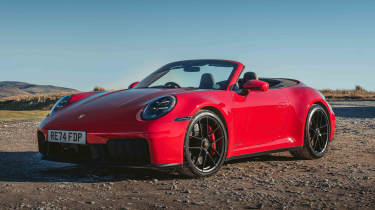
Chopping the roof off successfully adds another dimension to the Porsche 911 Cabriolet experience


Is the Porsche 911 Cabriolet a good car?
The drop-top version of the 911 is still a genuine sports car, with driving dynamics that almost match its coupe sibling. But there is a hefty premium to pay for the 911 Cabriolet over the Coupe, and the limited availability of a manual across the line-up isn’t ideal. There’s a strong range of engines to choose from, with the base Carrera providing all the oomph and engagement you could need on the road, up to the Turbo-troubling GTS with Porsche’s new and fantastic ‘T-Hybrid’ powertrain. The ride is well sorted in the Cabriolet to really make the most of its top-down cruising ability, but it doesn’t wallow around in the corners either.
| Key specs | |
| Fuel type | Petrol |
| Body style | Convertible |
| Powertrain | Flat-six turbocharged |
| Safety | N/A |
| Warranty | Three years/unlimited mileage |
How much does the Porsche 911 Cabriolet cost?
Despite having plenty of variants of just one car, Porsche’s line-up of 911 models is pretty straightforward. The Porsche 911 range kicks off at a whisker under £100,000 in hard-top Carrera form, but if you want the privilege of having the wind in your hair and an unobstructed audible connection to a flat-six engine, you’ll have to add £10,000 to the price tag. That applies to the base Carrera, Carrera S, the new GTS, the all-wheel-drive 4 GTS and the latest Carrera T – yes, you can have every single Carrera as a convertible these days.
Used - available now


The T costs just over £120,000, with the Carrera S Cabriolet priced from a little under £130,000. The two-wheel-drive Carrera GTS comes in at around £142,000, while the 4 GTS costs just under £150,000.
There are plenty of differences between the Carrera’s trim levels, starting with the engines. The base Carrera uses a 3.0-litre twin-turbocharged flat-six, with the Carrera S receiving the same engine but in a slightly higher state of tune. The GTS and 4 GTS use a 3.6-litre flat-six with turbocharging and hybridisation, marking the first time a 911 has used electric power. Compared with the Carrera, the ‘T’ is a more driver-orientated proposition that has several chassis tweaks, although it gets the same engine as the base-spec car. Aside from the GT3 models and the S/T, the Carrera T is the only 911 to be offered with a manual transmission – a six-speed in this case. All other 911s come with an eight-speed PDK automatic.
Engines, performance & drive
Lopping the roof off a car will, of course, result in a less rigid body and have negative consequences for the driving dynamics. Porsche has been making 911 Cabriolets since 1982, with the SC, and even built a functioning prototype of the 901 predecessor back in 1964, so it’s had a long time to develop its drop-top sports car. In the latest 992.2 generation that arrived in late 2024, it’s safe to say the brand has honed the Cabriolet model to a tee (quite literally in the case of the first-ever Carrera T Cabriolet).
Yes, torsional stiffness is down by 50 per cent compared with the hard-top Coupe, and you can expect around 80kg of weight gain for the Cabriolet model, too. The way the open-top 911 goes down the road is almost imperceptible to the Coupe, however.
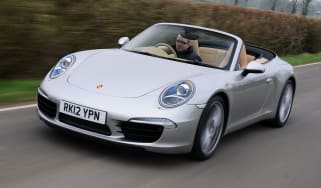
There’s a button in the centre console to get that canvas roof down, and another next to it to put it back up again. It only takes 12 seconds to fully open or close.
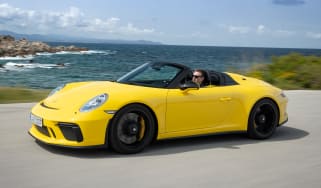
Once the roof is down and you’re up to a steady cruise, you’ll notice there’s very little buffeting in the 911 Cabriolet – it’s roughly on par with the Targa. That’s because you sit low down (although the driving position is perfect), allowing the wind to wash over the cabin - there’s no wind deflector between the seats either, because the Cabriolet is a four-seater.
Your only reminder that this is the convertible model (aside from the obvious lack of a roof) is the ride. As with the 911 Coupe, the Cabriolet soaks up small bumps and potted surfaces with relative ease, only shuffling slightly over larger imperfections in the road where the coupe might feel tauter.
The suspension in the 992-generation 911 is a triumph and it's been reworked to suit the needs of the Cabriolet. Porsche Active Suspension Management (PASM) is offered on the Carrera S and up, and on the 4 GTS we tried it helped give the 911 Cabriolet a broad choice of damping set-ups, along with lowering the car by 10mm. Of course, you never feel detached in a 911, but in the sportier driving modes with the suspension stiffening up, you develop a more confidence-inspiring feel of the road beneath.
Helping with this connection is the steering, which is just as quick and responsive to inputs as the Coupe. It’s not a car that revels in being thrown into corners, it’s more rewarding to lean on the copious amount of grip afforded by the 911’s increasingly wider tyres and dazzling chassis and see how early you can squeeze than flat six – whether it be the base model or the supercar-rivalling GTS.
Almost matching a Porsche Panamera for width, the 911 feels like a wide car, and strangely, this is especially so in the Cabriolet. The communicative steering obviously does its part to help you navigate tight B-roads, but the 911 can also be equipped with rear-axle steering, which works together with a revised steering ratio to reduce the car’s bulky feel around town. One side-effect of this is some front-wheel judder under full-lock turns in car parks.
It’s been the case with the current generation that whatever engine you pick to power your 911 Cabriolet will be a gem, but for the 922.2 version Porsche tweaked the line-up quite a bit. The standard Carrera, the Carrera S and the T all got power bumps, thanks to utilising the previous GTS’ twin-turbochargers. The GTS T-Hybrid is an incredible introduction to hybrid power for the 911 with a new single-turbocharger getting electrical assistance to feel crisper and compliment an excellent 3.6-litre flat-six.
One slight disappointment that some might feel with the roof down in the 911 is that the exhaust note doesn’t sparkle in the same way some of its V8-powered rivals from Mercedes-AMG. We’d certainly recommend going for the 911’s sports exhaust system if that’s an option.
With the Cabriolet’s extra weight, soft-top 911s can’t quite match their hard-top sibling’s 0-62mph times. The Carrera takes 4.3 seconds, with the S dropping this to 3.7 seconds - both 0.2 seconds slower than the equivalent coupe versions. The Carrera T is 0.2 seconds slower, at 4.7 seconds, and the GTS Cabriolet is just 0.1 seconds slower than the coupe, at 3.1 seconds.
| Model | Power | 0-62mph | Top speed |
| Porsche Carrera T Cabriolet | 394bhp | 4.7 seconds | 182mph |
| Porsche Carrera GTS Cabriolet | 541bhp | 3.1 seconds | 194mph |
| Porsche Carrera Cabriolet | 394bhp | 4.5 seconds | 181mph |
MPG, emissions & running costs
You not only pay the price for having an electronically foldable roof when it comes to performance, but also in efficiency too. The 911 Cabriolet is understandably thirstier than its Coupe cousin, although not by much.
The standard Carrera Cabriolet returns a combined figure of 27.4mpg – just 0.6 down on the Coupe. The S, at 26.9mpg, is only slightly worse off than the hard-top's 27.4mpg, while the T Cabriolet is also 0.5mpg thirstier than the Coupe, at 26.4mpg.
Despite being the most powerful Carrera, the GTS returns a decent 26.4mpg, thanks to its hybrid system, and that’s without any electric-only running being available.
There’s not too much difference in emissions throughout the convertible 911 range, with the Carrera emitting 234g/km of CO2 and the GTS being the worst offender with 243g/km.
Depreciation figures for the pre-facelift, 992-generation Cabriolets tell us that they retain around 60 per cent of their original value after three years and 60,000 miles. The steepest drop-off was for the GTS, which kept 58 per cent of its value, with the Carrera 4S performing best, at 62 per cent.
| Model | MPG | CO2 | Insurance group |
| Porsche 911 Carrera Cabriolet | 27.4mpg | 234g/km | 50 |
| Porsche 911 Carrera GTS Cabriolet | 26.4mpg | 243g/km | 50 |
| Porsche 911 Carrera T Cabriolet | 26.4mpg | 243g/km | 50 |
Design, interior & technology
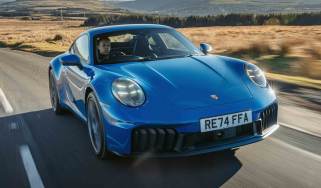
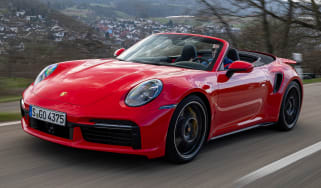
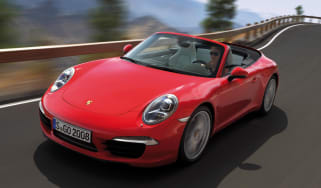
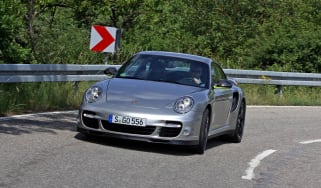
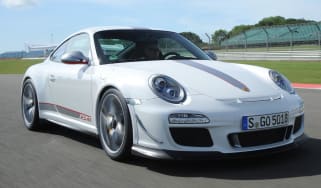
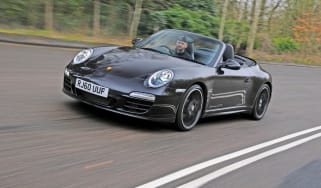
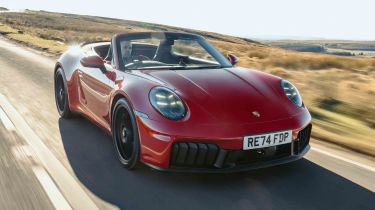
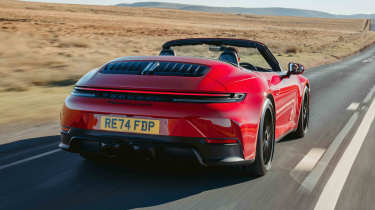
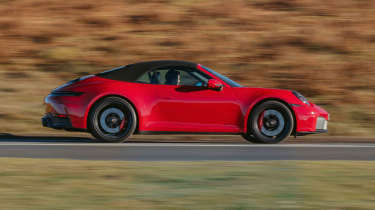
The 911’s shape has evolved and modernised over the years, but it’s still just as recognisable. The Cabriolet manages to stand out alongside the Coupe and Targa with its rather bulbous rear-end giving it a real presence on the road.
It’s easy to lose your way in Porsche’s online configurator when building your 911, such is the variety of colour combinations, materials, plus wheel and bumper designs. Having a broad array of customisation options means you’re able to quite easily build a unique 911, although we’d recommend thinking long and hard about the interior, because it will be on show and at the mercy of the elements more often.
Unlike the Coupe, the Cabriolet doesn’t come with the option of Porsche’s excellent bucket seats, due to the potential for rain to scupper the fabric. The standard-fit sport seats are rather good, though, with the ‘Sport Seats Plus’ option providing a little more bolstering.
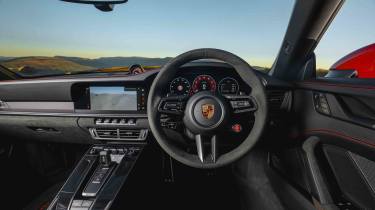
Aside from the roof switches in the centre console and that fabric roof, it’s the same as the Coupe inside. That means there’s a 10.9-inch horizontal touchscreen in the dash and a digital driver’s display, which is new for the 992.2 model. While the driver’s screen features a similar layout to the old analogue one, we would like more customisation options.
As ever, the switchgear in the 911 is excellent – familiar while feeling expensive and robust. The whole ergonomics of the cabin are great, too, although the 2024 update saw the loss of a physical key slot, which might sadden some purists.
Sat-nav, stereo and infotainment
Porsche’s in-car ‘PCM’ infotainment system is pretty impressive. It’s easy to use on the move, quick to respond to inputs and suits the interior’s classy look. If it’s not to your style, however, the 911 has Apple CarPlay and Android Auto connectivity.
The new driver’s display sees the rev-counter sitting front and centre - just as it should be in a 911. The controls for this are on the steering wheel and, thankfully, are proper physical controls rather than touch-sensitive ‘buttons’. The cruise control and lane-keep assist stalk has also been retained, so these functions are easy enough to use on the move.
An added bit of theatre comes with the rotary switch on the steering wheel that controls the drive modes, which comprise Wet, Normal, Sport, Sport Plus and Individual settings.
Boot space, comfort & practicality
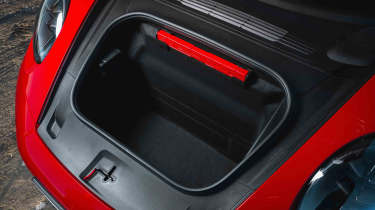
Considering it’s billed as the ‘everyday sports car’, the 911 is woefully impractical on paper. The 135-litre boot in the nose (there’s no rear boot for obvious reasons) is pitiful, so if you’re on a long weekend away, the back seats will have to double up as storage. The rear seats aren't fit for anyone with long legs, so it's best to treat the 911 Cabriolet as a two-seater.
There’s not a tremendous amount of storage space inside either. You do get a couple of decent-sized door bins and one central cup-holder with a storage box under the armrest, but that’s about it. The seating position is low for those in the front, but you’ll find that there’s loads of headroom and legroom available.
| Dimensions | |
| Length | 4,542mm |
| Width | 2,033mm |
| Height | 1,297mm |
| Number of seats | 4 |
| Boot space | 135 litres |
Safety & reliability
Porsche has a strong history for reliability, and even with its latest cars with all their cutting-edge technology, this appears to still be the case. In our 2024 Driver Power customer satisfaction survey, Porsche came fourth out of 32 manufacturers, with particularly good scores for reliability and overall quality.
Euro NCAP hasn’t crash-tested the current-generation 911, although we’d expect it should perform well, thanks to its suite of standard-fit safety technology.
| Key standard safety features | Euro NCAP safety ratings |
|
|
Porsche 911 Cabriolet alternatives
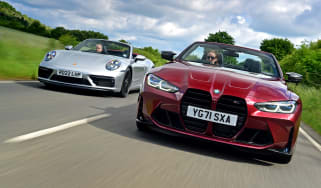
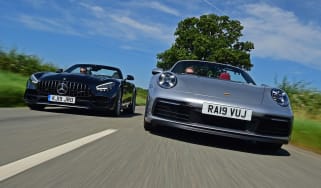
Well north of £100,000, the 911 Cabriolet has to cope with some heavy-hitting rivals. There’s the ever-present Mercedes-AMG SL with the ‘AMG’ part of that name more involved than ever. Lesser SL 43 models use a four-cylinder, which is no match for any of the 911’s flat-six configurations - you’ll have to up the ante to the V8-powered SL 55 and 63 models. Priced significantly more than the 911 these days is the Aston Martin Vantage Roadster. The British drop-top received a mid-life facelift in 2025, though with 650bhp on tap from its Mercedes-AMG twin-turbocharged V8, it has the firepower to cause the Porsche problems.
Frequently Asked Questions
The Porsche 911 GTS Cabriolet has a 0-62mph time of 3.1 seconds and a top speed of 194mph
More reviews
Car group tests
In-depth reviews
Road tests
Which Is Best