Best car tyres to buy now: top tyres tested and reviewed
Nine brands go head to head in our annual test, but which one should you put on your car?
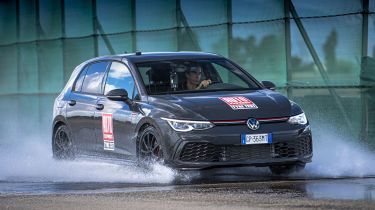

The subject of our 2025 summer tyre test is the best-selling 18-inch tyre, the 225/40 R18. It’s three years since we last put this size through the comprehensive Auto Express test regime and back then there were Covid-related supply issues that saw some big names absent. It was a close contest, with the Bridgestone Potenza Sport just seeing off the Goodyear Eagle Asymmetric 6 for the win, with the Maxxis Victra Sport 5 a healthy third.
Both Bridgestone and Goodyear are back again this year and they’re up against a strong group. Among the competition are Michelin with the Pilot Sport 5, and Continental with its SportContact 7, while Pirelli fields the latest PZ5 version of the P Zero. There’s also new products in the shape of the Hankook Ventus Evo K137, Kumho Ecsta Sport PS72 and Yokohama Advan Sport V107.
Plus, as usual we’ve included a budget tyre to show what level of performance you might expect if you pay less for a lesser-known brand. Notable absentees are Maxxis, due to stock issues, and Vredestein, which is readying its replacement for the Ultrac.
As ever, our test has all the data to help you make an informed choice when replacing your tyres. Our scoring is weighted towards wet-weather performance, but broken down so you can see what tyre best suits your needs.
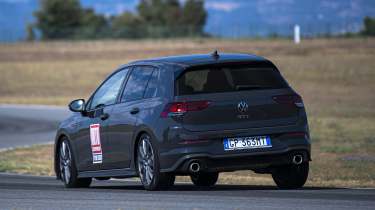
What we tested
The tyre manufacturers nominated their tyres, all opting for a speed rating of Y (186mph), a weight rating of 92, and XL – Extra Load. We sourced all the test tyres from the open market via a German independent wholesale supplier to ensure that the tyres we assessed were exactly what you can buy.
Used - available now

2025 Kia
Niro EV
22,872 milesAutomaticElectric
Cash £18,200
2024 Honda
HR-V Hybrid
15,000 milesAutomaticPetrol1.5L
Cash £22,295
2023 Jaguar
F-Pace
31,381 milesAutomaticPetrol2.0L
Cash £30,790
2024 Volvo
XC60
15,043 milesAutomaticPetrol2.0L
Cash £36,990EU tyre label ratings are included here for fuel economy (RR – rolling resistance) and wet grip (WG), which range from A to E, with A being best. We also show pass-by noise (N), which is measured in decibels, so the lower the number the better.
| Tyre | Ratings |
| Bridgestone Potenza Sport | 92Y RR: D WG: A N: B (72) |
| Ceat SportDrive | 92Y RR: D WG: A N: B (71) |
| Continental SportContact7 | 92Y RR: C WG: A N: B (72) |
| Goodyear Eagle FI Asymmetric 6 | 92Y RR: C WG: A N: B (70) |
| Hankook Ventus Evo | 92Y RR: C WG: A N: B (70) |
| Kumho Ecsta Sport PS72 | 92Y RR: C WG: A N: B (72) |
| Michelin Pilot Sport 5 | 92Y RR: C WG: A N: B (72) |
| Pirelli P Zero (PZ5) | 92Y RR: C WG: A N: B (70) |
| Yokohama Advan Sport V107 | 92Y RR: D WG: A N: B (71) |
How we tested them
Wet
Our scoring is weighted towards wet-weather performance because here in the UK you’re most likely to find the limit of a tyre’s grip on rain- soaked roads. The key test is straight-line wet braking, measured on an evenly wetted surface from 50 to 12mph (not zero, to eliminate anti-lock interference), the result being the average of a number of runs.
We also test wet cornering, taking the average of a number of laps around a 50-metre wetted circle, and undertake laps of a wet handling circuit too. We not only measure lap times, but also assess each tyre’s grip, traction and dynamic balance at the limit, tackling the circuit’s challenging mix of fast and slow turns.
Plus there are two deep-water tests that measure aquaplaning performance. In straight-line aquaplaning we measure the speed at which each tyre is generating 15 per cent of slip in 7mm of water. Resistance to aquaplaning when cornering is calculated from the average amount of residual lateral acceleration when traversing a curve flooded with 7mm of water over a range of speeds.
Dry
We measure the tyres’ dry braking distance performance from 62mph to zero and use a dry handling circuit that combines a challenging mix of traction-testing slow corners and sequences of faster sweeps and bends that put a premium on each tyre’s grip, dynamic balance, traction and stability under braking.
Noise
Every new tyre carries a label that includes a rating of the noise it generates, but this is an external, drive-by measurement. Instead, we measure the level of noise the driver and passengers hear inside the cabin over specially prepared smooth and coarse surfaces.
Our test rating also includes a subjective element, assessing each tyre’s reaction to a variety of features including ridges, raised manholes and lumpy and broken asphalt.
Fuel economy
Rolling resistance – the energy required to roll a tyre over a surface – influences fuel economy. The EU tyre label carries the rating of the tyre from A (good) to E (poor) but these are bands and represent a range. We measure all test tyres to the same industry standard but give you a more accurate result. Roughly speaking, a four per cent alteration in rolling resistance is equivalent to a one per cent change in fuel consumption.
Prices
These are sourced from online retailer Blackcircles and are for a fitted tyre at the time of writing. Price has a limited impact on the final result since tyres are a safety-critical item.
Calculating a winner
The results for each category are converted into percentages. Half the overall score is accounted for by wet performance, 40 per cent by dry – with the emphasis on braking and handling in both cases – and the final 10 per cent by the other tests. The top tyre in each test scores 100 per cent with the others rated relative to this.