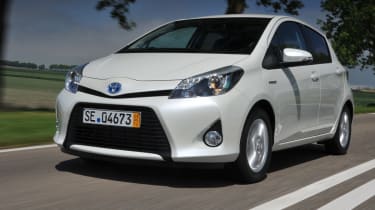
Toyota has released its smallest hybrid yet, with a new petrol-electric version of the Yaris supermini. But how will this expensive technology stack up at the cheaper end of the car market?
Well, the starting price-tag of £14,995 isn’t as high as you might expect – it’s only £600 more expensive than the cheapest five-door diesel Yaris – and the rock-bottom running costs will be a real draw for many buyers.
In its most frugal form the Yaris Hybrid emits just 79g/km (though range-topping T Spirit models emit 85g/km), which is enough to make it the cleanest car in its class. That also comes with other benefits, such as car tax exemption and while fuel economy of 80.7mpg can’t match models like the 88mpg Kia Rio 1.1D, it should keep trips to the petrol station to a minimum.
Those impressive figures are down to a petrol-electric set-up that has been developed from the system found in the Prius and Auris Hybrid models. While both those use a 1.8-litre engine, the Yaris uses a smaller 1.5-litre petrol and a more compact electric motor. Together they produce 98bhp and can accelerate the Yaris Hybrid from 0-62mph in 11.8 seconds.
Out on the road things aren't quite as good as they sound on paper. The hybrid set up works perfectly around town, providing enough low-end shove to get you to speed but it soon feels as though it has run out of steam. Getting up to motorway speeds is a struggle and once there, there's a consistent drone from the petrol engine and the CVT gearbox is constantly adjusting the revs, which does eventually grate.
The good news is that unlike the Toyota Prius, the Yaris Hybrid actually rides quite well. The occasional deep pothole will cause a loud thud to enter the cabin but otherwise the suspension deals well with very rough roads.
The handling is good, too, thanks to the quick and direct steering, but there's too much roll and too little feel in the steering for this to compete with the best in class, like the Ford Fiesta.
Unlike the Toyota Auris, the Yaris was designed with a hybrid model in mind so the packaging and practicality are much better. The batteries are now located underneath the rear seats, instead of compromising boot space. That means there's a full 286-litre load area available.
It's also the best-looking Yaris available, both inside and out. New LED daytime running lights and an aerodynamic front end have both done their part to smarten up the supermini. Inside, blue stitching and new dials have helped lift an otherwise drab interior.
The Yaris Hybrid's biggest problem though, will be its diesel competitors. The new Ford Fiesta 1.6 TDCi ECOnetic boasts similar emissions, a similar power output and far superior driving dynamics along with a price-tag that's just £500 higher for the same level of equipment.
But, the Yaris Hybrid does have an ace up its sleeve – all models in the range are automatic. Generally in this class an automatic gearbox costs an additional £1,000 or so, and speccing one has an adverse effect on emissions, too. In that sense, the Yaris Hybrid provides something unique and it's certain to draw some buyers in for that alone.
Disqus - noscript
Have to say I'm a fan of the Hybrid system, having driven a few over the years I've always found them to be smooth, quiet and easy to drive compared to most small diesels.
I think the Yaris will open up the Hybrid market for a lot of people who want a smallish, reasonably practical and reliable 5door car and I can tell you as someone who has worked in the trade for a long time, that's a large number of customers!
Well done Toyota!
Well the Rio 1.1D does 8mpg extra, that sounds good but with diesel being 5p or more per litre expensive is it really cheaper to run? Neither of these are automatics which would heavily cut their MPG and increase their emissions, around town hybrids are very relaxing to drive. Toyota Hybrids don't have CVT gearboxes they have a planetary powersplit device. And the real problem is the kind of use these cars are going to be put to, if either of the mentioned diesels have particulate filters (which I'm pretty sure they will) how long before the DPF become blocked because they aren't able to regenrate in a city environment, so how much time will be spent at the dealers for a forced regeneration of the DPF because the owners don't know what to do. As for the ride and handling comments, the buyers these cars are aimed at don't care about feedback, they want light, easy to drive cars.
If bought for around town use, diesel superminis are a DPF disaster waiting to happen.
The Yaris Hyrbid could, therefore be the perfect city car, especially when considering the handy autobox compared to manual rivals.
If travelling on the motorway all day, a diesel option would make more sense, but how many buy a supermini for that kind of usage? For that reason, this Yaris is possibly the best supermini on sale today, despite its flaws.
Oilburner, you posted exactly what I was thinking, its a Toyota, so its going to be reliable, its got a 5 year warranty, and its a genuine game changer, this is what should have been car of the year, not the overpriced and overrated Ampera, in its natural habitat it is going to be a hit, and it puts proven technology in the hands of the masses for what is generally speaking good value for money compared to its rivals, an automatic Fiesta Zetec is £14,700 before options.
As mentioned previously, there is a 9% increase in MPG from the Yaris Hybrid to the Rio 1.1D, however there's a 5% increase in fuel costs for the Rio 1.1D over the Yaris Hybrid. This brings the "benefit" of the Rio 1.1D to just 4%. Also, with the aforementioned particulate filters, the figures just don't add up for diesel motoring for this market.
Unless you are doing 20k miles a year, the price difference in initial purchase, servicing and fuel bills for a diesel in this market make no sense.
with you on that one.
but bit more to it than that the hybrid and diesel make no sense equally. if you drive arroung the town then you want a modern petrol engine. now yes they hybrid and a good diesel will give posibley 25-30 mpg more sounds alot but if you a town run driver i have never met one doing much more that 10k a year.
so a nice vw group 1.2 tsi from any brand the skoda fabia for best price and you will get 55 mpg.
over 3 years may cost about 600 more to run than a hybrid or diesel including what you pay in annual road tax.
and for equvilant spec cost about 3000 less to buy
message really here is look at what your doing over the time you will have the car and dont be fooled by small face value saving of mpg.
plus only reason toyota so fixated on hybrid is they cannot compete with diesel technology compared to i was about to say the germans but really its every one.or cost effectivly use dpf filters
Rio 1.1D gets better MPG ONLY if it has no air conditioning specced... normal version is 74-78 MPG and 15.5s to 60mph, a lot slower than Yaris.
Phoenix - Toyota is "fixated" on hybrids because it is superior technology that can be used worldwide. Yaris Hybrid will get 20mpg more any way you slice it, compared to TSI.
AE does seem to be against certain makes of car. Don't know why.
Toyota have been making good reliable cars for a long time now.
This new one looks to very good. The technology has been around for a while now so should be OK. But still they struggle to past 3 stars. My 2011 Yaris is MMT petrol and has the same VED as the manual.
Fiesta and other makes/models VED is much higher. Low tech autos it would seem. As though others don't want to make them.
Yaris is also 6 speed. Fiesta 4 speed!!!! In my hands the Yaris is as good as any supermini I bet. No doubt this new Yaris is easily as good.
I think this car makes sense if you do lots of mileage. Being Toyota it should be reliable unlike other car groups, I agree with spwolfs comment above too.
I just wish Toyota would release a hot hatch so they have something in the range for everyone, not just the more 'green' consumers.
Toyota build diesel engines to match the best efforts of other manufacturers. However, they have made a huge investment in hybrid technology. Toyota believe that future strict emission standards will necessitate oil refiners producing cleaner diesel fuel, at a significant end consumer cost. Diesel engines will also have to be built cleaner, another cost.
So while diesel motoring is destined to cost more and decline, hybrids will become cheaper as volume increases. Whatever the fuel of the future may be, there will be an opportunity for hybrid technology.
Toyota are building today a range of hybrid cars for the future. Based on my experience, hybrid motoring can also be a quieter, more comfortable and more economical motoring experience.
Where people have to drive in towns, where there are traffic jams and car parks, the Yaris wins hands down. Quiet, no DPF, automatic, easier to enter, more headroom and where parking a hybrid is so much easier due to the auto... the Yaris wins hands down.
I will buy one: second hand.
Most of the comments appear to be by people who have never driven a Toyota hybrid at low speeds. It is VERY relaxing.
I think the writer is correct: this Yaris hybrid has a CVT. I've never a driven a car with CVT but I'm sure it's preferable to the automated-clutch system, which lurches uncomfortably when changing gear, or the planetary system, which makes the car fun to drive but kills the fuel consumption. The more expensive Japanese spec. super-minis and city cars seem to have CVT nowadays e.g. Mazda Demio SkyActiv, Daihatsu Mira e:S.
This is an excellent car with a few flaws - surely it deserves four stars instead of only three? I'm now convinced that Carbuyer.co.uk offer the best and most accurate reviews.
Funny reading the comments from the usual anoraks about mpg figures. Can they not get it inot their thick heads that manufacturer mpg figures should be taken with a jarful of salt? There is no reason to believe the Kia offers any better economy than the Toyota Yaris - a few mpgs here and there on the official figures prove nothing, and diesels only come into their own when driving extended distances out of town. The problem I have with the Yaris Hybrid is that the car itself isn't very nice or spacious, and the engine a little on the weak side - though the economy is fantastic. Once the same level of economy is offered on the Auris or the Prius then I would be seriously interested.
Have owned Audi A2 1.2 TDI for over 10 years. 81g/km, 98MPG and nimble as a nimble thing with room for a huge amount of luggage with lightweight rear seats removed.
Have carried Washing machines and 2 seater sofas inside!
On Autobahn averaged over 66MPG at an average of over 90 mph.
The Yaris Hybrid makes the most sense to anyone wanting a small economical reliable well equiped small car especially if they want one with an automatic gearbox. Sadly as with the Auris, Prius and CT 200h, the Yaris Hybrid will be compared by the motoring press with manual diesels which doesn't make sense to me - this car should be compared with a fiesta, polo, jazz etc with a petrol automatic gearbox. Go on Autoexpress buck the trend and publish a group test of comparable petrol automatics.