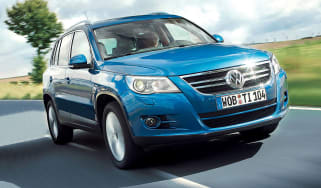
Volkswagen Tiguan review

Our Rating:
4
4.0/5.0
By Auto Express Test TeamComments

The VW Tiguan is a popular alternative to the Skoda Yeti, with smart styling and a wide range of engines

For: 
Powerful and refined engines, comfortable ride, classy interior
Against: 
Rivals are better equipped, bland styling, limited off-road ability

The Volkswagen Tiguan is one of the best all-round crossovers on the market. When it was launched back in 2008, it was designed to offer all the appeal of the Golf but with the versatility and confidence of an SUV - and it’s a recipe that’s proved hugely popular with UK buyers ever since. With its wide range of petrol and diesel engines, masses of interior space and a comfortable ride, the VW is hard to fault. Its only real downsides are that the design is smart rather than stylish - rivals like the Range Rover Evoque are better looking - and that it doesn’t come as well equipped as cheaper alternatives like the Kia Sportage and Skoda Yeti. It was given a mid-life facelift in 2011, though, which included a new look inside and out, as well as improvement to fuel economy. The most efficient option is the front-wheel-drive 2.0 TDI BlueMotion Tech model, which uses start-stop and regenerative braking to return average mpg of more than 53 and CO2 emissions of 139g/km. A new range-topping R-Line model joined the line-up at the end of 2012 and is only available with the three most powerful engines and the firm's 4MOTION four-wheel-drive system.

Our choice: Tiguan 2.0 TDI 140 SE BlueMotion Tech 4MOTION

Styling

3.8

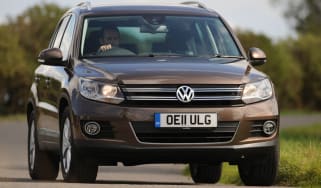
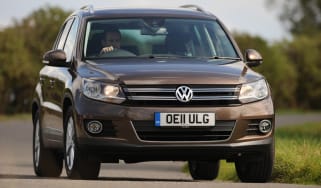
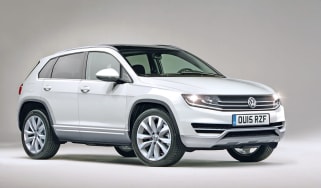
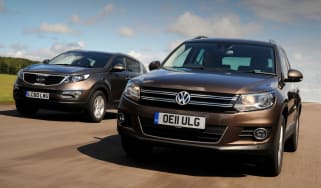
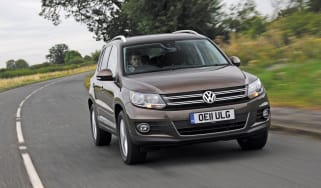
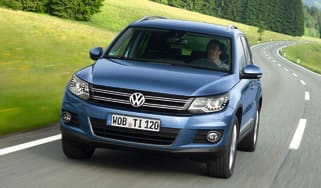
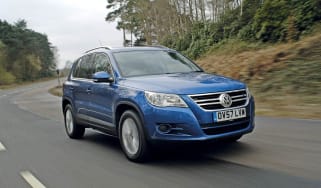
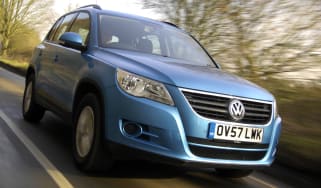
Although the Volkswagen Tiguan doesn't stand out as much as rivals like the Range Rover Evoque or Skoda Yeti, it does look smart and understated. A facelift in 2011 brought it into line with other Volkswagens in the range, with a new, more prominent two-bar grille, a sleeker front bumper, intricate headlights with daytime running lights and LED taillights. The interior is beautifully crafted, while the manufacturer’s latest touchscreen infotainment system and multi-function steering wheel help it to keep up with its newer rivals. There are four specs to choose from – S, SE, Escape and R-Line – but entry-level cars are a little spartan considering the high price tag. S versions do without the attractive chrome trim on the windows and roof rails, but do at least get 16-inch alloy wheels, air conditioning, all around electric windows and a DAB radio. You’ll have to opt for SE and above if you want Bluetooth, though, as well as a touchscreen display and climate control. Escape models come with underbody protection, for peace of mind when off-roading, while range-topping R-Line cars get bi-xenon headlights, 18-inch alloy wheels, sportier front and rear bumpers, as well as two-tone sport seats.

Driving

3.8

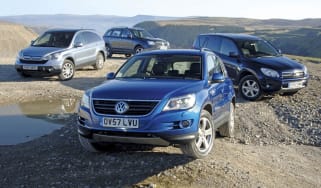
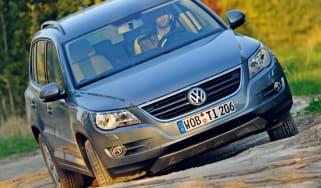
The Tiguan has a high driving position and light controls, which makes it just as easy to manoeuvre as a Golf despite its increased size. The range of petrol and diesel engines includes a 1.4 TSI, a high-powered 2.0 TSI and an efficient 2.0 TDI that’s available in a variety of power outputs. The entry-level petrol option is surprisingly capable, but it’s the diesels that make the most sense, as they pull smoothly and are very refined. Sport models have quite a firm ride - a trade off for the excellent handling - but models on smaller wheels are more comfortable, which makes them excellent cruisers. The Tiguan feels more comfortable on-road than off it, but Escape models do come with a higher front bumper and hill descent control for maximum traction over challenging terrain.

Reliability

4.4

Although Volkswagens reputation in this area isn’t as strong as it used to be, the Tiguan has scored well with owners since its arrival back in 2008. It finished an impressive 27th in the 2012 Driver Power Top 100, just ahead of its rival, the Toyota RAV4. The interior feels extremely well put together, while all of he mechanicals are tried and tested on other VW models, with no major problems reported. As for safety, it received a five-star Euro NCAP rating when it was tested back in 2009, with a score of 87 per cent for adult occupant protection and 71 per cent in the safety assist category. This is because electronic stability control is fitted as standard to all Tiguans, along with seatbelt reminders for the driver and passenger, traction control, electronic brake assist and six airbags.

Practicality

4.2

Considering its compact dimensions, the Tiguan is a very spacious car. The 470-litre boot size is considerably more than the Qashqai’s 410 litres and the Yeti’s 416 litres. The rear seats slide and recline, too, which allows you to create more luggage space or legroom as needed. If you fold the rear seats flat – which you can do with one hand – there’s a maximum load area of 1,510 litres. Plus, the front passenger seat can also fold, which makes loading extra long items a doddle. It’s just a shame the loading lip is so high, as it makes lifting heavier items more difficult. Inside, there’s plenty of room for five adults to sit in comfort, with generous amounts of head and legroom for all. SE cars and above come with drawers under the driver and front passenger seat, as well as handy folding tables for rear passengers. The 4Motion four-wheel-drive system provides plenty of grip, which means it will easily cope with grassy car parks and soggy hillsides, while those who plan on going off road more often can opt for the Escape version, which comes with underbody protection and a different front end to allow steeper approach angles.

Running Costs

4.2

The most efficient Tiguan in the line-up is the 109bhp 2.0 TDI BlueMotion Tech model, which in front-wheel-drive-guise has an official fuel consumption figure of 53.3mpg and CO2 emissions of 139g/km, making it relatively cheap to tax. The BlueMotion Tech pack adds a stop-start system, regenerative braking and longer gearing to improve fuel economy and emissions. As you’d expect, option for four-wheel drive or the automatic gearbox will have a significant impact on running costs, with the 2.0 TSI 4MOTION petrol model managing just 33.2mpg with CO2 emissions of 199g/km. Most of the engines strike a good balance between performance and economy, but as it’s not offered with a smaller diesel, rivals like the Skoda Yeti and Mazda CX-5 are cleaner. For example, the Yeti 1.6 TDI GreenLine II returns 61.0mpg and emits just 119g/km of CO2, which actually makes it free to tax for the first year. But the CX-5 is better still, with the 2.2 Skyactiv-D managing 61.4mpg and emitting only 119g/km of CO2. Plus, the Yeti also has better residual values. Volkswagen does offer a range of fixed-price servicing deals, though, while all Tiguans come with a three-year, 60,000-mile warranty.

Last updated: 16 Apr, 2013
Auto Express Issue 1,268
For more breaking car news and reviews, subscribe to Auto Express - available as a weekly magazine and on your iPad. We'll give you 6 issues for £1 and a free gift!