Used Suzuki Swift (Mk7 2017-2024) buyer's guide: a fun, but pricey supermini
A full used buyer’s guide on the Suzuki Swift, covering the Swift Mk7 that was on sale between 2017 and 2024

Verdict
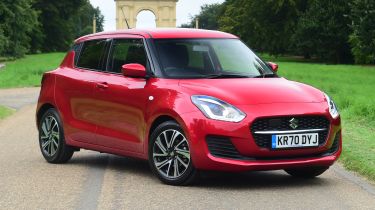
The Suzuki Swift is a likeable car and it’s one that we wouldn’t necessarily steer you away from, but while it offers quite a bit in isolation, when you compare it with its more obvious rivals it’s on shaky ground. As a new buy the Swift is reasonable value, but as a used purchase it can look quite expensive, depending on which model and spec you’re interested in buying.
The Sport is a really fun warm hatch, but it’s no class leader, while all Swifts will probably frustrate if you’re intent on doing lots of long-distance motorway journeys. If you do buy one, keep it for more local trips or rural driving where you’ll be able to appreciate the perky engines and brilliantly set-up chassis, along with the compact dimensions that make parking a breeze.
Suzuki recently unveiled an all-new Swift and it’s an incredibly important car for the brand because it sits in a very competitive and crowded segment. With the previous generations notching up nine million sales so far across the world (across eight generations globally), we’re expecting big things of the new model, not least because the outgoing car is a very likeable supermini in many ways.
Used - available now

2021 Suzuki
Swift
12,363 milesManualPetrol1.2L
Cash £11,836
2021 Suzuki
Swift
11,283 milesManualPetrol1.2L
Cash £11,792
2021 Suzuki
Swift
11,175 milesManualPetrol1.2L
Cash £11,818
2021 Suzuki
Swift
18,269 milesManualPetrol1.2L
Cash £12,233But cars in this class today have to be very well rounded, with a wide range of talents, so the big question is whether the current version has what it takes to compete in a large pool of outstanding contenders.
History
Globally there have been eight generations of Swift, including the all-new model that’s due in 2024. However, the variant covered here is the Mk4 in the UK, and it reached dealerships in June 2017 in five-door hatchback form only. Buyers could choose between 89bhp 1.2-litre non-turbo three-cylinder and 110bhp turbocharged 1.0-litre three-cylinder petrol engines, dubbed Dualjet and Boosterjet respectively.
The Boosterjet unit was also available with mild-hybrid tech, called SHVS, which was shorthand for Smart Hybrid Vehicle by Suzuki. A lively 138bhp 1.4-litre Swift Sport joined the range in June 2018, and from spring 2020 this featured hybrid technology to cut fuel consumption and CO2 emissions.
Suzuki facelifted the Swift at the end of 2020, with updated styling for the front, and extra standard equipment for each trim level focusing on enhanced safety kit.
Which one should I buy?
The 1.2 Dualjet engine feels a little lacklustre compared with the turbocharged 1.0-litre, and it came only in entry-level SZ3 (later renamed SZ-L) guise. We’d opt for a 1.0 Boosterjet engine, in mid-range SZ-T or range-topping SZ5 forms. But the most fun Swift of all is the 1.4 Sport, which is an entertaining warm hatchback.
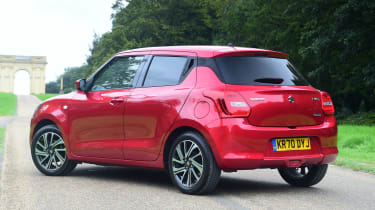
SZ3 trim comes with plastic wheel trims, a DAB radio, Bluetooth, air-con, privacy glass and electric front windows, while the SZ-T adds a rear parking camera, smartphone link and 16-inch alloy wheels. The SZ5 adds navigation, climate control, LED headlights, adaptive cruise control, keyless entry plus auto emergency braking and lane-departure warning. The Sport gets 17-inch alloys, dual exhausts and side skirts; the Attitude special edition featured cosmetic changes only, with no extra standard equipment.
Alternatives to the Suzuki Swift
For the past four years the Ford Fiesta has won the Best Used Supermini gong in our annual awards; before that it was the SEAT Ibiza that took gold. Both make for compelling second-hand buys that are more convincing than the Suzuki, and the same goes for the Skoda Fabia, which is closely related to the SEAT. The Hyundai i20 and Kia Rio are cousins that are also tempting, and so is the Citroen C3, although that car was beaten by the Swift in a 2021 twin test.
The segment wouldn’t be complete without the Vauxhall Corsa or Peugeot 208 with which it shares its platform, while the Toyota Yaris is another strong contender in this class. We’d also urge you to think about the Renault Clio and Mazda 2.
What to look for
4x4
Unusually for this segment, Suzuki offered 4WD with the 1.2 Dualjet engine. It came in manual-gearbox SZ5 form only.
Gearboxes
The 1.0 and 1.2-litre engines were both available with an automatic transmission and with a choice of SZ-T or SZ5 trims.
Wheels
Some Swifts have diamond-cut alloy wheels that can corrode once the lacquer has been attacked by cleaning chemicals or road salt.
Connectivity
Android Auto and Apple CarPlay can disconnect at random times. Software updates and using different smartphones can help.
Reliability
Suzuki generally doesn’t score very well in our brands survey when it appears, perhaps because more mainstream rivals may be better all-rounders. But Suzuki does score well for dependability, which helps to trim running costs.
Interior
One of the key areas in which superminis have come on in leaps and bounds in recent years is interior design and quality. This Swift is much better than before, but it can’t compete with more obvious rivals due to its cheap plastics in places and switchgear that doesn’t feel as durable.
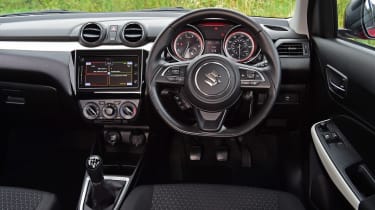
Cabin space is okay, although if there are tall people in the front, adults in the rear will complain of a lack of legroom. There are seatbelts for five. Boot space also trails the class average, at 264 litres with the back seats in use, or 579 litres with them folded down. This could be viewed unfavourably by some people, but the boot remains practical and easy to access.
Prices
There’s no shortage of Swift Mk7s to buy, but they are expensive. There are plenty of automatics for sale, while four-wheel-drive editions are very unusual. The entry-level SZ3 is the rarest trim of all, which is no bad thing; most common is the SZ5.
To check prices on a specific model head over to our valuation tool.
Running costs
All Swifts need to be serviced every 12 months or 12,500 miles, with maintenance alternating between Minor and Major, priced at £202 and £333 respectively. There’s a big service costing £450 due in year six, or at 75,000 miles, when all of the filters and drive belts need to be replaced. That doesn’t include a cambelt, because all Swift engines are chain driven.
The brake fluid has to be replaced every other year and the coolant has to be renewed after eight years or 90,000 miles, but in both cases the cost of this is built into the service. The standard warranty that comes with a new Swift is for three years or 60,000 miles, but owners can extend this cover up to as much as seven years or 100,000 miles at extra cost.
Recalls
Suzuki has a pretty good track record when it comes to issuing recalls, so it comes as no surprise that the Mk7 Swift has been the subject of just two campaigns so far.
The first was issued in June 2019 and it only involved the Swift, but more than 22,000 cars were affected, from the start of production up to February 2019.
The problem centred on side airbags and seatbelt pretensioners activating when they shouldn’t; a software update was required to put things right.
Recall two came in December 2022 and affected 71,508 Swift, Baleno, Vitara and S-Cross models. Some cars built between October 2017 and June 2019 were fitted with faulty brake servos, which could lead to the brake assistance failing, but not the brakes altogether. The fix was to fit a new valve in the servo.
Driver Power owner satisfaction
The Swift hasn’t appeared in any Driver Power surveys, and, apart from the Vitara, the brand rarely shows up. The Vitara tends to get mid-table scores; in recent years it has peaked in 46th place and dropped as low as 54th. Suzuki came 28th in the 2022 brands survey and managed only 26th in 2023. First place for value and seventh for running costs were impressive, but the overall quality got a thumbs down.
Looking to sell your current car quickly and for a good price? Get offers from top dealers with our Sell My Car service
Suzuki Swift Mk7 review: what we said
Extracts from our test drive of the Suzuki swift in 2022...
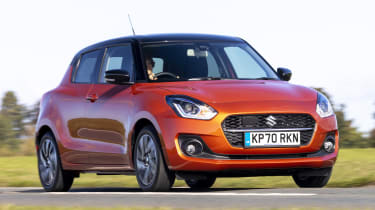
The Suzuki Swift is an appealing alternative to the likes of the Hyundai i20, Kia Rio and Toyota Yaris, that delivers good economy, particularly from its punchy three-cylinder engine, and solid build quality.
However, that doesn’t mean that it’s able to challenge the likes of the Ford Fiesta and Skoda Fabia at the top of the supermini class; put simply, there are better-finished, more comfortable and more refined offerings on the market. Since prices for this Swift have been nudged upwards, it can no longer rely on ‘bargain’ appeal either - unfortunately the same is true for the Swift Sport flagship.
About the Suzuki Swift
While the Suzuki Swift Sport has gone down as one of the best small hot hatchbacks for sale in the UK, the standard Swift is more of a left-field choice in the supermini market. The Suzuki used to be able to trade on its competitive pricing, but the Japanese-built car is no longer the bargain it once was. Still, it's a decent enough small car and will appeal to those looking for something that's fun to drive, while the Swift 4x4 model is an interesting proposition.
The Mk7 Suzuki Swift arrived in 2017 with an evolutionary shape (albeit now five-door only), more kit and additional space when compared to its predecessor, while a facelift in 2020 saw the addition of LED lights, a revised grille and updated tech and safety kit. The current model line-up comprises SZ-L, SZ-T, and SZ5 models with the Swift Sport at the top of the range.
Competition in the supermini class is very strong. Sporty handling is one of the Suzuki's plus points, and other cars that can match it include the all-conquering Ford Fiesta, the Mazda 2 and SEAT Ibiza. Elsewhere, the Skoda Fabia and VW Polo are also competitive, and the Citroen C3 offers comfort and a unique style of its own. The Toyota Yaris, Hyundai i20 and Kia Rio offer reliable, well equipped transport, while the Vauxhall Corsa, Renault Clio and Peugeot 208 are all fighting for sales.
Power for the latest Swift comes from a 82bhp 1.2 Dualjet four-cylinder engine with mild-hybrid technology, while the SZ5 model is offered with four-wheel-drive. A five-speed manual gearbox is standard, with a CVT auto transmission available for the SZ-T and SZ5 (front-wheel-drive) versions. The Sport model gets a 127bhp 1.4-litre turbo four-cylinder unit with a six-speed manual 'box.
Engines, performance and drive
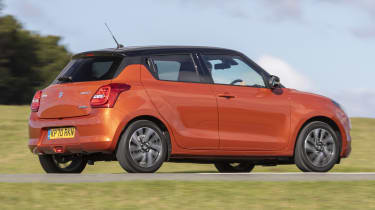
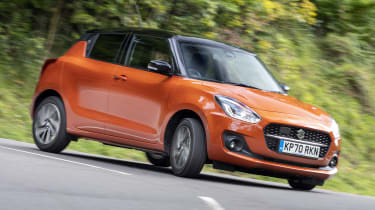
The Swift features some very trick construction that means it’s just about the lightest car in the supermini class, with even the SZ5 4x4 model weighing less than 1000kg - a minor miracle in this day and age. The 82bhp offered by the 1.2-litre Dualjet motor sounds small by modern standards, but the Swift's light weight means that it still feels enthusiastic, while working the slick and smooth five-speed manual gearbox gets the best out of the engine.
The rest of the basics feel sound enough. The steering doesn’t do an amazing job of communicating what the front wheels are doing but it’s nicely weighted and consistent, making it relatively easy to place the Swift in corners. The five-speed manual gearbox has a pleasingly short throw and is happy enough to shift quickly, too.
That lack of mass means the Swift feels pretty agile, too – not as crisp as the Ford Fiesta, certainly, but a match for just about anything else. The car is happy to change direction quickly and it stays admirably flat in corners. Unique to the class is the AllGrip all-wheel drive system available on SZ5 models, which offers extra traction and security. While its cheap and rugged enough to do a decent job off-road, it offers only limited appeal to buyers.
Ride quality is the trade-off for this agility; Suzuki’s engineers reportedly spent time developing the Swift on UK roads, but it hasn’t quite paid off. In the most part it stays composed, but over broken surfaces – precisely the sort of bumps and potholes that are common on British B-roads, in fact – it gets a bit unsettled. In particular, passengers in the rear are likely to complain about being bounced around - a result of the car’s relatively simple torsion-beam rear suspension set-up and low weight.
Mild-hybrid tech for the 1.2-litre engine uses a lithium-ion battery under the front passenger seat that harnesses braking energy and then uses it to power a small integrated starter generator. This, in turn, helps the petrol engine when you’re accelerating, but the goal is efficiency rather than performance, so it never feels like an extra surge of pace. Indeed, if anything, it’s impressively well integrated.
The hot Swift Sport has a decent breadth of talents, with a punchy engine and direct steering, but it's undone by handling that plays it too safe; as a result, other hot hatches are more exciting to drive.
Engines, 0-60 acceleration and top speed
The 1.2 Dualjet petrol unit produces 82bhp and 107Nm of torque. Opting for the four-wheel-drive set-up of the SZ5 model brings the slowest 0-62mph time in the range at 13.8 seconds, while the front-wheel-drive car trims this time to 13.1 seconds - both use a five-speed manual gearbox. The CVT auto versions are capable of the same sprint in 12.2 seconds.
The Swift Sport offers 127bhp from its 1.4-litre turbocharged engine. This doesn't sound like much but, given the Swift's low weight, and the engine's decent 235Nm of torque, it's satisfyingly brisk when shooting out of corners. 0-62mph is dispatched in 9.1 seconds, with a top speed of 130mph.
MPG, CO2 and running costs
There’s no denying that the Suzuki Swift’s lightweight construction helps it achieve some strong fuel economy figures. The 1.2-litre Dualjet offers CO2 emissions of just 106g/km and official fuel economy of up to 59.7mpg on the WLTP combined cycle.
Swift models fitted with the CVT auto transmission are slightly less efficient, with CO2 emissions rising to 115g/km and average fuel economy of 55.3mpg. Opting for the four-wheel-drive SZ5 means you'll see a return of 52.3mpg, while CO2 levels increase to 121g/km.
At the other end of the scale, the 127bhp Swift Sport delivers 50.4mpg and emits 125g/km of CO2 – decent numbers, considering the performance.
Interior, design and technology
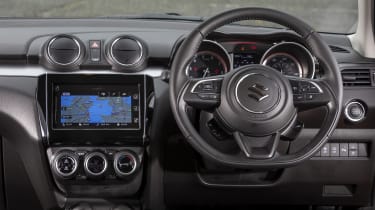
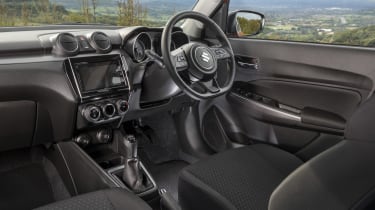
Inside, the swift’s cabin is best described as functional. There’s no soft, squidgy plastics or fancy swooping features here: what there is, is a fairly solid cabin with a neat layout and big, simple controls for the air conditioning system.
Suzuki has revised the trim structure for the Swift, with the cheapest SZ-L model featuring generous levels of kit: 16-inch polished alloy wheels, rear privacy glass, air-con, a DAB radio, Bluetooth and adaptive cruise control.
Mid-spec SZ-T looks the most appealing of the editions, because it brings Android Auto and Apple CarPlay compatibility (so you can use selected apps from your phone, including navigation), along with rear parking sensors and a host of extra safety equipment. SZ5 throws in integrated sat-nav, keyless entry, climate control, electric rear windows and power folding door mirrors.
The interior design is neat, and all of the switches are in sensible positions. However, while there’s no denying that it all feels tightly screwed together, the whole experience is short on flair, with even range-topping versions including swathes of hard, black plastic. Indeed, there are precious few soft-touch materials throughout the cabin; the likes of the Ford Fiesta do a better job of feeling plush in the right areas, and it’s a world behind the SEAT Ibiza in this regard.
The Swift Sport looks the hot hatch part without being garishly attention grabbing - if you don't choose Champion Yellow paint, of course. It gets a honeycomb radiator grille, carbon-fibre effect sills, twin exhausts and a small roof spoiler, plus unique bumpers and sports seats.
Sat-nav, stereo and infotainment
Only the SZ-T and SZ5 trims feature a touchscreen system, while the base SZ-L uses a more old-school head unit with a monochrome LCD screen and chunky buttons. Even though it looks a little dated, it does the job perfectly fine, and features DAB radio and Bluetooth functions.
The built-in interface of the Swift's touchscreen is a little clunky and slow, so you'll probably benefit from using the Android Auto and Apple CarPlay features. The set-up is close to a widescreen layout, however, which means that smartphone apps appear less cramped, while the main menu layout is very simple to understand.
Practicality, comfort and boot space
Many superminis will be used as two-seaters, in effect, with the rear cabin being used as a dumping ground for shopping more regularly than as a space for passengers. If this is your pattern of use, the Swift won’t disappoint; there’s room for two adults up front, and two grown-ups will be able to sit behind them for more than a short journey. If they’re over 6ft tall then they may complain about their knees hitting the front seats, however.
The Swift’s boot is a respectable size, at 264 litres - but while that’s a useful increase over this car’s predecessor, it lags well behind rivals. However, it’s worth noting that the Swift’s boot is smaller because the whole car is much shorter overall. So the choice comes down to either load capacity or ease of parking.
There’s a fair old lip to lift heavy items over, though – and while the Swift’s rear seats do fold down in a 60:40 split, they leave a pretty horrid step in the floor. It certainly wouldn’t be easy to slide heavier items into the expanded load bay.
It’s easy to see all round the Swift, despite the relatively thick C-pillars. And there’s a fair amount of oddment space in the cabin, with decent-sized doorbins and a storage area ahead of the gear lever.
Visibility is good, thanks to the thin pillars and upright rear screen, although top-spec cars offer a reversing camera as an option. Other practical features include a small central armrest, as well as usable doorbins and a decent glovebox. You’ll also find a couple of cupholders ahead of the gear lever.
Size
The latest Suzuki Swift performs a bit of a visual trick - because it’s actually about 10mm shorter than the previous generation car. However, and more importantly, its front and rear axles have been pushed further apart (by about 20mm); this increase in the wheelbase is designed to improve the amount of cabin space on offer, particularly to those sitting in the rear seats.
As a result, the Swift keeps its overall compact dimensions - as well as the wheel-at-each-corner stance and short overhangs that gave its previous generations such striking looks. To give you an idea, the Swift’s wheelbase is only around 20mm shorter than a Skoda Fabia’s, but the Suzuki is more than 150mm shorter than its Czech rival overall.
Leg room, head room & passenger space
The Swift’s diminutive size means that it’s still not quite as spacious as the likes of the Skoda Fabia, but there is room for four adults on board – and unless you’ve got a couple of six-footers in the rear, there are unlikely to be many complaints about longer journeys.
There’s plenty of head and shoulder room for both sets of passengers, but taller rear occupants might grumble about their knees hitting the backs of the front seats.
Boot
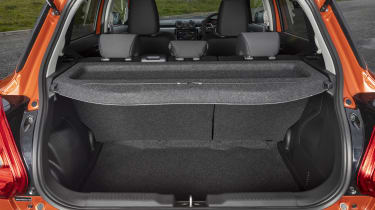
The good news here is that this Swift’s latest platform has allowed Suzuki’s engineers to package in a much larger boot than this car has ever offered before – 264 litres. The bad news is that this is still really only average in a class where plenty of rivals are used as small family cars. The latest Skoda Fabia now offers 380 litres, for example, and even the Fiesta manages 311 litres.
Nor is there anything remarkable about the Swift’s boot set-up; in fact, there’s a fairly hefty lip if you’re trying to lift in heavier items. The back seats fold down in a 60:40 split but while doing this does free up a fair amount of extra space, it also leaves a big step in the floor that makes it awkward to slide in heavier items.
Towing
With a maximum braked towing weight of 1,000kg, the Swift should be fine to pull a small trailer, although we'd always advise double checking your vehicle's towing capacity before hooking up.
Come and join our WhatsApp channel for the latest car news and reviews...
More reviews
Car group tests
In-depth reviews
Long-term tests