Nissan Juke 1.5 dCi
Can diesel power give supermini SUV a performance boost?
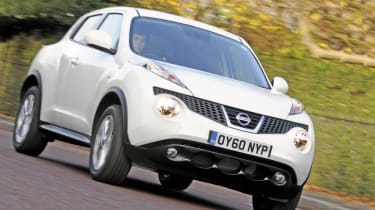

The Juke certainly has plenty going for it, including dramatic looks, a stylish cabin and a lengthy equipment list as standard. This diesel-engined model adds low running costs to the mix, but there are greener and smoother rivals out there. To make matters worse, it isn’t particularly practical, thanks to a relatively small boot, and it lacks the driver appeal of a traditional hatchback. But if you are in the market for a quirky alternative to regular small cars – one that boasts stop-and-stare looks – the Juke still holds plenty of appeal.
We've already driven the two petrol-powered Jukes – and neither managed to deliver on the promise of the supermini SUV’s bold looks. Could a diesel engine be the answer for the Japanese firm?
Things don’t get off to a great start for the funky Nissan – literally. Fire up the 1.5-litre dCi unit and it’s gruff, plus it’s just as unrefined at high revs, too. Aside from that, the Renault-sourced engine pulls strongly above 1,750rpm and can launch the Juke from 0-62mph in 11.2 seconds and on to a top speed of 109mph.
Video: watch CarBuyer's video review of the Nissan Juke
[[{"type":"media","view_mode":"content_narrow","fid":"68587","attributes":{"alt":"","class":"media-image"}}]]
The six-speed manual gearbox could be more precise – although this model is the most efficient in the line-up. It sports Nissan’s Pure Drive badge, which is worn by vehicles that emit less than 140g/km of CO2 – in this case, that’s 134g/km. Road tax will cost you £110 a year, as the Juke just falls short of the 130g/km threshold which guarantees your first year of motoring is road-tax free. Combined economy is an impressive 55.4mpg.
More reviews
Car group tests
In-depth reviews
Long-term tests
Road tests
- New Nissan Juke 2024 facelift review: welcome changes inside, but dull to drive
- Nissan Juke (Mk1, 2010-2019) icon review: a divisive trailblazer
- New Nissan Juke Hybrid 2022 review
Used car tests
White isn’t an obvious paint colour, but it actually suits the machine’s bold lines. No matter what shade the Juke comes in, it’s a car that always gets a reaction on the street – it’s one of the few affordable models that people will actually stop and chat to you about.
The interior is stylish thanks to lashings of chrome, glossy red door inserts and a matching centre console which takes its inspiration from a motorcycle fuel tank. Look a little closer, however, and you’ll find the quality of the materials is a little disappointing. The controls are intuitive, at least – press a couple of buttons on the centre console and you can toggle between settings for the air-conditioning or Nissan’s Dynamic Control system. This allows drivers to choose from three driving modes – Normal, Sport and Eco.
There’s not much room in the back seats for adults, while boot space is at a premium, too, with only 251 litres available. However, the rear bench does fold down to create a flat load area and boost capacity up to a more spacious 830 litres.
Engineers have tried to ensure the Juke can hold its own on twisty roads, and because of that it has quite stiff suspension to limit body roll in corners – as a result, the car is reasonably agile. The downside is a firm ride. The steering varies depending on which driving mode you’re in, with Sport weighting it up a little. Unfortunately, whichever mode you choose, there’s a lack of feedback.
At £16,045, our Acenta Premium-trim test car came with sat-nav, a reversing camera, automatic air-con, cruise control, 17-inch alloys and tinted windows. Prices for the 1.5-litre dCi do go as low as £14,145 for basic Visia variants, which get air-con and 16-inch alloy wheels.
As with the other models in the Juke line-up, the diesel doesn’t quite deliver. It’s fun to drive, but its elevated stance means it’s never going to match a conventional hatchback dynamically. The draw is lower running costs, but with a premium of £1,345 over the petrol unit, buyers will have to cover a lot of miles before the outlay pays off.
Rival: MINI Countryman D
The MINI trumps the Juke for economy, with low CO2 emissions of 115g/km and returns of 64.2mpg. Trademark MINI handling ensures it’s fun to drive, but it’s pricey, with even a basic One D model £17,000. The Countryman’s looks are divisive, too.