New Clio Renaultsport
We get behind the wheel of the all-new Renault Clio RS ahead of its arrival in showrooms in April
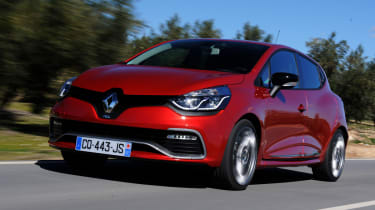


While the outgoing Clio RS was an example of an extreme hot-hatch, this new car is a milder proposition. It’s classier to look at and more generously appointed inside, while the new engine’s thump of torque makes accelerating out of bends easier and the new gearbox allows you to concentrate on enjoying the car’s excellent chassis. It’s a much better all-rounder now, and will appeal to more people more of the time, but die-hard fans of the old model might need to get their fun elsewhere.
We’ve already driven the new Ford Fiesta ST this month, and a new 208 GTi awaits next week, but the current Clio 200 has ruled this segment in recent years. It was always one of the most focused hot hatches you could buy, but this new RS’s has been designed to have a broader appeal, so have the marketing men spoiled the fun?
It’s clear from the outset that Renault doesn’t want the RS to stand out too far from the rest of the Clio range. The makeover is more subtle that before, with a big intake running across the front bumper and a discreet RS badge under the Renault logo, but it doesn’t scream performance quite like its predecessor. There is one massive difference next to the current car, though; the Clio Renaultsport 200 Turbo now sports five doors rather than three.
Even on the £185 optional 18-inch wheels, there isn’t much to shout about in profile either, while a pair of nice rectangular exhaust exits lifts the rear. Previous Clio RS models have had more outlandish looks, but toning down the design is key to broadening the car’s appeal. Although we’d have liked Renault to play up the Clio’s design a bit more for the RS model, the standard Clio is one of the best-looking superminis on the market.
More reviews
Car group tests
- Toyota Yaris vs Renault Clio 2024 twin test: hybrid supermini battle
- Renault Clio vs Skoda Fabia vs Honda Jazz group test review: a battle for supermini supremacy
- Skoda Fabia vs Renault Clio vs Vauxhall Corsa-e: 2022 group test review
In-depth reviews
Long-term tests
Road tests
- New Renault Clio 2023 facelift review: stylish French supermini gets a striking new look
- New Renault Clio TCe 90 2022 review
Used car tests
Inside, current Clio RS owners will be genuinely shocked by how much more upmarket the interior feels. You sit in supportive seats upholstered in soft leather – a far cry from the brilliant yet rather squashed Recaros of the old car – while there’s tasteful matte red trim dotted around the air vents and doors. There’s a touchscreen display for the sat-nav and stereo, while the classy chrome and gloss black materials used across the dash make the current Clio RS’s interior feel closer to a car from sister-brand Dacia.
The driving position in the new car is better than the previous one, as the wheel offers more adjustment, allowing you to position your feet on the pedals comfortably, while not having your arms too stretched.
Press the starter button and the engine springs into life. Gone is the rev-hungry naturally aspirated 2.0-litre engine and in its place is a 1.6-litre turbo that develops exactly the same 197bhp, but torque climbs 25Nm to 240Nm – the same figure as the Fiesta ST. Fuel economy is also up 10.3mpg, to 44.8mpg – a major draw for those with an eye on running costs.
The most significant change of all, though, is that the new RS is only fitted with a six-speed EDC dual-clutch gearbox – there’s no manual option. Thankfully, the gearbox is very slick, shuffling through its ratios smoothly in auto mode, making it no more demanding to drive than a normal Clio in traffic, although it does hold onto its gears longer than usual.
There are three driving modes – Normal, Sport and Race – selectable by the silver RS switch between the front seats. Race deactivates the traction control and gives full manual control of the gearbox to the driver, either with the gear selector or by the aluminium paddles that are mounted on the steering column. Sport is a closer approximation of how the old car feels all the time, giving a nice sharpness of throttle and steering response, and a MINI JCW-style popping from the exhaust on the over-run.
But while the gearbox does make its changes quickly, it’s not all good news. The time it takes between pulling the paddle and the next cog engaging is slightly too long. Add in the fact that the car emits an annoying beep at the limiter, and you’ll find yourself, most of the time, leaving the gearbox to do its own thing. That frees up your hands to perfect your steering and braking - and there’s no doubting it’s more efficient - but it’s much less fun than the slick manual of the old car, and will leave fans of the outgoing model disappointed.
Gearbox aside, the Clio’s ride is excellent, thanks to some two-stage rally-derived dampers,which help smooth out small bumps and ridges better than the old car, while still delivering minimal body roll and lots of stability at speed. The car also features an RS Diff, which uses the front brakes to mimic the effect of a limited-slip differential. It seems to work well, too, as the Clio features lots of grip, although the nose does hunt around a little when accelerating hard on uneven surfaces.
The engine’s extra mid-range torque is a bonus, too, helping to boost you out of bends. An added bonus is the RS Sound Pipe which pipes extra bassy notes into the car, directly from the engine’s intake, as you get above 2,000rpm. The engine is more vocal than the ST’s, but that makes the Clio feel like it’s working harder to shift its weight – which, at 1,204kg, is 36kg less than the outgoing car. Perhaps that’s also down to the gearbox, which unfortunately really does take the edge off the fun.