Toyota Prius Plug-in (2012-2016) review
Advanced new batteries make the Toyota Prius Plug-in the most efficient hybrid model in the range

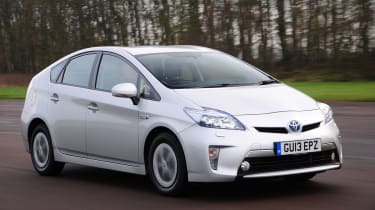


Toyota has responded to the challenge of the latest range-extending electric cars by boosting the battery range of the Prius. To help it take on the Chevrolet Volt and Vauxhall Ampera, the Prius Plug-in is fitted with the latest lithium-ion batteries to increase the EV range from one or two miles to around 15 miles on a single charge.
Toyota's Hybrid Synergy Drive is offered on other models, but it’s still synonymous with the Prius. The Plug-in gets a higher-capacity battery, which can be recharged via a socket in the rear wing. It’s a bit cheaper than a BMW i3, but costs about £8,000 more than the most expensive standard Prius.
To ensure that buyers still get value for money, the Plug-in is based on the top-spec T Spirit model so it comes with luxuries like heated seats, climate control and a touchscreen sat-nav as standard.
Engines, performance and drive
Unlike the BMW i3 and Vauxhall Ampera, the Prius relies on its petrol engine more than its battery pack. This also sends drive direct to the wheels rather than acting as a generator for the batteries.
You can select EV mode for city driving if you’re certain the short range it offers is enough for your journey, although the petrol engine is ever-present and ready to engage.
More reviews
Car group tests
- Hyundai Ioniq vs Toyota Prius
- Hyundai Ioniq Plug-in vs Toyota Prius PHV
- Toyota Prius PHV vs Kia Optima PHEV vs VW Golf GTE
In-depth reviews
Long-term tests
Road tests
- New Toyota Prius 2023 review: the hybrid superstar now coming to the UK
- New Toyota Prius AWD 2019 review
- New Toyota Prius Plug-in hybrid 2017 review
Used car tests
The Prius is comfortable, and easy to drive thanks to its light controls. But those controls are also a bit numb, which means there’s not much fun to be had, and as in other Toyota hybrids, the sharp brake pedal takes some getting used to.
By using a lithium-ion battery pack, Toyota has extended the electric range of the Prius to a maximum of 15.5 miles on a full charge. This means that at low speeds and in town, the electric motor alone powers you around and in EV mode progress is smooth and silent.
There's also a 'hold' mode accessed via a button on the dash that allows you to use hybrid power on the motorway and save the batteries for when you reach the city centre.
Once the 1.8-litre petrol engine starts, the noisy CVT gearbox spoils refinement and you have to work the car hard just to keep pace with traffic. The ride is also quite firm and jittery over rough surfaces, yet the body still leans heavily in corners. The light controls mean that the Prius Plug-in is easy to drive but keen drivers will get more enjoyment.
MPG, CO2 and Running Costs
The Plug-in is a lot more expensive than the standard Prius but it also benefits from the £5,000 government grant for electric cars and should offer very low running costs, too.
Toyota claims it can return average fuel economy of 134.5mpg and CO2 emissions of just 49g/km, so like all Prius models it's free to tax.
Charging the batteries takes just 90 minutes and as long as you can charge it at home and at work, then the Plug-in does offer the possibility of an tailpipe-emissions-free commute.
If you plan on doing lots of motorway miles, than a conventional diesel would still be much more efficient than the heavy Prius, as when it's running in normal hybrid mode at cruising speeds it will only manage around 48-50mpg.
Interior, design and technology
Apart from the extra flap for the electric plug socket, the Prius Plug-in looks exactly the same as the standard car. That means it gets a familiar slippery shape, although small 15-inch alloys are the only option - to keep CO2 emissions low.
The most obvious difference is that is has two filler caps (one for petrol and one for electricity), but ther's also a few subtle badges on the wings and the boot lid, plus some extra chrome trim underneath the grille.
The lack of conventional dials and large windscreen make it feel especially spacious. A wide centre console and stubby gearlever are carried over from the standard model, but the textured plastics feel hard and scratchy to the touch. The digital energy display on the centre console looks particularly cheap, while the touchscreen graphics are blocky. This means that despite its generous equipment levels, the Plug-in feels a bit cheap.
Practicality, comfort and boot space
The new batteries are the same size as before, which means that the Prius Plug-in is just as practical as the standard car. This means a 443-litre boot that includes a dedicated area for stowing the electric charging cable.
Fold down the rear seats and this increases to an impressive 1,120 litres, but the light fabric of the boot lining is easy to mark.
Storage in the cabin is reasonable, although the high centre console creates a shallow storage tray underneath. This is where the heated seat buttons are, but it’s a bit of a fiddle to reach in to use them.
Passengers will find it spacious in the back, too, although headroom is a little tight. The spoiler across the back window affects rear visibility and the small rear wiper fails to clear much water when its raining.
Reliability and Safety
Toyota dropped down four places to finish ninth out of 32 in the 2013 Driver Power customer satisfaction survey manufacturers rankings.
The lithium-ion batteries are something of an unknown quantity, but all the other major components have been tried and tested for years.
Toyota covers the hybrid system with an eight-year/100,000-mile warranty – although this is combined with a conventional five-year warranty, compared to three years for the BMW i3.
The standard Prius has a five-star Euro NCAP rating, and the extra parts of the Plug-in model won’t have a negative effect on that.