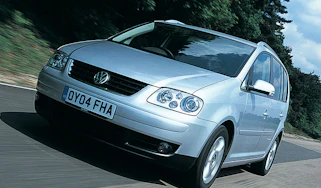
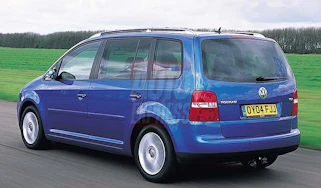
Volkswagen Touran (2015-2025) review
The Volkswagen Touran is a practical MPV, but it looks dated next to newer rivals

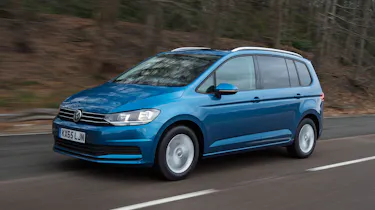

Just so you know, this is an older review of the 2015-2025 Volkswagen Touran. If you are interested in information about a used Volkswagen Touran, or news about the latest Volkswagen models, please follow the links provided.
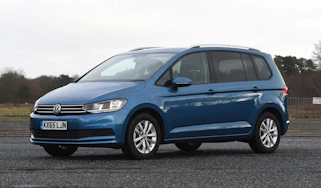
The Volkswagen Touran is never going to be a desirable car, but while it fails to appeal to the heart, customers who buy with their heads will be impressed with the car's sheer functionality. It sits underneath the larger VW Mutlivan in Volkswagen's range, and while it misses out on that car's sliding doors, it matches up pretty well for size and space.
Crucially, for a relatively small car, it's a genuine seven-seater, and the whole interior has been designed to work better than it did on the previous car. That also means increased safety and more gadgets to play with, however the Touran is starting to look rather dated In VW’s line-up. That’s because it shares its features with the Mk7 Golf, rather than the Mk8 that’s currently on sale.
However, base S models were just that – pretty basic in terms of toys – and the slightly better equipped SE is now the most affordable trim. But moving higher up the Touran tree sees plenty of creature comforts loaded in, albeit at a cost that pushes the MPV past the £34,000 barrier.
Used - available now

2022 Volvo
XC40
47,924 milesAutomaticPetrol1.5L
Cash £17,495
2023 PEUGEOT
PARTNER
31,009 milesAutomaticElectric
Cash £11,000
2013 Renault
Clio
80,550 milesManualPetrol0.9L
Cash £3,597
2019 Ford
Fiesta ST
79,996 milesManualPetrol1.5L
Cash £11,500With a typically intelligent selection of Volkswagen’s excellent turbocharged engines, smooth gearboxes and a comfortable ride, the Touran feels like the classy upmarket sort of product you’d expect from the German company, but none are electrified, let alone plug-in hybrid for really low running costs. So while its occasional rear seats mean it won't suit the largest families (the Multivan has that covered), for most buyers it will be more than practical enough for their everyday needs.
It's difficult to believe that the original Volkswagen Touran was on sale for 12 years. The first seven seater MPV was replaced by the Mk2 in 2015, so this version of the Touran is unlikely to match its record – especially as SUVs continue to grow in popularity.
But if you want a car that offers space and aren't bothered about following the herd and going for an SUV, the Touran still has a lot going for it. The seven-seat interior is more spacious than you'll find in any seven-seat SUV, and there will be more storage space, too.
The current Touran uses the MQB platform familiar from the Mk7 Golf and a host of other VW Group models, but it’s one of the last to be updated to the brand’s latest technology, which may put some buyers off. The Touran still drives well for its size, and space has been optimised inside. All cars are front-wheel drive - there's no 4MOTION option in the UK - and while power previously came from 1.0 or 1.5 TSI petrol engines or 1.6 and 2.0 TDI diesels, only the larger petrol is now offered. A six-speed gearbox is fitted to most models as standard, with VW's seven-speed DSG auto offered as an option with the 1.5 TSI.
How much does the Volkswagen Touran cost?
The model range comprises S, SE, SE Family, SEL and R-Line, with prices starting from around £32,500. Standard kit on all cars includes a touchscreen infotainment system with Apple CarPlay and Android Auto available, Bluetooth and DAB radio, individual rear seats and plenty of storage.
SE trim gets tinted windows, auto lights and wipers and adaptive cruise control, among others. Keyless entry and a powered tailgate can be added for £720, while a panoramic sunroof is an additional £1,360.
SEL adds three-zone climate control, ambient lighting, microfibre seat trim, while R-Line features a sportier look with 18-inch wheels and sporty trim inside. However, get this high in the range and you're looking at prices well over £35,000.
Engines, performance and drive
If you’re looking at a nearly new Touran, we’d recommend the 1.6 TDI engine with the manual gearbox, because it offers a great balance of performance versus economy, but it’s no longer available on the current Volkswagen price list. The diesel has just enough get up and go to keep you comfortably shifting the Touran’s rather hefty body about, with only a few occasions where it struggles for power.
This lack of performance is only really noticeable if you try to overtake slower moving traffic, but on the motorway it’s smooth enough. The steering is reasonably precise, gear changes are slick and the suspension is soft enough to make the ride comfortable.
Road and wind noise does become quite loud at high speeds and, compared to BMW’s 2 Series Gran Tourer, it feels a little unrefined.
Around town, the Touran feels wide but Volkswagen has kitted the MPV out with plenty of driver aids to make urban manoeuvring easier. Other safety features such as wide orange blind spot indicators are a nice touch compared to the usually subtle icons found in the Ford C-MAX, for example.
Engines
As this generation of Touran approaches retirement, the only engine is a petrol familiar to the VW Group – the 1.5 TSI Evo, which replaced the older 1.4 TSI. It makes 148bhp, while its cylinder deactivation tech helps to save fuel. This engine comes with either a slick-shifting six-speed manual or VW's smooth seven-speed DSG auto.
Previously, two TDI diesel units and a pair of petrol options made up the engine offerings for the Touran range. The entry point to the range was the 1.0 TSI turbo three-cylinder, which replaced the older 1.2 TSI turbo four. It's an engine seen throughout the VW range, and here it makes 113bhp and came with a six-speed manual gearbox. It's a decent performer with more mid-range grunt than the older 1.2, but it’s much better suited to smaller Volkswagen Group products than this one-and-a-half-tonne MPV.
If you're going to be using the Touran to transport lots of people or luggage, then seeking out a lightly used diesel could be a better choice. Our pick is the 1.6 TDI, which matches the 1.0 TSI by making 113bhp, but has more torque. It came with a six-speed manual as standard, or an optional seven-speed DSG, and was available in S, SE and SE Family trims, with the latter being our pick.
The 2.0 TDI used to come in 150 and 190 guises and the 148bhp version was a great workhorse that's found in a wide variety of other VW Group models. Like the 1.6 TDI, it came with a six-speed manual as standard and a seven-speed DSG was offered as an option.
MPG, CO2 and Running Costs
The 1.5 TSI Evo with its active cylinder shut-down system is pretty fuel-efficient for a petrol engine, recording up to 43.5mpg with the manual gearbox and up to 42.2mpg with the DSG. CO2 emissions hover around the 150g/km mark, so the Touran isn’t especially cheap to run for company-car drivers.
When offered, the 1.0 TSI had claimed WLTP fuel economy of up to 41.5mpg, which isn’t bad for a small capacity, low output petrol engine in a big car. However, if you regularly load the car up with passengers or stuff, don't expect to get near that figure. Emissions are 128g/km.
The (now discontinued) diesels weren't as far ahead as they once were, which was down to the new WLTP test, rather than any poorer performance from the engines themselves. The 1.6 TDI returns up to 51.4mpg and emissions of 120g/km as a manual, and 50.4mpg and 111g/km with the DSG transmission.
Insurance groups
When the 1.6 TDI in SE trim was still on sale, the Touran in this spec sat in group 12. However, the base 1.6 TDI S was in group 13, because it makes do with fewer driver assist and safety systems than the two plusher models.
It was the same story for the 1.0 TSI, which as an SE or SE Family was in group 11, while the S equivalent was in 13. The 1.5 TSI Evo and 2.0 TDI diesels are all in group 17, irrespective of whether you choose SE, SEL or R-Design trim.
Depreciation
While MPVs aren't as desirable as some other types of family car, the Touran holds on to a respectable 53-57 per cent of its value after three years. That's probably down to the fact it's a VW, a badge that still holds appeal with buyers. In comparison, the Citroen Grand C4 SpaceTourer manages 47-49 per cent and the Peugeot Rifter is in the 41-47 per cent range, even though these two are arguably more versatile than the Touran.
To get an accurate valuation on a specific model check out our free car valuation tool...
Interior, design and technology
The Touran won't win any beauty contests. It’s always been about substance over style, but at least it smartened up in its latest incarnation. The Touran is getting close to retirement, however, with a design and technology shared with the Mk7 Golf that was already replaced some time ago. Some may prefer the extra physical controls of the older infotainment setup, but if you plan on keeping the Touran for a while, it will look seriously dated inside by the time you come to sell.
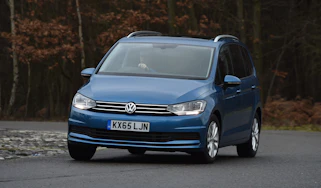
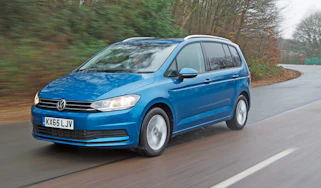
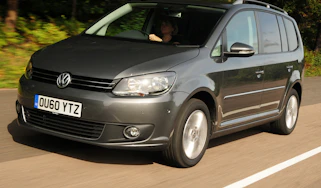
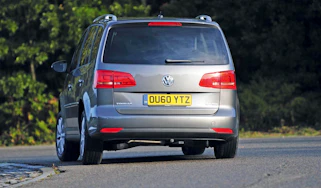
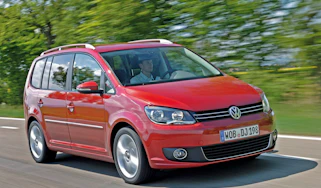
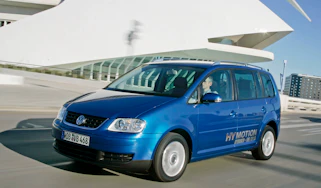
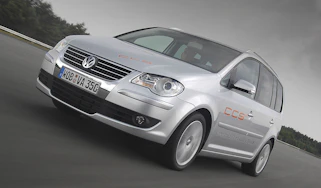
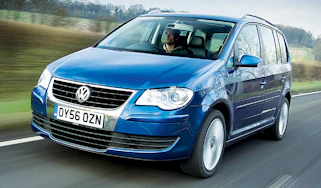
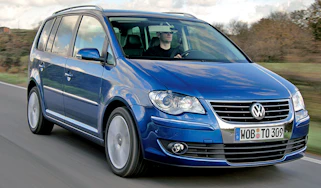
On the outside, the Touran has adopted more angular lines and a sleeker, sharper look than previous models, with features like LED lights helping to inject some style.
The colour palette for the Touran is muted, although we’re not about to advocate bright yellow for an MPV. There are some glitzier colours in the mix, such as Caribbean Blue Metallic, but sadly Nutshell Brown metallic and Titanium Beige metallic - yes, beige - are no longer offered.
Pure White and Urano Grey are the solids, the white costing around £420 and Urano being in effect the ‘standard’, solitary no-cost Touran colour. Another silver and another grey, both metallic finishes, join the pearlescent (Deep Black) to give buyers seven options. The five metallic and pearl finishes add about £600.
Although 16-inch ‘Karlstad’ and 17-inch ‘Alexandria’ alloy wheels are the regular fitment on the SE, SE Family and SEL models accordingly, there’s another optional design of 17-inch wheel, while 18-inch alloys that are standard on R-Line can be fitted for a fee on the SE, SE Family and SEL.
Inside the Touran, everything is extremely accessible and laid out logically. The seats are plush and comfy, and lumbar support has been added to the Touran for the first time, which even has a massage function on some models.
Sat-nav, stereo and infotainment
The Touran doesn’t feature VW’s latest infotainment, but even the basic set-up in the SE, is pretty powerful. It features eight speakers in total and has an 80-watt total output, as well as being capable of connecting Apple CarPlay and Android Auto. That it also throws in Bluetooth, DAB, an SD card reader, a CD player and USB connectivity is all the more impressive. Moving up to SE Family adds Discover Navigation on an 8-inch screen.
Practicality, comfort and boot space
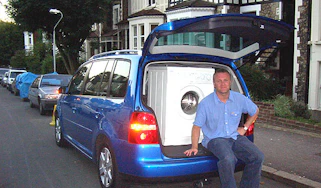
Practicality was clearly high on the agenda when creating the Touran, and no opportunity to add storage space has been neglected. In fact, Volkswagen has managed to cram an impressive 47 cubbies and pockets inside this car.
It’s probably best to be aware that it’s on the SE where a lot of the most useful additions to the Touran’s interior are made, including a large storage compartment in the roof console; a multifunction centre console with storage box; under-seat drawers for the driver and front passenger chairs; folding tables on the back of the front seats; and storage pockets on the rear of the same seats as well. The SE also benefits from a leather-trimmed multifunction steering wheel, allowing the driver to keep their hands on the wheel more often.
Dimensions and size
Despite being larger than its predecessor, the Touran is not gargantuan by MPV terms, with a length just a little in excess of 4.5 metres (4,527mm, to be exact). Parking sensors all round are standard fit from the SE upwards, while Park Assist – which can automatically steer the vehicle into a parallel parking position – is offered as an option on SE, SE Family and SEL cars. A rear-view camera is around £300 on all Tourans.
Leg room, head room and passenger space
Even lofty passengers will find plenty of space to stretch their legs. Every seat in the middle row is large enough for a full sized adult and six footers will have no problem fitting in comfortably.
Fortunately, this also means children will struggle to kick the backs of seats – a boon for parents on longer motorway journeys. People in the third row get the rough end of the stick, but the middle seats slide forward to leave all passengers with adequate legroom. Headroom, elbow room and knee room are all excellent in the front and second rows of seats.
Boot Space
The Touran only comes to the UK as a seven-seater, but the third row of seats fold flat into the floor giving the option of five seats with a large boot. With all of the seven seats in position, bear in mind there’s just 137 litres of space at the back of the vehicle. Volkswagen quotes a more impressive 927 litres with the third row folded away.
The second row of seats will also fold completely flat to give 1,857 litres of load space in total, loaded up to the ceiling. Each seat folds individually and new to the Touran is the folding front passenger seat, which gives further flexibility. Owners can now carry items up to 2.7 metres long.
Reliability and Safety
Volkswagen is known for its ability to build sturdy cars and the Touran is no different. Whether you’re driving or a passenger in this car, it certainly feels like a safe pair of hands. However, Volkswagen’s scores in our Driver Power survey are only middling at best. While the Touran sells in too few numbers to make the Driver Power survey of cars for sale in the UK, its scores contribute to VW's overall rating.
Safety kit on the Touran has been comprehensively updated, an important factor for families in the market for a people carrier. It gets nine airbags as well as a raft of safety systems for the first time. These include Automatic Post-Collision Braking and Pre-Crash proactive occupant protection system as standard, plus adaptive cruise control, emergency braking and traffic alerts, as well as Trailer Assist for the first time on an MPV. Also, all the five rear chairs have Isofix child seat preparation.
All this was instrumental in the new Touran picking up a maximum five-star Euro NCAP rating when it arrived in 2015, with individual safety scores of 88 per cent for adult occupants, 89 per cent for child occupants, 71 per cent for pedestrians and 76 per cent for safety assist.
Warranty
Volkswagen’s warranty is three years and 60,000 miles, but for a fee this can be extended on the Touran to four years and 75,000 miles (around £600, years one and two unlimited mileage, years three and four subject to 75,000-mile cap), or five years and 90,000 miles (a hefty £1,300, again unlimited mileage to begin with and then introducing the 90,000-mile cap from years three to five). Both those sums are more money than the extended warranties for some other Volkswagen models.
Servicing
Fixed-price servicing is offered by Volkswagen on all models, which covers the car for three years and 30,000 miles. This includes an oil change at 12 months or 10,000 miles (whichever is soonest), an interval service including oil change at 24 months/20,000 miles and a full inspection service with oil and brake fluid changes at 36 months/30,000 miles. All the parts and labour are guaranteed for two years and the plan is transferrable to another owner if the car is sold during the period.
Volkswagen Touran Alternatives
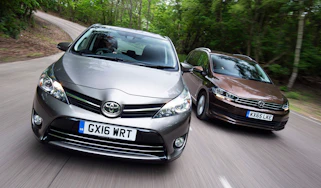
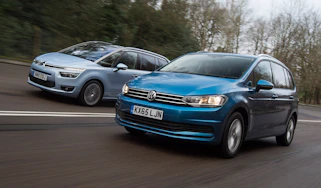
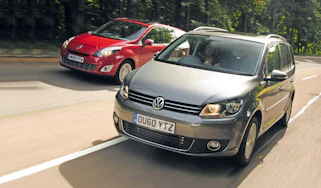
Due to the decline in popularity of MPVs, the Touran has a mix of rivals that it goes up against. Amongst its main opponents are the Citroen Grand C4 SpaceTourer and upmarket BMW 2 Series Gran Tourer.
But that's not all. In terms of maximum space, the latest Citroen Berlingo, Peugeot Rifter and Vauxhall Combo Life van-based MPVs are a big step forward in terms of quality and are offered with seven seats. And then there are the SUVs. Cars like the Skoda Kodiaq, Peugeot 5008, Hyundai Santa Fe and SEAT Tarraco offer flexible seating in a more desirable body. Whichever way you slice it, the VW Touran is going to struggle against this variety of models that are either newer, cheaper to buy and run or more spacious.