Best hybrid cars to buy 2026
With more hybrid cars on the market than ever before, these are the best ones to buy

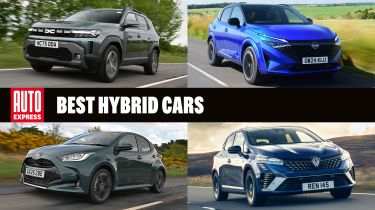
As the world works towards cutting emissions, car fuel economy is top of the agenda. The best hybrid cars on sale in 2026 offer far better fuel efficiency than regular petrol or diesel cars by combining a combustion engine with a battery and one or more electric motors.
These hybrid cars are capable of running exclusively on electric power at low speeds, such as in heavy traffic or around town. The engine will only kick in when it’s necessary as speeds increase. This can result in some big savings when it comes to emissions and fuel economy with no need to charge the car. You’ll sometimes see these full hybrids referred to as ‘self-charging hybrids’.
If you’re looking for even more fuel savings, plug-in hybrid cars can travel further still on electric power, up to 50 miles or more in some cases. The larger batteries in these cars need to be regularly recharged via a plug, however, and when the battery is flat its extra weight can reduce efficiency.
Our expert road testers have driven and tested every hybrid car on sale in the UK. In order to make your search as easy as possible, we’ve rounded up the very best cars right here, based on our in-depth, real-world evaluation.
Compare the top 10 best hybrid cars
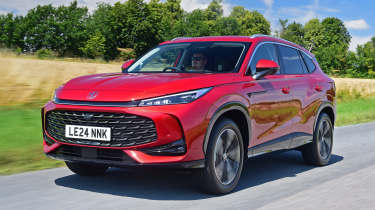
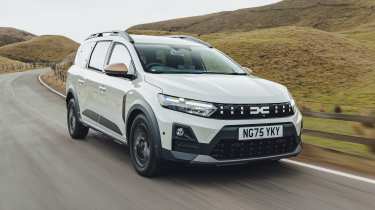
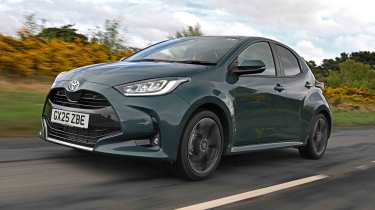
Offering high efficiency and SUV practicality but at a price that’s more befitting of a much smaller car, the MG HS Hybrid+ is the best hybrid car on sale in 2026. The family-focused Dacia Jogger hybrid is in second place, while the compact and cost-effective Toyota Yaris is the best small hybrid car in third.
| Rank | Make and model | Price from |
| 1 | MG HS Hybrid+ | £29,500 |
| 2 | Dacia Jogger Hybrid | £23,500 |
| 3 | Toyota Yaris | £24,000 |
| 4 | Nissan Qashqai e-Power | £30,600 |
| 5 | MG3 Hybrid+ | £19,500 |
| 6 | Dacia Duster Hybrid | £23,400 |
| 7 | Mercedes CLA Hybrid | £38,700 |
| 8 | Toyota C-HR | £31,700 |
| 9 | Renault Clio E-Tech | £21,000 |
| 10 | Hyundai Kona Hybrid | £31,500 |
Keep reading to find the top 10 best hybrid cars you can buy right now. You can also click the links in the table above to jump to a specific model
1. MG HS Hybrid+
- Prices from £29,500
- Affordable Hybrid Car of the Year 2026
Pros |
|
Cons |
|
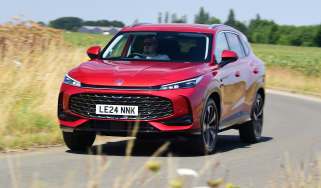
Hybrid SUVs are two a penny in the UK, but they often come at a high cost. As has become a running theme with this reborn brand, the MG HS Hybrid+ undercuts plenty of the competition on price. What’s more, we’ve genuinely struggled to find any major flaws with it. The HS won our plug-in hybrid megatest in May 2026.
At up to 51.3mpg on the WLTP combined cycle, the HS Hybrid+ goes easy on its fuel supply. In fact, it’s even slightly more frugal than the Kia Sportage Hybrid, as that only manages up to 50.4mpg on paper. With 224bhp on tap, the MG can get a reasonable shift on when required, and it then settles down nicely once you hit motorway speeds.
Inside, there’s room for a family of five while the 507-litre boot should provide ample space for their luggage. Admittedly, this is smaller than the Hyundai Tucson’s extremely large 620 litres, but it’s a pretty minor drawback when considering the price difference. The interior quality is impressive, too, as MG has hidden most of its cost-saving measures surprisingly well.
“Everything feels well screwed together, and most surfaces are covered with soft-touch or squishy materials. It’s only lower down on the door cards or centre console that you’ll start to find hard, cheaper-feeling plastics.” - Shane Wilkinson, senior content editor
2. Dacia Jogger Hybrid
- Prices from £23,500
- Best for big families
Pros |
|
Cons |
|
The Dacia Jogger offers incredible value for money. If you want a seven-seater car, it’s much cheaper than almost any other brand-new alternative. You will miss out on some of the luxuries in pricier rivals, but it’s not short on tech under the bonnet.
A 1.6-litre petrol engine works alongside electric motors and a clever multimode gearbox to deliver reasonable performance and return up to 58.9mpg on the WLTP combined cycle. According to Dacia, the Jogger Hybrid can run in pure-electric mode for up to 80 per cent of the time when you’re driving in town.
There’s only one downside here; the base pure-petrol Jogger is thousands of pounds cheaper, so unless you do huge miles (or you really need an automatic car), you’re unlikely to recoup that cost with lower fuel bills. But as hybrids go, it’s still a star.
“There’s more to the Dacia Jogger than just passenger carrying, because it’s a practical estate car that offers versatility and low running costs, and it just so happens to have a third row in the boot.” – Dean Gibson, senior test editor
3. Toyota Yaris
- Prices from £24,000
Pros |
|
Cons |
|
The basic template for the Toyota Yaris’s petrol/electric set-up is largely similar to that in the brand’s first production hybrid, the Prius: an Atkinson Cycle petrol engine (in this case a 1.5-litre unit) and electric motor both drive through what Toyota calls an ‘e-CVT’ gearbox (essentially a power-splitter that mixes and matches petrol and EV power), supplied by a small battery.
But constant honing of that formula has resulted in a superbly smooth, lively and efficient small car. Officially it’ll hit as much as 68,9mpg, and we achieved a highly impressive average of 65mpg during our own real-world testing.
The Yaris is among the more fun cars to drive in its class. While it’s better suited to getting around town, this small supermini can still hold its own on the motorway, making it a sensible all-rounder.
“The latest Toyota Yaris supermini is one of the best cars of its type in our view, helped by its stylish design, good fuel economy and plenty of kit thrown-in as standard.” – Max Adams, online reviews editor
4. Nissan Qashqai
- Prices from £30,600
Pros |
|
Cons |
|
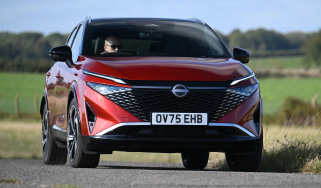
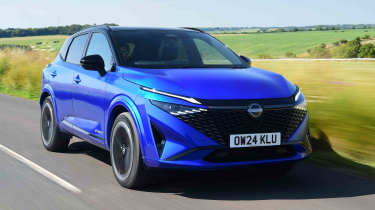
It’s not quite the sales sensation it once was, but the Nissan Qashqai is still a sensible, home-grown SUV that’s worthy of your consideration.
The e-Power hybrid system is different to the tech employed by most other hybrid SUVs. Rather than using both the engine and electric motor to power the wheels, here the engine acts purely as a generator for charging the on-board battery. The result is a very smooth, almost EV-like driving experience, not to mention significant efficiency gains. Officially, it can return up to 62.8mpg
The Qashqai is one of the more practical mid-size SUVs on the market, too, boasting a larger boot than the Ford Kuga. We don’t think adults will have any issues climbing into the back seats and getting comfortable, either, unless they’re unusually tall.
“Nissan’s effort stands out in this highly competitive market sector by offering consistency across the board. It’s fine to drive, efficient, practical, well equipped and tightly priced, so despite it not being a class leader, the lack of weaknesses gives it an edge.” - Steve Walker, head of digital content
5. MG3 Hybrid+
- Prices from £19,500
Pros |
|
Cons |
|
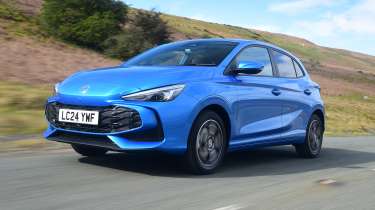
The supermini market is dwindling, but the MG3 is still creating shockwaves, given that it offers a full-hybrid powertrain capable of returning over 60mpg, a huge amount of on-board tech, decent build quality and a genuinely fun driving experience. The best news? All of this starts from less than £20,000.
While we did find the MG’s powertrain to be a little laggy in certain situations, this is forgivable in such an affordable price bracket. It also provides a massive power boost compared to the regular petrol model.
The interior is also smart and hides its budget roots well. The materials feel robust, and getting comfortable behind the wheel is easy for most people, unless you are on the tall side. There is 293 litres of boot space which is on par with rivals like the Toyota Yaris and Vauxhall Corsa.
What sets the hybrid system in MG3 apart from those in its rivals, such as the Renault Clio and Toyota Yaris, is how much more involved the electric motor is. The result is that the MG3 Hybrid+ behaves more like an electric car.” - Shane WIlkinson, senior content editor
6. Dacia Duster Hybrid
- Prices from £23,400
Pros |
|
Cons |
|
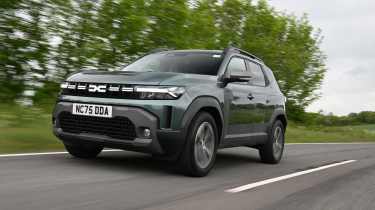
The latest Dacia Duster is more desirable than ever, but it still retains its appealingly low starting price of under £25,000.
The Duster comes with a respectable amount of kit, despite being budget-friendly, especially if you opt for the Expression trim. This variant comes with a 10.1-inch touchscreen with wireless Apple CarPlay and Android Auto. Thanks to its cleverly designed interior, this tough, budget-friendly SUV is also more than capable of taking on family car duties. You won’t need to be too precious about interior trim damage, and there’s plenty of room for everybody on board.
The hybrid-powered Duster is fitted with a 1.6-litre powertrain that’s sourced from parent company Renault, and this is shared with the Dacia Jogger Hybrid. It’s a tried-and-tested set-up, and it shouldn’t be difficult to achieve an average fuel economy figure of over 50mpg.
“It’s a shame that a Spartan Essential model is no longer offered for the budget-minded buyer, but the rest of the range taps into Dacia’s ambitions to be an outdoor adventure brand, and fits that brief well.” - Dean Gibson, senior test editor
7. Mercedes CLA Hybrid
- Prices from £38,700
- Mid-size Company Car of the Year 2026
Pros |
|
Cons |
|
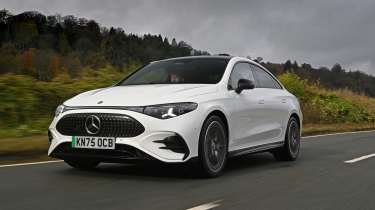
If you’re someone who enjoys having tonnes of technology within their car, the Mercedes CLA is certainly one for you.
Hiding behind the huge array of LED lights on the grille, you’ll find a hybrid powertrain that claims over 50mpg in every variant. What’s very unusual, though, is that we surpassed Mercedes’ claims during our own testing by achieving more than 70mpg. This is a rare occurrence and a massively admirable one.
Admittedly, the CLA is a bit lacking in the fun factor when compared to the BMW 3 Series, but it is very calm and comfortable instead.
It’s inside where the techfest is most obvious, as this car can be fitted with the MBUX Superscreen infotainment system. Not only is this setup massive, but it’s also super-fast in its operation.
“Mercedes has taken the decision – rightly, we feel – to focus not on the sharpest dynamics or Tesla-like immediacy, but on a more measured and consistent feel right across the board.” - Steve Walker, head of digital content
8. Toyota C-HR
- Prices from £31,700
Pros |
|
Cons |
|
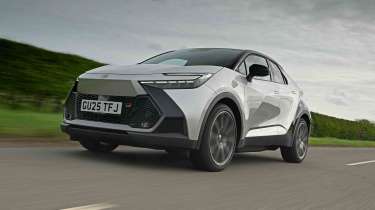
Toyota has been in the hybrid car game for decades, and the Toyota C-HR is one of its more distinctive entries into the market.
The C-HR is essentially Toyota’s answer to the popular Nissan Juke. It’s a uniquely-styled small SUV that places a lot of focus on efficiency, and the result is up to 60.1mpg. When the Toyota C-HR spent six months on our long-term fleet, we saw a consistent real-world average of over 54mpg after a wide range of driving scenarios.
Quality-wise, it’s business as usual for Toyota as the C-HR feels good and sturdy to the touch. Toyota has also taken steps to improve its on-board tech in recent years, so it now feels much more on par with the competition. Interior space has also been improved compared to the older model, but fitting a child seat is a tad tricky due to the shape of the roof.
“This version of the C-HR benefits from a refined and enhanced powertrain that seems much more comfortable with life. The engine still drones if you ask for maximum acceleration, but it gets up to speed quicker.” - Dean Gibson, senior test editor
9. Renault Clio E-Tech
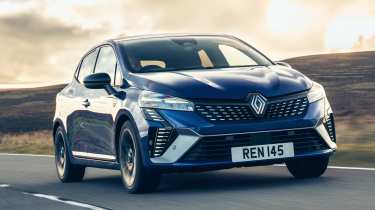
- Prices from £21,000
Pros |
|
Cons |
|
On the outside, the Renault Clio is very much an evolution of its predecessor, especially following its latest facelift. Big changes under the skin have brought it right to the sharp end of the supermini market. The Renault Clio E-Tech features a full-hybrid powertrain that combines a 1.6-litre petrol engine with an electric motor to generate 143bhp.
The E-Tech achieves over 60mpg and sprints from 0-62mph in under 10 seconds, plus the rest of the package is a marked improvement over the old car. The Clio is relatively engaging along twisting roads, and the well judged suspension offers a decent blend of precision and comfort. Cabin quality is particularly strong and the five door-only bodystyle provides enough rear legroom for adults, and a 301-litre boot in hybrid form.
“The full-hybrid Clio E-Tech offers impressive fuel economy and zippy EV-like performance around town.” – Ellis Hyde, news reporter
10. Hyundai Kona Hybrid
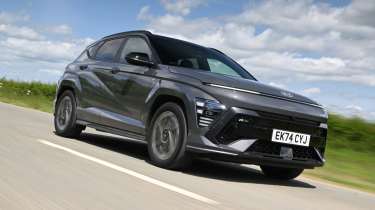
- Prices from £31,500
Pros |
|
Cons |
|
The latest Hyundai Kona Hybrid is getting on in years, but it still offers an impressive level of practicality for its size. Its low running costs and distinctive appearance also help to make it an appealing hybrid car.
It certainly won’t set pulses racing with its 127bhp power output or 12-second 0-62mph time, but the Kona Hybrid more than makes up for its lack of driving excitement with some impressive efficiency figures. When we tested the Kona Hybrid against the Honda HR-V, we achieved an average of 58.4mpg.
“After the initial pep of the electric motor, the petrol engine seems to provide more noise than it does propulsion, but there’s still enough oomph available for overtaking at motorway speeds.” – Ellis Hyde, news reporter.
How we test hybrid cars
Our expert road testers have tested every hybrid car on the market in the UK over hundreds of miles, and because the focus of these cars is very much on cutting costs we pay particular attention to the real-world fuel economy we can achieve.
You’ll find the results of our efficiency testing in our in-depth reviews and you can rest assured that the best hybrids we select do a better job of matching their official fuel efficiency figures in the real world than some of the alternatives.
We also look for a smooth and natural-feeling hybrid system that intelligently shifts between power sources without much impact on the driver. A good hybrid should offer excellent refinement and low noise levels but also strong electrically-assisted performance. Otherwise, it’s largely the factors we look for in any car; build quality, space, practical design and user-friendly technology.
How to choose the best hybrid car for you
Hybrid cars come in a wide range of different shapes and sizes, although the full hybrid technology that we’re concentrating on here does tend to be more common in small to mid-size models.
Plug-in hybrid systems, that can travel much further on purely electric power, are more regularly found in larger, more expensive cars these days but there are exceptions. Here are the key issues to consider when considering a hybrid car.
1. Running costs
The big appeal of a hybrid car tends to be cutting costs. Buyers will look to hybrids for the improved fuel economy that electrical engine can deliver.
Because most hybrid powertrains are offered as part of a range of engine options, that also includes non-hybrid petrol and diesel engines, it’s important to consider if the fuel economy savings of a hybrid car will outweigh the extra cost of buying it in the first place.
Hybrid tech will cost more so you need to do enough mileage over the course of your ownership period to make that extra outlay worthwhile compared to a cheaper non-hybrid option.
2. Driving experience
Hybrids can run purely on electric power at low speeds and some can drive for a few miles without engaging the petrol engine at all. This helps cut noise levels in the cabin and around town for a more relaxed driving experience. It’s also good for local air pollution.
When test driving a hybrid, you’ll want to look for a car that drives smoothly at low speeds, especially in that transition from electric to petrol power, and back again.
Some models will rev the engine unnecessarily or be slow to respond to your inputs on the throttle in certain situations, but the best hybrid systems feel easy and natural to drive with the difference between the two power sources virtually unnoticeable.
3. Practicality
There is very little difference between a hybrid car and a purely petrol or diesel car when it comes to practicality. Whereas plug-in hybrid models often sacrifice a little boot space to accommodate the larger battery, full hybrids have smaller battery units and any compromises are minimal.
As always, look for a car with the space to perform the tasks you need it to. Sit in all the seats and check out the legroom in the seat behind your own driving position. If you need to fit a child seat in the back, put golf clubs or pushchairs in the boot, make sure you take these items with you when you go to look at or test drive the car.
Hybrid or electric?
With costs being such a big driver for customers who choose a hybrid car, the thought of buying a full EV has probably also crossed their minds. We often think of plug-in hybrid technology as a stepping stone to a pure electric car but with full hybrids, which don’t need charging at all, the ownership experience is very much like that of a normal petrol or diesel car.
If you’re worried about the logistics of charging an EV, a hybrid has none of those concerns attached, but it will give you a little flavour of electric running around town.
Most buyers with the facility to have a charging point installed at home could save even more on running costs by choosing an electric car over a hybrid but those forced to rely on more expensive public charging may find that the costs and practicalities of an EV don’t add up. You can find out more about the differences between hybrid and electric cars with our guide.
Looking to buy a new hybrid? Search our dealer network and you'll find 1,000s of great value new cars in stock and available now right across the UK. Find your new car...