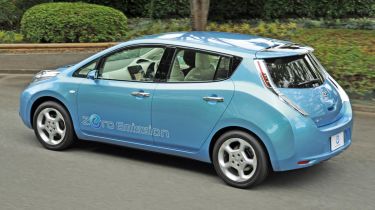
The charge down electric avenue starts here… So says Nissan, which is poised to deliver the first examples of its all-new battery-powered Leaf to customers from next March.
The car’s arrival promises to be big news for British drivers. Not only will the plug-in electric model be built in the UK – at Nissan’s Sunderland factory – it should be affordable, too.
First versions are currently being assembled in Japan, and the Leaf is expected to cost a Toyota Prius-rivalling £22,000 (after the Government’s promised £5,000 grant has been applied). It will offer seating for five people, as well as a 100-mile range.
The production-ready model made its European debut at this year’s Geneva Motor Show, but won’t be available to drive for some months yet. So Nissan has brought this early prototype to the UK, to provide a taste of the newcomer’s performance and driving dynamics – even if the styling will have changed by the time it reaches dealers.
Auto Express has already driven a version in Japan, based on the home market Tiida (Issue 1,087), but this model, badged EV-12, is a little further down the road to production. Even though eight laptop-sized battery modules have been added under the rear seats, space inside the cabin is generous. In fact, when you jump behind the wheel there are few clues that this car offers anything out of the ordinary.
Turn the ignition key, though, and you are greeted with silence. There’s no mechanical hum from the electric motor – only a light on the dash to tell you the engine is ready for action. You can select the single forward gear with a switch in the centre console, then it’s simply a case of releasing the brakes and pressing the throttle. Acceleration is progressive and the ride smooth.
After our limited time behind the wheel of the Leaf, we came away with the impression that it felt, well, car like. Its electric motor delivers power in almost exactly the same way as a petrol-engined vehicle, with a noticeable increase in torque as your speed rises. Although this is an early prototype, it points to a bright future for the pioneering Nissan.
Rival: Mitsubishi i-MiEV
Electric city car is already on sale, but it’s pricey at £33,699, even with a grant. Unlike the Leaf, the Mitsubishi is a conversion of a regular petrol model – the i – rather than a dedicated battery-powered
vehicle. And that means inevitable compromises in performance, engineering and technology.

For more breaking car news and reviews, subscribe to Auto Express magazine. We'll give you 6 issues for £1 and a free gift!
I'm not convinced by electric cars; they do move the pollution to a power station well away from the city, where it can be dealt with on an industrial scale, but if the batteries only last 3 years like on your laptop, that''s more nasty chemicals to deal with, and more expense. The limited range is also a bit nerve-racking, even if the average journey is only 20 miles.
I've propounded this theory before, but there will be millions of internal combustion engines about for decades to come, so converting them to run on hydrogen would get rid of lots of CO2 emissions without scrapping the whole car, the big problem being the freezing cold, uncompromising cylinder needed to carry the fuel.
Nissan are saying the Leaf has a range of 100 miles.
I wonder what the range would be on a typical British winter evening with headlights on, air conditioning and electric heater on full blast, rear heated window on and all the other modern necessities that will use up a lot of the electricity from the battery.
Test it in these conditions and I bet the range will be a lot less than 100 miles.
Electric cars are 80+ efficient, so the old argument that they are as damaging to the environment as normal cars is untrue. Even taking the manufacturing into the equation, yeah it consumes energy to make batteries, so too does making anything to do with engines and probably a lot more so. +electric cars once they are made emit no Co2 or other MUCH more harmful pollutants. Charging them from Renewable sources or a mixture greatly reduces emissions.
People with wind turbines can charge the leaf for free. Imagine that. Okay it will go for 100 miles or so but quite a lot of people don't drive much more than that if even anyway. And it is most suited for people who do city and urban driving as that kind of driving uses up much more fuel than any electric car making electrics again win over ICE's
I really can't see that the range of the leaf will be a lot lower than the stated 100 miles because this would not do Nissan much good at all. I remember from Nissan's own site I think it was, stated that the range was including any heating or cooling switched on or off, I guess time will tell!
The only thing people care about is if the car will be cheaper to run, and the over all running costs will be much lower with Electrics because of the fact they need very little maintenance, and the cost of electricity is much cheaper than petrol or diesel. Okay the price may be up there with a good spec new golf, but for people wanting to save money in the long run it makes sense!
There is a new lithium battery around the corner using nano technology and is estimated to give 8-10 times the capacity and will enable much faster charging, so range problems will be a thing of the past in the not so distant future.
First of all, it's important to understand the VAST amount of power needed to move a car, compared to the power required to work ancillaries like lights and wipers. The lights are going to be something like 200Watts, so I don't think these things will substantially affect the range. Maybe aircon on a very hot day might knock (at a guess) 10% off the range.
What they don't tell you is the capacity of the battery. If it takes 8 hours to charge from an ordinary 13 Amp house socket, then VERY roughly we're probably looking at something in the region of 20kWh (or a two-and-a-bit kilowatt electric fire running for 8 hours). If you can get that out of a domestic windmill in a howling gale, I'd be impressed!!!
DEFRA have a figure of 500grammes of CO2 per kwH at the mains socket in your house, fed from the National Grid. If it does 100 miles on a full charge and the battery is empty, that means soemthign like 65grammes per kilometre of CO2. That's pretty darned good for a 4-door saloon that will do a 10 second 0-60!
But the best thing is the cost. If you have cheap off-peak electricity at (say) 6p per kWh, that means it will cost about £1.20 for the 20 kWh needed to charge the car. Now if anyone can get ANY kind of internal combustion engined car to do 100 miles for £1.20, I'd be impressed!
On the other hand, the batteries are cripplingly expensive and (like a laptop or a mobile phone) loose a bit of their capacity every year - say 3%? So after 5 years it might only have a range of (say) 80 miles. That probably means the car will be of very little use by the time it gets to 10 years old a new battery is likely to cost a lot more tha nthe car is worth!
At last a really realistic Electric Car at a realistic Price! And this is just the start. Well done Nissan and Carlos Ghosn - much more forward thinking than many others from Stuttgart and Munich!
Of course it is not perfect but its certainly on the right track and will be providing this at an attainable price for normal drivers.
On that range I can just about get to work & back but I'm stuffed if I need to pop into the supermarket on the way. I won't even consider an electric car until they have the same range as a petrol one and don't take all day to charge up. Good old molebag has given you the figures, but you should also remember that you have to create electricity & batteries in the first place from oil and all sorts of other non-environmentally friendly stuff. Do a teeny bit of research into battery prodiuction then come back and tell me how "green" your car really is.
I actually went to the Nissan website to buy one of these.
When I read the detail I became increasingly worried, so I made a lot of contacts and checks on what could really be expected of this very expensive car. I should add that the local dealer was close to useless.
It isn't good reading!
For £31000, the all-plastic finish inside is decidedly poor. Compare it with a Mercedes or BMW at this price and you will see what I mean.
(I personally resent my Tax money being spent on projects like this when libraries are closing and the Police forces being cut back.)
As for Range, don't expect much! As one contributor has rightly said, lights, heating, brisk driving, passengers and hills will crucify the range. As little as 40/50 miles is quite likely and that is when the batteries are new......they age from day one and cost a whopping £8000 to repace.
Forecasts from the major trade depreciation experts put the Leaf as being virtually valueless after five years. A cool £5000+ depreciation per year.
A very very expensive car to run!!
As for being Green! No way, absolutely no way.
Yes, it moves its pollution down the road to a Power station but how does that help with CO2 and
Global Warming?
For the sad record, the Leaf needs 23KwHrs of electricity to charge up. That is some 15000g of CO2 released at the Power Station.( Based on DEFRA's figures).
It might do 50/70 miles on a charge or in other words 200g/mile to 300g/mile of CO2 pollution. That is truly appalling!
The botom line is that this car is a 'con'. It is not zero emmissions, just as no other electric car is.
I didn't buy one and will stay with more conventional vehicles until there is new battery technology and we have nuclear power stations in place.
The Telegraph has just classed a 5 door VW Golf as being an equivalent car to a Leaf but based on conventional fuels.
Price.....to you, £13800.
Now NOTE this: Take that £13190 you will have saved by buying the Golf and invest it in a simple compound interest savings account for the five years you would keep either car.
You will then have £16,834 plus a Golf worth around £2500.
In other words over £18,000. The Leaf is forecast to be worth virtually nothing and will be looking for a new set of batteries at £8000.
Oh, and keep in mind, that if you have cheap rate Economy 7 electricity to use for charging during the dead of night, you will also have to pay very high rates for ALL your other electricity and God help you if you have to charge the Leaf during daytime or evening!
This whole venture is a no-brainer!
provide some facts not made up data..
You sure seem to talk alot and seem to have an agenda to push !!
Our drive is over almost as soon as it has begun – and it raises nearly as many questions as it answers. Will the production Leaf really be capable of travelling 100 miles from a single charge? Who will buy it? We won’t have to wait long to find out. Sales start in March, and Nissan says it has buyers for nearly all the cars in the first year of production. From what we have seen of the new model’s performance and driving experience, those customers shouldn’t be disappointed.