Peugeot Quark
Ever fancied a quad bike, but don't spend much time in the countryside? Well, Peugeot has come up with the urban dweller's answer to the farmer's favourite mode of transport - the cool Quark concept. And the technology behind this clean city machine is closer to showrooms than you think.
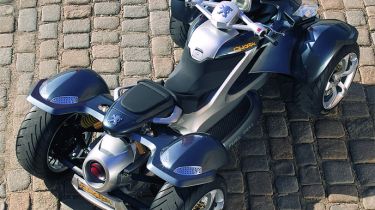
The Quark is one of the most promising urban concepts we've seen. It's cool, stable, practical, fun to drive and incredibly stylish. Fuel cells are a long way off, but we'd like to see the Peugeot happen sooner - maybe with a more conventional propulsion system.
Ever fancied a quad bike, but don't spend much time in the countryside? Well, Peugeot has come up with the urban dweller's answer to the farmer's favourite mode of transport - the cool Quark concept. And the technology behind this clean city machine is closer to showrooms than you think.
Made of aluminium and with bespoke 17-inch alloys, the Quark is driven by four wheel motors, fed with electricity from a hydrogen fuel cell and booster battery. Maximum power of 37bhp is backed by 400Nm of torque - enough to propel the Quark from 0-30mph in 6.5 seconds and on to 68mph. Its range is around 80 miles, and when the 9.0-litre hydrogen tank runs out, swapping it for a freshly charged one is easy.
Despite the futuristic design, start-up is simple. A handheld computer takes the place of a key, and this plugs into the centre of the handlebars. It contains basic instruments such as the speedo, plus the navigation system, Bluetooth wireless phone, MP3 player and personal organiser. An on-off switch on the bars sets the ball rolling, the throttle is worked by a motorcycle-style twist grip and the brakes are on a lever.
The Quark accelerates easily, with a quiet whine for a soundtrack. Steering two wheels with handlebars takes some getting used to, and the wide tyres feel heavy at low speeds, despite the total weight of only 450kg. Our Peugeot was running on battery power only and, with low reserves, performance was modest.
But it rides smoothly, the hydraulic disc brakes are powerful and the Quark feels stable on its double wishbone suspension. There's no vibration, no smelly exhaust fumes and, when you stop, so do the electric motors - everything falls silent. This vehicle is fun to drive, looks cool and would be handy in town - especially given its ability to carry 140kg of luggage. There are no plans for production yet, but if the fuel cell was swapped for a more conventional engine, why not? Come on Peugeot, give us a treat.