Kia cee’d 1.6 CRDi LS
It’s the best car the brand has ever made – but can it steal a march on more established rivals?

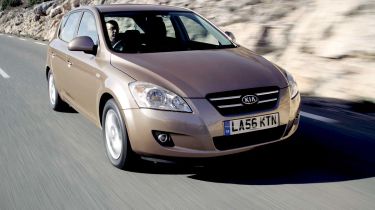
Is Kia’s quest for mainstream acceptance now complete? From the Picanto city car to the Carens compact MPV, the firm is now creating models that suit the needs of British buyers. The cee’d is the next big step along the path to sales success.
Kia obviously believes in investing in talent, too – although designer Peter Schreyer (the man responsible for the Audi TT) was obviously recruited too late to give the cee’d any real pizzazz. The styling is modern, with tight panel gaps, attractive light clusters and clean surfaces, although it’s also rather safe. While it’s not bland, the car doesn’t stand out, either, and its proportions are similar to the Mazda 3’s. Is this a coincidence? We don’t think so.
Yet the cee’d is better packaged than its Japanese rival. Although it’s the shortest car here, the Kia has the longest wheelbase, and is taller and wider than either opponent.
Open the tailgate, and you’re greeted by a 340-litre load area with minimal intrusion from the suspension. The seats also fold flat to create a maximum 1,300-litre space. These figures aren’t class-leading, but the cee’d is roughly as practical as a Ford Focus or Volkswagen Golf.
Used - available now

2020 Ford
Ka+ Active
49,446 milesManualPetrol1.2L
Cash £7,849
2021 Ford
Fiesta
45,061 milesManualPetrol1.0L
Cash £9,000
2019 Ford
Kuga
66,948 milesManualDiesel2.0L
Cash £10,010
2020 Ford
Fiesta
46,575 milesManualPetrol1.0L
Cash £9,823Back seat passengers are certainly well catered for, though. The doors open wide to make getting in and out easy, and both rivals fall 40mm short of the Kia’a 760mm legroom measurement. What’s more, the bench is comfortable, and the cee’d is the only car of our test trio to come with electric rear windows.
The driving environment is even more successful. For starters, Kia has got the seating position inch perfect. Tall drivers can get low enough, while a wide range of steering column adjustment means shorter occupants won’t be ill at ease, either.
In fact, the only real criticism we have is that the column stalks on our test car were the ‘wrong’ way round – indicators on the right, wipers on the left. Kia assures us that this is being corrected for right-hand-drive production models.
The cabin design is simple and intuitive. A large glass area ensures that the interior is light and airy – especially in the rear – ergonomics are first-rate and stowage is well thought out, too. What’s more, build quality is the best of these three contenders. We particularly like the dashboard plastics, although it’s a shame the instrument binnacle and door control panel have such a cheap-looking, shiny finish.
When it comes to the cee’d’s engineering, Kia hasn’t cut any corners. The 1.6-litre common-rail diesel is excellent – it is smoother and quieter than Citroen’s acclaimed HDi unit and it delivers faster acceleration than the Mazda.
That’s all the more impressive when you consider the cee’d is the heaviest and least aerodynamic car here. For those who don’t need this model’s ability to cover 0-60mph in 10.9 seconds, there’s also a low-power 90bhp GS version which costs £1,250 less.
But we think the 115bhp unit is the one to go for. With a 15Nm torque advantage over its rivals and long gearing – 70mph equates to 2,400rpm in fifth – the 255Nm unit proved extremely flexible. It picks up well from low revs and dismissed the 50-70mph top gear increment in only 10.4 seconds.
Unfortunately, the brakes are a weakness, and the cee’d’s 38.3-metre stopping distance from 60mph was the longest here. Overall, though, the Kia comes across as relaxed and easy-going – more so than the Citroen, which is some achievement – and the ride is actually very competent. It doesn’t waft you along like the C4, but it’s better at taking the sting out of rough roads – largely due to the stiffer bodyshell. This also helps refinement, and in our tests the cee’d was quieter than both rivals on the move, dealing with wind and tyre noise just as effectively as engine intrusion.
The Kia’s ability to cruise comfortably is matched by its handling. The steering isn’t the last word in feedback, but body control is good, and the car is reassuring through corners. Decent visibility and a tight 10.3-metre turning circle mean it’s not intimidating when tackling city streets, either.
The price is also unlikely to frighten anyone off. At £14,245, it’s not exactly cheap, but then Kia is anxious not to be perceived as a budget brand any more.
The solid build quality certainly aids that impression, as does the kit tally. Stability control really should be standard, but climate control, a multifunction steering wheel and the MP3 player input are all desirable features that should help Kia easily reach its target of 10,000 UK cee’d sales this year.
Details
Price: £14,245
Model tested: Kia cee’d 1.6 CRDi LS
Chart position: 1
WHY: The cee’d aims to upset the establishment, promising top-notch quality and refinement.
Economy
It may have the same 60.1mpg claimed combined figure as the C4, but in reality our cee’d didn’t prove quite as frugal. It returned 41.6mpg on our test route, while a 53-litre tank gives the Kia a range of 485 miles.
Residuals
The experts at HSBC have yet to calculate residual values, but Kia’s improving image and drive upmarket should mean the cee’d does reasonably well. We anticipate a retained figure of around 40 per cent after three years.
Servicing
As Auto Express went to press, Kia dealers hadn’t been able to calculate servicing costs. However, the cee’d’s pricing is likely to be competitive; the first three checks on the Cerato 1.5 diesel – which this cee’d replaces – came to around £510.
Tax
Business users are expected to account for 35 per cent of cee’d sales, and they will be glad to learn that the Kia emits only 125g/km of CO2. Consequently, it sits in the bottom tax bracket and is the cheapest of these three.