Skoda Fabia 2 1.4 TDI
The dependable Czech supermini is back with more space and a bold look

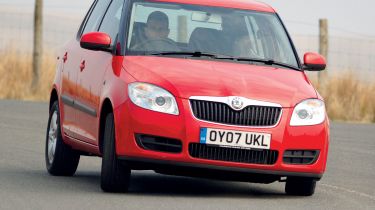
Take a look at the new Fabia, and it’s clear Skoda has taken inspiration from several directions. The headlights and grille echo the firm’s Roomster supermini-MPV, while the black windscreen pillars and sloping roof edges are reminiscent of the Suzuki Swift.
Yet the shape of the C-pillars and tailgate looks similar to the outgoing car, leaving you in no doubt that this is a Fabia. The chassis confirms this – the newcomer uses a reworked version of the old model’s platform.
Video: watch CarBuyer's video review of the Skoda Fabia
[[{"type":"media","view_mode":"content_narrow","fid":"69228","attributes":{"alt":"","class":"media-image"}}]]
This hasn’t hurt interior space, though, because the Fabia has the best rear legroom and a 300-litre boot. Both the front seats are height adjustable, while reach and rake wheel movement is standard. As a result, the driving position is excellent.
As with the old car, the dash layout is simple and the trim feels robust. However, the interior design hasn’t moved forward, and the cabin is more basic than either rival’s. Starting the engine doesn’t help matters, because the gruff 1.4-litre TDI unit is noisy at idle. The three-cylinder motor vibrates, too, and the distinctive buzz spoils refinement on the move. What’s more, below 2,500rpm, throttle response is sluggish. However, from 3,000rpm onwards it revs quickly, and with 80bhp and 195Nm, it has a power advantage over the Corsa.
As a result, a 0-60mph time of 13.1 seconds is well ahead of the Vauxhall’s, and, more importantly, the Skoda has better responses in third and fourth. However, a lack of low-down torque and a long fifth gear mean the Fabia is slow from 50-70mph, taking 12 seconds to reach the motorway limit – 2.7 seconds longer than the Vauxhall. That makes the Skoda frustrating on dual carriageways, with frequent downchanges needed for overtaking. But once up to speed, it’s a comfortable cruiser.
The suspension helps refinement, as the soft set-up copes well with rough surfaces. However, compared to the Clio and Corsa, there’s more body roll in corners, and despite having sharp steering, the Fabia isn’t as agile as its rivals. There’s also more dive under braking, and the Skoda had the longest stopping distances of this trio. At least it’s easy to drive and feels mechanically robust. The Fabia 2 is the cheapest car here, but while alloys and air-con are included, stability control is a £340 option, and only the Fabia 3 gets the curtain airbags which are standard on the Corsa and Clio. The Skoda also has a small options list, and for luxuries such as parking sensors and climate control, you need to upgrade to the Fabia 3.
Well built, simple and roomy, the Fabia retains many of its predecessor’s qualities, but is it good enough to beat its rivals here?
Details
Price: £11,175
Model tested: Skoda Fabia 2 1.4 TDI
Chart position: 3
WHY: The five-door Fabia hopes to uphold its predecessor’s reputation for value, space and quality.
Economy
A disappointing figure of 37.6mpg was all we could squeeze out of our test car, making it the least economical here. Constant working of the little three-cylinder engine doesn’t help, and a 372-mile range between fills was frustrating.
Residuals
While too new to have solid figures yet, residual values are expected to be on par with the old Fabia: expect around 44 per cent, well ahead of the Clio. This good result also helps to keep running costs down to only 28.8ppm.
Servicing
Servicing prices aren’t yet available for the new-look Fabia, but the old one wasn’t the cheapest supermini to maintain – as is often the case with Skodas – and this latest version’s 10,000-mile service intervals are modest, too.
Tax
Opting for a small diesel-driven model as your company car is a good way of keeping your tax bills down. Thanks to its low price, the Fabia is the cheapest option of the three here, costing standard-band owners £442 a year.