BMW M3
Newcomer builds on Coupé’s good looks, and gets V8 for first time

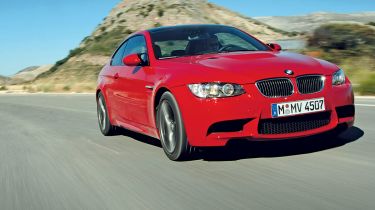
There’s an old design adage that form follows function, and this is certainly the case with the M3. While few would argue that the 3-Series flagship looks great and is beautifully detailed, much of the car’s appearance is driven by technology.
For example, the wonderfully blended, rounded and widened wheelarches disguise bespoke suspension, the carbon fibre roof reduces the coupé’s weight and the prominent bulge in the bonnet hides a 4.0-litre V8 engine.
So the M3 is clearly a very special car. But you wouldn’t know it from the interior. Aside from a smattering of M branding, it’s virtually the same as that of a standard 3-Series Coupé.
This isn’t necessarily a bad thing, as it means a driving position which is difficult to fault and a spacious rear cabin. But when you consider how much the M3 costs, some customers will be disappointed that there’s no real step up in luxury or sportiness from a conventional 3.
BMW will argue that’s because its M division tuning arm has focused instead on filling the car with cutting-edge driver aids – such as the EDC variable damping. But if this is the case, why does the M3 have the same spindly gearlever as the 1995 E36 version? It suffers from the notchy shift action and long throw that blighted the previous-generation car – a real disappointment when you consider so much effort has been made under the bonnet.
The engine is the first-ever V8 in a full production M3. Peak torque arrives from 3,900rpm, which results in a wonderful gutsy surge of power throughout the rev range. The motor delivers 414bhp – that’s exactly the same as the RS4, and shows how far BMW has gone to match the benchmark set by the Audi.
At the test track, acceleration is seriously impressive, and it’s accompanied by a glorious eight-cylinder soundtrack. However, once you push it beyond 6,000rpm, the BMW takes on a more mechanical and manic character, and there is a final burst of performance to the 8,400rpm red line. The M3’s extreme feel becomes even more apparent when you press the Power button, which sharpens throttle response.
Similarly, the stability control system can be adjusted by the driver; there’s a choice of three settings. However, thanks to the M Differential – a hi-tech limited slip diff – on dry roads, the M3 delivers sufficient mechanical traction to render electronic intervention unnecessary.
The M Differential combines with the bespoke suspension to provide the car with a sensational level of cornering grip. But our main criticism concerns the steering. While it’s sharp and very precise – and drivers can select a Sport mode to enhance this – it feels a little remote.
We have a similar complaint with the active dampers, which are optional on the BMW. When set at their stiffest in Sport mode, body roll and dive is all but eliminated, and the M3 corners incisively as a result. Yet some drivers will miss the reassurance that this movement provides.
The RS4’s more supple suspension is one of the most noticeable differences between the two; even in comfort mode, the M3 doesn’t ride as well as the Audi. But the BMW is the sharper driver’s car, has impressive brakes and is more accomplished if you are considering track use. The question is whether that makes it the better all-round performance machine.
Details
Price: £50,625
Model tested: BMW M3
Chart position: 2
WHY: The new M3 is the fourth generation of a car that invented the performance compact sector.
Economy
With a claimed combined figure of 22.8mpg, the M3 is the more economical car on paper. BMW’s Efficient Dynamics technology (see Back seat driver, below) should help you top 20mpg.
Residuals
Resale figures have yet to be forecast, but the outgoing model retained more than 50 per cent of its value. With demand set to outstrip supply, new M3 residuals will be very strong.
Servicing
BMW has yet to extend its fixed-price servicing to the M range, but as a guide, the last-generation car cost £1,185 for the first three visits. As with the RS4, intervals are variable.
Tax
Even though the M3 is slightly cleaner, it sits in the same 35 per cent tax bracket as the RS4. But the BMW’s lower price makes it the marginally cheaper company car choice.