Hyundai i30 1.6 CRDi Comfort
Big promises are being made for the new hatch. But does it deliver?

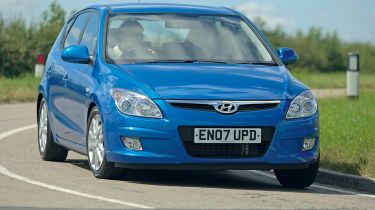
There's a lot more to the i30 than a new badge – and considering that bosses expect this to be the car that forces hatchback drivers to take the brand seriously, it needs to be. Changing people’s perceptions of the Korean marque won’t be easy – especially among image-conscious UK buyers.
The company says that in terms of packaging, quality, driving dynamics, style and image, the i30 is capable of equalling anything in its class. That’s a big statement. But with the Santa Fe doing wonders for Hyundai’s status, the marque is certainly on the right path.
Video: watch CarBuyer's video review of the Hyundai i30
[[{"type":"media","view_mode":"content_narrow","fid":"69217","attributes":{"alt":"","class":"media-image"}}]]
As with its Cee’d counterpart, the i30 was designed and developed in Europe, although it will also be sold in the Asian market as the Elantra Neos. The company has done enough to ensure there’s a distinction between it and the Kia – in particular, the nose has a bluffer shape, while the grille is smaller. But the bonnet, roof and doors are all identical, as is that distinctive upswept rear-quarter window.
The biggest differences are at the back, where the Hyundai’s elongated rear lights have a hint of Mercedes A-Class to them. Look at the flat, recessed tailgate, and the i30 also takes cues from the BMW 1-Series – a deliberate attempt to add an upmarket air.
The trouble is, this doesn’t extend to the cabin. While it’s well laid out, and is similar to the Kia in appearance, our entry-level model is dominated by a large expanse of dull plastic. More upmarket models get a leather steering wheel and metal-effect centre console.
But it all seems well constructed. There were no squeaks or rattles, while the switchgear and controls are all fairly robust. It’s comfortable, with a good driving position and plenty of seat adjustment. And rear passengers don’t miss out, either; because the front seats aren’t as bulky as those in the Cee’d, the i30 has 20mm more legroom, at 770mm. Yet overall, the cabin doesn’t feel as spacious as the taller Toyota’s.
Power for the i30 comes from the same range of engines as the Kia, and our car was fitted with the 1.6-litre diesel engine seen in the Cee’d in this test. But Hyundai has made a few changes which improve refinement. The unit isn’t as noisy as the Cee’d oil-burner on start-up, and at 42dB, is 4dB quieter at idle inside, too. Yet while it’s smooth, the powerplant in this Hyundai didn’t feel as flexible as that in the Kia.
It’s important to note that our test model had covered only 1,000 miles and, significantly, the i30 is 178kg heavier than the Cee’d, at 1,545kg. So it wasn’t surprising the Hyundai was slower at the test track; it trailed by nearly a second from 30-70mph. But with 255Nm of torque – that’s 65Nm more than the Auris – it’s punchier than the Japanese car when pulling out of junctions.
On the road, the i30 feels composed and reassuring. It’s far from inspiring to drive, but is comfortable and refined enough to ensure long journeys aren’t a chore.
And at less than £13,000, it’s tremendous value. Equipment is generous – even our entry-level Comfort comes with ESP, 15-inch alloys, electric windows, air-con, six airbags and a USB port/auxiliary input as standard. With a five-year, unlimited mileage warranty, it’s a great package – until you compare it with the Cee’d, which has a seven-year deal. The question is whether that’s enough for the newcomer to be upstaged here?
Details
Price: £13,370
Model tested: Hyundai i30 1.6 CRDi Comfort
Chart position: 2
WHY: It’s one of the most crucial new Hyundais ever, so can the i30 make an impact in the hatch class?
Economy
Our i30 didn’t have many miles on the clock when it came to us, so it’s no surprise that the fuel economy figure of 44.4mpg we averaged is some way off the claimed 60.1mpg. That’s still in line with its rivals here, though.
Residuals
With the exception of the Santa Fe, Hyundai has struggled with residual values. The i30 outperforms the Cee’d, though, and after three years, will be worth £5,029 – that works out as 38.7 per cent of its original price.
Servicing
Servicing costs aren’t available for the i30 yet, as it’s too new. But the Korean brand performed well in our Driver Power 2007 dealer survey, finishing an excellent seventh out of 32, with value for money rated highly.
Tax
For company car buyers, the Hyundai works out to be the cheapest option here. Lower-band earners face an annual bill of £515 – that’s £51 less than for the Kia. But opt for an equivalent-spec i30, and the price would rise accordingly.