Mercedes E220 CDI Avantgarde
It’s competent, spacious and classy – but at a price

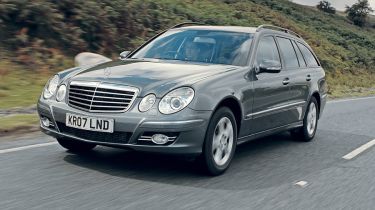
With its classic styling, the Mercedes has a traditional upmarket air – and, in load-lugging form, the E-Class is a proper estate car. The prominent rear overhang doesn’t look great, but it’s an indication of the Merc’s excellent carrying capacity.
When the seats are upright, the boot load length is 1,260mm – 130mm longer than the Volvo, giving it a 115-litre greater capacity. With the chairs flat, that advantage rises to 350 litres. The E220 also has the longest load area in this configuration, and the gap from boot floor to roof is 30mm taller than that of rivals. The Merc is 130mm narrower than the V70 and lacks the Swedish car’s 40:20:40 split/fold ability. But it’s seriously practical, and while rear passenger room is fractionally tighter than in the BMW, it’s still comfortable.
The rest of the interior is user friendly and oozes quality – there’s plenty of adjustment in the driving position and, aside from the US-style foot-applied parking brake, there’s little to fault. As there’s less precision in the steering, the E220 is not as engaging as the BMW, and despite the £810 Airmatic suspension, it rolls more through corners. Yet the ride is very comfortable, and the Mercedes is seriously refined on the motorway.
Despite being only a four-cylinder 2.2-litre unit, the CDI’s torque matches the BMW’s with 400Nm, which is more than the 2.7-litre Audi develops. And a 9.2-second 0-60mph time beats the A6 by two tenths. While it’s less tuneful than the six-cylinder units, the CDI is smooth and quiet once it’s up and running. The Mercedes is expensive, but is also refined, roomy and well built. Is that enough for it to win this test?
Details
Price: £40,212
Model tested: Mercedes E220 CDI Avantgarde
Chart position: 2
WHY: A large and practical load bay means the E-Class is a proper estate car with classy styling
Economy
Our E-Class came with an optional 80-litre tank (a rise from 70 litres for £80). And with frugal consumption of 34.7mpg, it had a range of 610 miles
Residuals
The Mercedes has the weakest second-hand values of the three German cars. It retains 45.8 per cent of its price, and after three years is worth £16,081
Servicing
It has the biggest dealer network, but Mercedes garages came 18th out of 32 in our Driver Power dealer survey. A total of £960 for three visits is competitive here
Tax
It emits 194g/km and sits in the 28 per cent bracket, but the Mercedes’ higher list price means it costs £3,931 a year for top-band owners. That’s £200 more than the Volvo