Honda Accord 2.2 i-CTDi Sport GT
It’s showing its age, but the Tourer still has a few tricks up its sleeve

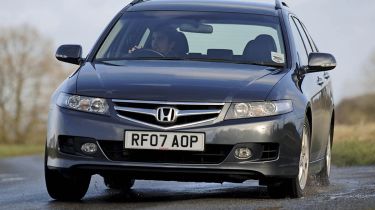
This year sees the arrival of an all-new Honda Accord. But although that car is guaranteed to have the Renault and Ford trembling in their boots, you shouldn’t write off the current model just yet.
The seventh-generation Accord remains one of our favourite family estates, even though it’s been around since 2003. And Honda is making sure it enters its final year on a high by replacing the Sport model with Sport GT trim, which includes sat-nav, new wheels and privacy glass.
Unfortunately, we were unable to get hold of the latest version for our pictures, but mechanically nothing is different, and visual tweaks are
confined to new wheels, dark chrome door handles and grille, fresh lights and a rear spoiler.
What hasn’t changed is the square-edged design, with those long back windows. The Accord certainly isn’t a pretty estate, but the shape has
a certain charm, and despite appearances it’s commendably aerodynamic. Visibility out of the back is equally impressive, which is useful because, as with its two rivals, the Honda doesn’t have parking sensors as standard.
Open the tailgate, and rather than the bulky sides of its rival, the Accord’s boot has been sculpted to create as much space as possible – hence the superb 626-litre load volume, which increases to a Mondeo-rivalling 1,707 litres with the rear seats flat. And closing the boot requires nothing more than the press of a button – electric operation is standard.
The driver hasn’t been overlooked, either. The Accord offers the best seating position of these three, and the layout is straightforward. However, it’s also beginning to show its age. The cabin is dark and joyless, with shiny plastics and a brittle feel. We have no doubt that quality is beyond reproach and nothing’s likely to go wrong, but it’s lacking the feelgood factor of its European rivals.
The same can’t be said of the engine. The i-CTDi diesel may have remained unmodified, but it’s still a great choice, with consistent power across the rev range, better performance than the Mondeo and noise levels at idle that neither rival came close to matching. However, other firms have caught up, and the 2.2-litre unit is no longer the class leader it once was. The Laguna’s engine is stronger, smoother, free running and more responsive, too.
At low revs the Honda comes across as a little lethargic, although there’s no doubt that it’s the most economical (we achieved over 45mpg) and has a far better manual gearshift than the Laguna. If only the brakes were as positive as the Mondeo’s. Not only is the pedal rather dead underfoot, but in the wet the ABS was overactive, leading to a lengthy 54.1-metre stopping distance from 70mph.
Provided you don’t need to hit the brakes hard, the Accord is a pleasant car to drive. It has a more settled ride than the Renault, but at high speeds wind and road noise take the edge off its refinement. Overall it’s better behaved than the Laguna, but can’t match the Mondeo. The steering is duller, there’s less grip, more understeer and it doesn’t feel as honed or enjoyable.
But the introduction of the Sport GT trim means equipment levels have improved. Offering sat-nav, Bluetooth phone connectivity and a CD changer is generous, although you still can’t have leather, heated seats or xenon lights.
Details
Price: £22,367
Model tested: Honda Accord 2.2 i-CTDi Sport GT
Chart position: 2
WHY: The ever-popular Accord is very practical, and new Sport GT trim enhances its appeal.
Economy
No rival can match the Accord’s claimed 47.9mpg combined figure, and in our tests it was the same. The Honda topped 45mpg, while neither opponent broke the 40mpg barrier. Expect well over 600 miles between fill-ups.
Residuals
It’s the oldest car on test and is due to be replaced this year, but the Accord still represents the best place to invest your money. It holds on to 42.5 per cent of its value after three years, which is seven per cent better than either rival.
Servicing
If you want a painless dealership experience, go for the Accord. While Ford garages came 25th out of 32 in our 2007 Driver Power satisfaction survey, and Renault’s were 30th, Honda finished second. Costs are high, though.
Tax
Emissions of only 155g/km are the lowest here by 20g/km. So not only does the Honda have the cheapest company car bills, but it also sits in vehicle duty band D. The Mondeo is in band F, and costs £65 a year more in road tax.