Toyota RAV4 SR180
Healthy dose of power and sharp handling mark out newcomer.

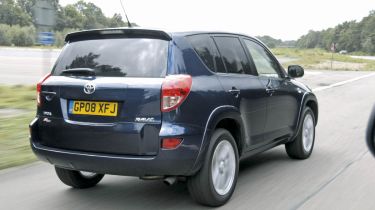
Few models have quite such a tough brief as the Toyota RAV4. As well as being able to handle everyday chores such as stop-start town driving and motorway cruising, it needs to entertain owners when they take the scenic route home. That’s a big ask for any car, never mind a compact SUV.
Based on the XT-R, the newly launched SR180 model aims to add a dose of sporty desirability. As with its Peugeot rival, the Toyota’s biggest draw will be its looks. And although it’s not as visually striking as the 4007, the extended wheelarches, 18-inch alloy wheels and dark tinted headlamps provide it with much greater presence.
The question is whether this is reflected by an injection of excitement on the road. As a driver’s car, the RAV4 already has a strong reputation, thanks to its competent chassis. Tackle a twisty bit of tarmac, and the benefits of the superbly punchy engine and taut suspension are obvious straight away. Most of the time, the front wheels alone are driven, as the Toyota only sends power to the rear if it detects a loss of grip. The system works really well, and although the car wrestles with 400Nm of torque, the impressively weighted steering rarely pulls to one side under hard acceleration.
Turn-in to bends is eager and the brakes are strong and responsive, so only the high centre of gravity stops the RAV4 rivalling a conventional hatch. At the track, we covered 0-60mph in 9.7 seconds. But our car had yet to be properly run in, so we’d expect to get closer to Toyota’s claimed 9.3 seconds.
The RAV4’s traditional strengths haven’t been compromised in the pursuit of greater performance. Once you’re used to the sharp clutch take-up, it tackles town centre journeys with ease. The high driving position means good visibility and, aside from the stereo, the controls are well placed. It feels more compact than the Peugeot and is easier to park, even though the thick rear pillars restrict your over-the-shoulder view. Only the unsettled ride compromises it in the city, while run-flat tyres combine with the SR’s large alloy wheels and firm suspension to provide bumpy progress.
It’s a similar story on the motorway. Although the engine is flexible and refinement superb, the flawed ride detracts from the car’s cruising ability.
While the Toyota is faster, it’s not as practical as the Peugeot. The seats slide to enhance boot or passenger space as required, but six-footers will need the chair set to its rearmost position to ensure decent legroom. There’s no seven-seat option, either, although a smart mechanism drops the back bench into the footwell with one tug of a lever to leave you with a completely flat load area.
The side-hinged tailgate still has the potential to irritate if you’re trying to access the boot in a tight parking spot, though. So the key is whether the RAV4’s stronger pace compensates for its less versatile design.
Details
Price: £23,045
Model tested: Toyota RAV4 SR180
Chart position: 2
WHY: We set out to discover if new 175bhp diesel engine can inject some sparkle into RAV4.
Economy
With an on-the-road price of £23,045, the Toyota is cheaper to buy than this Peugeot – yet it still looks costly considering it’s one of the class’s smaller SUVs. For the money, you get nine airbags, a CD changer and an electric sunroof. So, unless you’re after luxuries such as leather or satellite navigation, you’re unlikely to add much to the price. With CO2 emissions of 185g/km, the RAV4 sneaks into band E for road tax. Company car users will find the Toyota marginally cheaper to run than the 4007. Standard-rate tax payers fork out £1,291 annually; higher-rate payers must hand over £2,581 to the Treasury.