Nissan Qashqai+2 2.0 dCi
Does UK-built model make even more sense with seven seats?

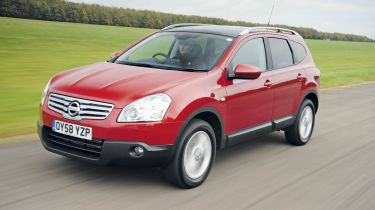
The Qashqai has been a big hit for Nissan. A pioneer of the fashionable crossover sector, it was launched early in 2007 with the intention of shaking up the compact family hatchback class. And it has worked. In the past 12 months, the model has found nearly 250,000 homes across Europe.
Now, the Japanese firm is hoping to build on this success by adding two extra seats in the Qashqai+2. The newcomer is stretched by 211mm, while the height and wheelbase gain 38mm and 135mm respectively.
Nissan’s designers have done a decent job of disguising the model’s extra size. From the nose to the base of the windscreen, the +2 is identical to the five-seater.
Where you really notice the difference is at the back, as there’s a longer rear overhang. Inside, it’s immediately clear that the cabin is more spacious. Occupants sitting in the middle row benefit from more leg and headroom, while the bench slides back and forth by up to 240mm.
This useful function also allows easy access to the rearmost seats. However, the Qashqai’s raised suspension means that less agile passengers will still struggle to step up and through the narrow gap to the back.
It sounds like a cop-out, but Nissan admits the extra seats are for “occasional” use only. While children will be comfortable, adults are likely to suffer, even on short trips. Headroom is the biggest issue, with most occupants having to hunch down to fit in.
Used - available now

2022 Toyota
Corolla Touring Sports
50,035 milesAutomaticPetrol1.8L
Cash £15,510
2023 BMW
X5
28,356 milesAutomaticDiesel3.0L
Cash £49,991
2021 BMW
X3
46,045 milesAutomaticDiesel2.0L
Cash £26,850
2019 Mercedes
GLA
67,000 milesManualPetrol1.6L
Cash £11,600Not surprisingly, luggage capacity is sacrificed with seven on board. With the third row in place, there’s only 130 litres of room. However, the chairs fold easily into the floor when not in use, while stowing the centre bench creates a maximum area of 915 litres – 58 litres more than in the Mazda. The rest of the cabin is shared with the existing Qashqai, which means it’s well equipped and solidly built. Better still, +2 versions get a full-length panoramic glass roof as standard, helping to create a bright and airy feel.
On the road, the +2 is composed when cornering, despite its SUV pretensions. It can’t match the 5’s agility and there’s plenty of body roll, but direct steering and strong grip mean it feels stable and secure.
At the test track, the Nissan had the edge over the Mazda. While the 148bhp 2.0-litre diesel is far from refined, it delivers strong performance. A 50-70mph time of 10.5 seconds in sixth was more than two seconds faster than its rival. Even more impressive is the Qashqai+2’s 41.5mpg economy – the 5 managed only 34.8mpg.
With such a strong mix of abilities, the Nissan has definitely given MPV designers something to think about...
Details
Price: £20,149
Model tested: Nissan Qashqai+2 2.0 dCi
Chart position: 2
WHY: Latest Qashqai adds extra seats to the car’s SUV styling and hatchback practicality.
Economy
it’s the more expensive car of our duo, but the Qashqai+2 counters this with better residual values. After three years and 30,000 miles, the Nissan will have retained a respectable 40.8 per cent of its new price, making it worth £8,221. Its case is strengthened by fuel returns of 41.5mpg. However, the official CO2 emissions of 177g/km mean the car falls into Band E for road tax, resulting in an annual bill of £170. The Mazda costs £145. But it’s company drivers who are hit hardest. Higher-rate buyers pay £2,095 over 12 months, which is £362 more than they would be liable for with the 5.