Honda Jazz 1.4 i-Shift ES
Hi-tech new gearbox completes Honda's versatile package

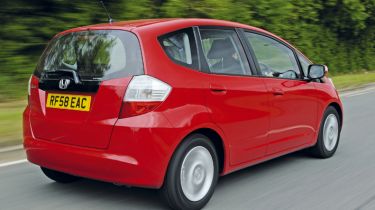
If you put space and versatility ahead of styling and driving pleasure, the Honda Jazz is in a different league to its supermini rivals. From the outside, its neat lines and boxy profile owe more to a small MPV than a compact hatchback, but the rewards are obvious on the inside.
Pull back the wide-opening doors and it’s the most spacious car in its class. The ‘magic’ rear seats, a Honda speciality, can fold forward or pivot upward. With the back chairs in place, there’s 399 litres of space – 99 litres more than in the Skoda, and 104 litres more than the i20.
Video: watch CarBuyer's video review of the Honda Jazz
[[{"type":"media","view_mode":"content_narrow","fid":"69240","attributes":{"alt":"","class":"media-image"}}]]
Cabin quality is also good. You won’t find the expensive soft-touch plastics of European rivals, but the switchgear has a precise and well engineered feel, while the distinctive dash looks great. The layout is more restrained than that of the Jazz’s futuristic Civic stablemate, and all the better for it. Only less-than-perfect build quality and stepped adjustment for the front seat backrests let things down.
The attractive multifunction steering wheel features a pair of neat gearshift paddles. Using them overrides the automatic function of the gearbox, turning the Jazz from a competent auto into a deft clutchless manual. Without driver input, the set-up does a remarkably good impression of a traditional self-shifter. Select Auto mode using the spring-loaded shift lever, lift your foot off the brake and the car gently creeps forward.
Used - available now

2025 Volvo
XC90
72,984 milesAutomaticPetrol2.0L
Cash £29,276
2023 Hyundai
Tucson
30,971 milesManualPetrol1.6L
Cash £17,865
2023 Volkswagen
Tiguan
34,922 milesAutomaticPetrol1.5L
Cash £20,698
2024 Volkswagen
Tiguan
101,441 milesManualPetrol1.5L
Cash £10,666A common complaint with such systems is that there’s a jolt as the clutch engages. But it’s not an issue here. As a result, low-speed manoeuvring is simple, although on the move, changes aren’t as smooth as those of rivals. There’s a distinct pause in acceleration on upshifts, and you have to lift off the throttle to achieve perfectly smooth changes.
Heavy stop-start traffic highlights the i-SHIFT’s biggest flaw, though, because the clutch loses some of its composure when it gets really hot. This can cause jerky progress as you apply the throttle in crawling traffic. In Manual mode, though, the slick set-up comes into its own, as the 1.4-litre i-VTEC thrives on revs. Maximum torque from the 99bhp engine comes in at a heady 4,800rpm, so you need to work the powerplant hard in order to keep the car up with its rivals here.
The rest of the dynamic package is what we have come to expect from the Japanese supermini. Despite its rev-hungry engine, the Honda is refined at motorway speeds and its composed suspension, predictable handling and light controls make the car as adept in town as it is on the open road.
Its i-SHIFT box is the best of the breed and an improvement on the CVT design. But will our two traditional automatic contenders leave the Jazz trailing?
Details
Chart position: 1
WHY: The Honda’s CVT transmission has been replaced by an automated manual. Is it any good?