Used Ford Fiesta (2002-2008) review
It’s one of the UK’s top-selling cars, so there are thousands of used Fiestas to choose from. Here’s what to look for...

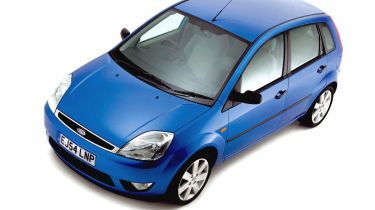
The rising cost of motoring means the current crop of super-sized super-minis is more desirable than ever. And one of the best is the Ford Fiesta, a household name that has been with us since the Seventies.
But the existing range makes real sense, thanks to a massive engine line-up and a wide variety of trim levels. With 466,000 examples registered to date, you will never have to travel far to find one, while the huge dealer network and variety of aftersales care options means maintenance is a doddle. Yet it’s the Ford’s talents on the road which make it so endearing – good to drive, spacious inside and well built, the Fiesta is a small car that feels bigger than it really is.
Checklist
Dash lights: make sure the dash warning lights illuminate on start-up. They should all go out, but glowing ECU lamps with a loss of power are common, and expensive to fix.
Footwells: ensure passenger footwell is dry. If not, it’s likely that the seals for the pollen filter are incorrectly fitted. Putting this right is easy – and needn’t cost anything.
Suspension: if you hear any creaks on the front suspension as you drive over bumps, this means that the drop links have worn – repair will set you back about £80 with parts.
Used - available now

2020 Audi
Q5
60,564 milesAutomaticPetrol2.0L
Cash £19,640
2023 Tesla
Model 3 Premium
90,443 milesAutomaticElectric
Cash £17,070
2024 BMW
1 Series
58,296 milesAutomaticPetrol1.5L
Cash £16,520
2023 Audi
Q5
55,190 milesAutomaticDiesel2.0L
Cash £26,240Seat catches: in three-door cars, check both front seats tilt forward properly when you activate the catch. The cable system can fail, and there’s a £60 bill to put it right.
Gearbox: problems can develop on the Durashift auto clutch unit on 1.4-litre cars, so check it closely. The conventional unit fitted to 1.6-litre Fiestas should be trouble-free.
What to look for?
You’ll pay similar prices for 1.25-litre and equivalent 1.3-litre Fiestas, but we’d recommend the smaller engine every time – it’s smoother and more powerful. Economical 1.4 TDCi models are also worth a look if you expect to cover a high mileage. You’ll pay a 10 per cent premium for one over the 1.4-litre petrol car, but the diesel has more torque and you can expect close to 60mpg, instead of 40mpg.
Alternatives
The Fiesta has a legion of rivals, led by Toyota’s ever-reliable Yaris. But the Japanese car is more expensive and offers less variety. Skoda’s Fabia is a more complete package, although it’s short on cabin space, while the VW Polo is costly. The Citroen C3 is much better value, yet it isn’t as solidly put together as its class competitors.
It’s more difficult to discount the Renault Clio and Nissan Micra – the first for its sheer driving enjoyment, and the second for its reliability. But the Fiesta’s biggest rival is the Honda Jazz, with its blend of superb reliability, practicality and equipment.
Recalls
MAR 2003: brake backplate may separate from rear axle on examples produced between late August and early September 2002. APR 2005: fuel return pipe may leak on cars built from mid-July 2004 to mid-February 2005.
The Fiesta came 83rd out of 100 in our Driver Power 2006 reliability and satisfaction survey, scoring 78.59 per cent. Owners praised its running costs, handling and practicality, but comfort, performance and ride were criticised.
Reader review
Anita Price from Hagley, West Midlands, bought her 03-plate Fiesta Finesse 1.3 last summer. She prefers the Ford to her old Vauxhall Astra, but it isn’t without its faults.
“It’s been a great buy, apart from one thing,” she said. “The 1.3-litre engine is a bit rough, and isn’t powerful enough. But the little things make the Fiesta very user-friendly – the heating and ventilation systems are efficient. It’s great to drive and spacious inside, while the seats are comfortable.”
Verdict
The sixth-generation Fiesta is more refined than its predecessor, but you might not find it quite as much fun to drive. However, improved practicality and a comfortable cabin mean that, overall, it’s a far better car.
While entry-level engines aren’t well suited to motorway trips, more powerful models are good high-speed cruisers. Affordability is what makes the Fiesta a second-hand winner, though.
How much?
Average-mileage Fiestas start at £4,000 from dealers. That gets you a 52-plate 1.25-litre model with 45,000 miles on the clock – an equivalent 1.3-litre example is around £300 less. A later 35,000-mile, 53-plate 1.4 Zetec is £5,000-£5,300 whether petrol or diesel, while £500 extra buys a similar 1.6-litre car.
However, the bigger 1.6 TDCi costs at least £8,000, as the earliest models are not yet two years old. For something more sporty, there are plenty of delivery mileage 06 and 56-plate Fiesta STs available for £12,000, against a list price of £13,595.