Honda FCX Clarity
Can fuel cell family hatch live up to green promise?

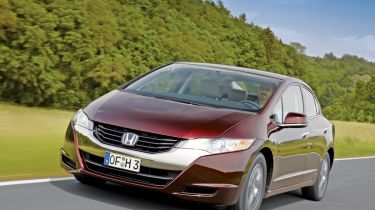

While questions over eco-friendly hydrogen extraction remain, this car impresses. Capable of returning the equivalent of 81mpg, it is quiet, refined and practical. Cabin quality is first-rate, and the ride and handling are acceptable, too. However, as a result of each example’s high production cost, it’s unlikely to be made widely available any time soon.
The outlook for Honda has never been so clear. This is the firm’s hydrogen-powered FCX Clarity, which it is backing to lead the world into a fuel cell future.
As part of that effort, the FCX Clarity gets its European launch this week. Being previewed in Germany, the clock is ticking on a UK launch, too. We got behind the wheel to find out what a lucky few have to look forward to.
It’s soon obvious that there are some major hurdles to overcome – not least the fact that extracting hydrogen in a sustainable way remains a major challenge. Honda’s short-term solution is to provide drivers with their own ‘home energy station’ – a device that turns gas from the mains supply into hydrogen for your car.
There are no such question marks over the way the model drives, though. With a fuel cell-powered electric motor turning the front wheels, the Clarity feels remarkably similar to any other hatch on the move.
Progress is smooth, and apart from a gentle whine as you get up to speed, the cabin is eerily silent.
The Clarity is no slouch, either: as with any electric car there’s plenty of torque, which shoots it from 0-60mph in 10.0 seconds and on to a top speed of 101mph.
Weighing in at 1,625kg, the Clarity is substantially heavier than eco-rivals such as Toyota’s Prius and Honda’s own Insight, and that’s sometimes noticeable in the corners. But the FCX more than makes up for it with a useful range of 270 miles, and its maker says the energy-equivalent fuel consumption works out at around 81mpg.
While questions over eco-friendly hydrogen extraction remain, this car impresses. Capable of returning the equivalent of 81mpg, it is quiet, refined and practical. Cabin quality is first-rate, and the ride and handling are acceptable, too.
However, as a result of each example’s high production cost, it’s unlikely to be made widely available any time soon.