Honda Jazz CVT-7
Sometimes five gears just aren't enough... or six, even! Honda's taking a big step forward and giving us seven. It's the popular Jazz that's been chosen to demonstrate this high technology, the first of a new breed of Continuously Variable Transmissions.
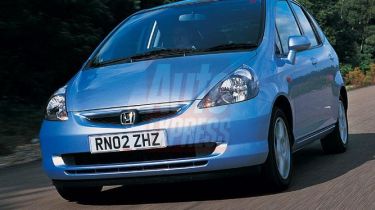
Autos are changing for the better, and CVT is the next evolution. This Honda offers fully automatic and F1-style manual shifts, and only a lack of refinement under acceleration lets the Jazz CVT-7 down.
Sometimes five gears just aren't enough... or six, even! Honda's taking a big step forward and giving us seven. It's the popular Jazz that's been chosen to demonstrate this high technology, the first of a new breed of Continuously Variable Transmissions.
Thanks to some clever engineering, the Jazz CVT-7 has a slick auto mode and a seven-speed manual override. We got behind the wheel to see what it's like.
Once inside, you're faced with what appears to be a conventional auto, but the steering wheel holds the Jazz's trump card. In either 'Drive' or 'Sport' modes, the seven-speed manual box can be activated, with changes made via F1-style wheel-mounted buttons.
So does it all work? In auto mode, the system sets the revs at their most effective point, wafting you along in one seemingly endless gear. The result is noisy, but there is none of the jerky changes that blight small autos, and the tall top ratio means improved motorway refinement over the manual car.
In manual mode, you'll enjoy zipping up and down the seven tightly packed ratios. The system involves two pulleys connected by a steel belt, which transfer torque directly from the engine to the wheels. Ratios are created as the second pulley is adjusted hydraulically, delivering a continuously variable transmission - hence CVT. Performance is hardly blistering with a 12.3-second 0-60mph time, but you'll still get there sooner than you think thanks to the clever gearing.
The great interior and dynamics of our Car of the Year are well documented, but there are no financial incentives to go for the CVT-7. Economy is good at 47.9mpg, as are the 139g/km emissions, but the manual Jazz is ahead in both areas. At £12,195, our 1.4i-DSI SE Sport also costs £900 more than the standard car. Yet this Honda makes sense if you spend a lot of time in town, or if you're only qualified to drive autos but want the control offered by a manual.