Mercedes E220
In Western Europe the Mercedes E-Class is number one with a huge market share

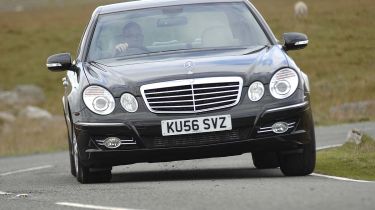
While the BMW is the biggest seller in the UK, in Western Europe the Mercedes E-Class is number one, with a 30 per cent market share. So it was no surprise that the manufacturer chose to keep the alterations subtle during the recent facelift.
The styling remains typically understated, but the headlamps and grille now sit at a more rakish angle, while the foglights have gained some glitzy chrome trim. It’s not a pretty car, but it is elegant and conveys an air of upmarket refinement.
It’s big inside, too. The 540-litre boot is vast (although the tailgate springs up too quickly when released), while split-fold rear seats can be added for £340. In the cabin, the impression of space is helped by the large windows, and even the tallest occupants in the back won’t fail to be impressed by the headroom on offer. The seats are comfortable (more so than those up front, in fact) and fold-flat headrests mean rear visibility is unimpeded.
Just as good is the view out of the windscreen. The dash-top is mounted lower here than in its rivals, so you see more of the road directly ahead, while the three-pointed star on the bonnet allows you to gauge parking distances easily. Also, the design and layout of the cockpit are excellent. The E-Class dash is as user-friendly as the Volvo’s – adjusting the heat, selecting different radio stations or checking the trip computer is easy.
Used - available now

2021 CITROEN
BERLINGO
101,864 milesManualDiesel1.5L
Cash £6,499
2023 Nissan
Juke
34,311 milesManualPetrol1.0L
Cash £12,397
2023 Ford
Puma
31,879 milesAutomaticPetrol1.0L
Cash £15,897
2024 BMW
3 Series Touring
39,754 milesAutomaticPetrol2.0L
Cash £22,197Given this ergonomic excellence, you have to ask why, when Mercedes made 2,000 alterations during the facelift, it didn’t add a right-hand column stalk. And that’s not our only criticism. The standard chairs lack lateral support, and the pedals in the manual car are badly offset to the right. This is a shame when you consider the attention to detail on display elsewhere, in the shape of the attractive rooflight clusters and clever storage.
The engine can be added to the list of E-Class strengths. With only four cylinders and 2.2 litres, it doesn’t appear to be anything special. But the maker’s constant updating means this is the most impressive diesel here. While not as tuneful as the six-cylinders, once up and running it was smoother and quieter than rival units, with the turbo feeding power in gradually from less than 1,500rpm.
At 400Nm, the 2.2 has more torque than the Audi’s 2.7, and delivered performance that was a match for any rival. Make no mistake, this engine is stronger than you might expect. But although acceleration and economy are both helped by the manual gearbox, in reality an automatic is much more suitable – and will improve residuals, too.
Fitted with small 16-inch alloys, the E220 CDI looks far from sporting, yet that’s not what this car is about. Instead, it aims to deliver peerless comfort and refinement. In that regard, it’s excellent. No rival rode as well either on the motorway or across pitted tarmac. However, the body is neither as stiff nor as well insulated as the BMW’s (although both had equally impressive noise meter readings), and the Mercedes occasionally became unsettled on particularly bumpy roads. We suspect the suspension is set up for heavier variants that steamroller over rough roads more effectively.
Roll is an issue in corners, and the E isn’t as engaging as the BMW, with less precise steering. But it copes well, is nicely balanced and effortlessly easy to get on with. It’s just a pity it’s so costly. The £31,565 E-Class is £2,000 more than any rival – and that’s before fitting the £1,480 auto box.
Details
Price: £31,565
Model tested: Mercedes E220 CDI Avantage
Chart position: 2
WHY: Featuring a 2.2-litre four-cylinder engine, you might expect the Mercedes to lag behind in the power stakes, but all four of our contenders have similar bhp and torque figures. Less surprising is the fact that the recently revised E-Class is the most expensive car on test.
Economy
The E220 CDI came closest to topping the 40mpg mark. It returned 41.1mpg on motorways, and its overall 37.1mpg was also best. You can add 120 miles to the 530-mile range with an £80 larger tank option.
Residuals
At the opposite end of the scale sits the E220 CDI, costing a huge 15 pence per mile more to run. This is caused by the heavy depreciation – the Mercedes loses £2,500 more than any rival.
Servicing
Mercedes main dealers don’t have the best reputation; they came 23rd out of 33 in our Driver Power 2006 satisfaction survey – well behind rivals. But the 30-year recovery deal can’t be faulted.
Tax
emittinG 2g/km less than the Volvo, at 167g/km, the Merc is a tempting business choice. Even though the E220 costs over £2,000 more than rivals, it’s cheaper to tax than the Audi or BMW.