Nissan X-Trail Aventura
Nissan's X-Trail's beginning to show its age

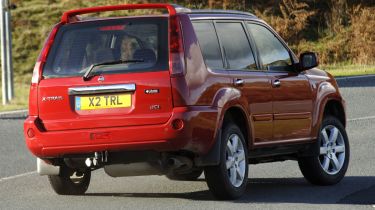
The Santa Fe arrived this year, while the Freelander and CR-V are brand new, but the X-Trail has experience on its side – it debuted in October 2001. That may seem to put it at a disadvantage, but Nissan has worked hard to ensure the SUV stays at the top of its game. We voted it our best Recreational 4x4 at New Car Honours for four years on the trot; the model was only dislodged by the Hyundai this year.
Nevertheless, many of its strengths remain – the X-Trail looks unfashionably square and flat-sided compared to its more rounded and chunky opponents, but it has an air of go-anywhere ruggedness that’s true of all Nissan SUVs. No doubt about it, despite the relatively compact dimensions (it’s the shortest, lowest and narrowest car here), the boxy machine manages to appear tough.
But the macho exterior hides a welcoming cabin. Designed to be easy to live with and offering loads of neat features, the X-Trail remains a more practical and thoughtfully designed car than either the Freelander or CR-V. The wipe-clean plastic surface in the boot may be slippery, but it comes with a load net to secure loose objects, there’s under-floor storage and the seats fold to provide a completely flat load bay which, at 1,841 litres, is second only to the Hyundai’s. Legroom is fine for those travelling in the back, but as with the Freelander, the large standard-fit sunroof limits headroom slightly – although we think that’s a price worth paying for the extra light the sliding glass lets in.
Used - available now

2024 Volkswagen
Golf
45,880 milesManualPetrol1.5L
Cash £15,995
2023 Tesla
Model 3 Performance
80,710 milesAutomaticElectric
Cash £13,295
2021 Renault
Zoe
18,010 milesAutomaticElectric
Cash £9,195
2023 Tesla
Model Y Performance
29,420 milesAutomaticElectric
Cash £27,995Up front, the airy ambience is aided by the low window line and commanding seating position – forward visibility is great. That’s helped by the fact that the instrument binnacle has been banished
to the centre of the dash.
The area freed up hasn’t been wasted in the X-Trail, though – just like most of the nooks and crannies in this model, the space has been filled with extra stowage. And there isn’t much wrong with the seats or driving position – it’s not as comfortable behind the wheel as the Freelander, but the broad, well padded chairs mean you can look forward to ache-free long journeys.
However, time is beginning to tell for the X-Trail – there’s bare metal on the inside of the tailgate, the doors are thin, the stereo is cheap, there’s no steering reach adjustment, some controls are haphazardly located and the atmosphere is less than luxurious. Everything is well built, but it feels low rent in this company, with cheap plastics. Under the bonnet, the engine is showing its age, too.
This powerplant is easily the most noisy and intrusive in this test. Moreover, as it doesn’t benefit from the latest-generation common-rail tweaks, unlike its rivals, it’s rather flat low down in the rev range. However, this lack of power isn’t such an issue as the Nissan doesn’t weigh much – against the clock, it returned similar performance to the more potent Freelander.
Engine vibrations through the pedals and steering take the edge off refinement, though, while the ride isn’t as smooth as its rivals’, either, so the Nissan felt comparatively crude. It’s very capable in the rough stuff, but on the tarmac – which is where the car is likely to spend most of its time – the vague, slow-witted steering and lack of grip prove its undoing. Nevertheless, the generously equipped X-Trail looks good value for money, and scores points for its honest approach.
Details
Price: £23,395
Model tested: Nissan X-Trail 2.2 dCi Aventura
Chart position: 4
WHY: Like its rivals, the X-Trail uses part-time 4WD. There are three engines and trims available, with prices starting from £16,995. We test the range-topping Aventura model, although the car in our pictures is in Columbia spec.
Economy
With the oldest engine, it’s hardly surprising the Nissan has the worst economy figures. However, a light kerbweight helped the X-Trail return a reasonable 32.1mpg on our 650-mile test route.
Residuals
It may be old, but the X-Trail holds its price well, with a projected figure of 52.3 per cent. That contributes to running costs of 54.8 pence per mile – similar to a top-line Ford Mondeo 2.0 TDCi estate.
Servicing
Pay £399 for the five-year, 70,000-mile Extended Care package, and the X-Trail will still be cheaper than the Hyundai. It’s a shame Nissan’s dealers finished 21st in Driver Power this year, though.
Tax
An ageing diesel spoils the Nissan’s company car appeal. Emissions of 203g/km place the X-Trail in the 30 per cent sector, so even though it’s the cheapest car to buy, only the Freelander costs more in tax.