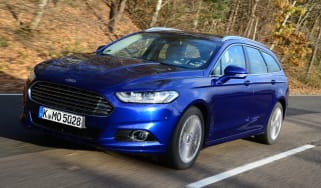
Ford Mondeo (2014-2022) review
The Ford Mondeo is more refined and high tech than ever, but that’s not enough to save it
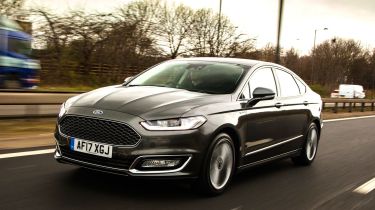

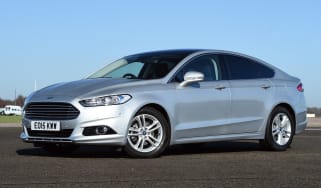
The Ford Mondeo - now in its fourth generation - is the largest and priciest it has ever been, although the family car is also a more premium, refined and high-tech offering than it was before. It faces fierce competition from the likes of the Skoda Superb, Mazda 6 and VW Passat, but its core strengths ensure that it holds its own.
The Mondeo is available as either a hatchback or an estate, and both body styles have an abundance of space for passengers and luggage, making them very practical for families. The engine line-up is not blessed with performance, it has to be said, but the diesels are very smooth and efficient, and offer enough power to get by on the road.
The disappointment with the current Mondeo is that it lacks the handling characteristics that made its predecessors shine. It’s not woeful by any means, but the fun of the old cars has been lost to a more comfortable set-up that’s more at home on the motorway than on a fast country road. That’ll deter some drivers, but the Mondeo is still a good family car nonetheless.
About the Ford Mondeo
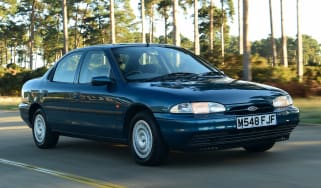
The Mondeo arrived in a blaze of glory in 1993 hen it was hailed as Ford’s new ‘world car’ to replace the old Sierra. It’s been massively popular over successive generations, but it isn’t any more. In fact, sales of this once ubiquitous model have slumped to the extent that Ford is killing off the nameplate in March 2022. Which is, to some extent, a shame.
Used - available now

2013 Volkswagen
Tiguan
80,500 milesManualDiesel2.0L
Cash £8,650
2022 Peugeot
3008
14,009 milesManualPetrol1.2L
Cash £16,500
2025 Kia
Niro EV
15,697 milesAutomaticElectric
Cash £19,508
2022 Citroen
C3 Origin
22,851 milesManualPetrol1.2L
Cash £10,179That’s because the Mondeo is still a very likeable car, but the writing has been on the wall for some time nonetheless. The shift in mainstream tastes towards SUVs is fundamental to the Mondeo’s imminent demise, but the car also has an image problem amongst business and company car users - the problem being that it’s not an Audi A4, BMW 3 Series or Mercedes C-Class.
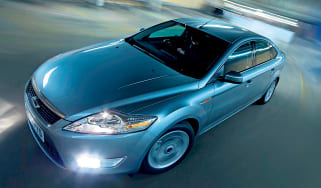
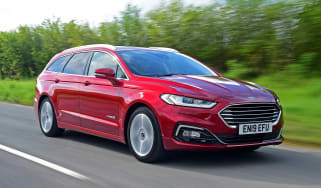
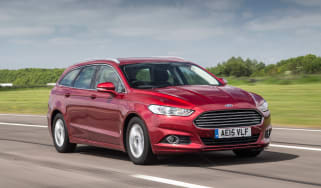
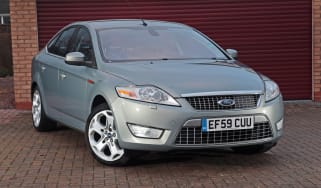
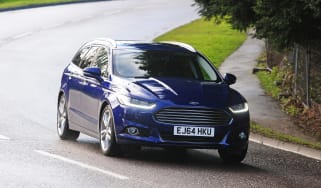
The Mondeo was last refreshed in 2019, when it received subtle exterior tweaks and some updates to the interior trim. New eight-speed automatic versions were also treated to the rotary gear selector as seen in the latest Focus. However, the pictures of the Mondeo you'll see in this review are taken prior to this facelift.
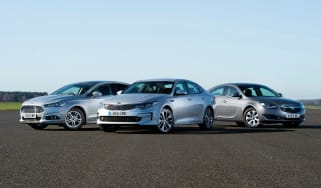
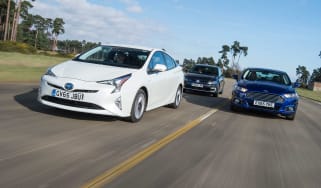
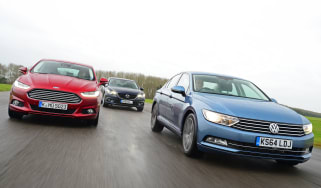
Despite the shift upmarket, the Mondeo is still behind the curve compared to the premium German models mentioned. It also faces highly competent and generally more desirable mainstream rivals including the Volkswagen Passat, Mazda 6, Skoda Superb and Peugeot 508. The Vauxhall Insignia and Toyota Camry are also alternatives to the Mondeo, though unlike the Ford they aren’t available as estates.
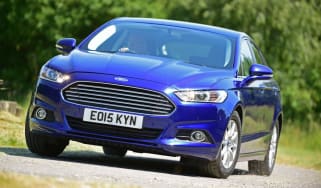
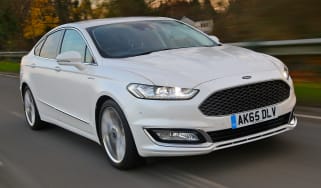
Whether you choose a basic Mondeo, an upmarket Vignale or the Mondeo Hybrid, you're getting a spacious family car with plenty of kit and handsome looks - the Mondeo has hints of the Mustang sports car about its appearance, especially up front.
Under the skin, the Mondeo shares its platform and running gear with the Ford S-MAX and Galaxy MPVs. Unlike past models that used a platform developed by Ford Europe, the current Mondeo platform was developed in the US, and its bias towards comfort over sharp handling was a distinct change for the Mondeo when it arrived in 2014, some 12 months after it had gone on sale in the US as the Ford Fusion.
Engines comprise of the 2.0 EcoBlue 150PS and 190PS diesels, plus a 2.0 TiVCT 187PS petrol hybrid. All Ford Mondeos are front engined, and the majority are front-wheel drive, with AWD four-wheel drive available as an option with the most powerful diesel. Gearboxes comprise six-speed manual and eight-speed autos, although the Mondeo Hybrid gets a CVT auto as standard.
Ford offers a broad range of trims on the Mondeo. The Zetec version used to be the bread-and-butter variant, but today it's the entry point to the range. Then there are Titanium, ST-Line and Vignale variants available, with Titanium and Vignale cars offering luxury, and the ST-Line being a sporty looking variant, albeit without a boost in performance.
Prices for the Mondeo range start from around £25,300 for Zetec models, while Titanium is less than £27,000 and ST-Line around £1,000 more than that. Vignale cars are a bit pricey, starting from just under £33,00. If you want an estate, there's a premium of around £1,800 to add to all models.
Engines, performance and drive
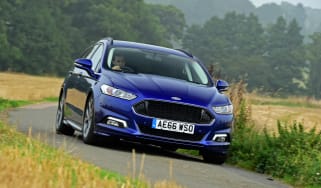
Thanks to the fact the latest Mondeo is part of Ford’s ‘One Ford’ philosophy, more emphasis has been placed on ride comfort and interior quality than driver enjoyment and handling agility. Where the old car was the sharpest steer in this class, the new one feels softer and less focused. The steering, for example, feels much lighter and has less feel, and the body leans more when you’re cornering at speed. It also feels cumbersome around town thanks to its sheer size and tricky visibility. ST-Line cars with sports suspension do handle with a bit more composure, however.
That said, the Mondeo is a far more refined prospect than before, with a notably better ride quality. It's softer around town, particularly on models with smaller wheels and standard suspension, while it's excellent on the motorway too, thanks to well isolated wind and road noise.
It’s still reasonably pleasant to drive, but it has lost its sparkle that made the older models special – or the class-leader, the highly enjoyable Mazda 6. The estate version’s optional self-levelling rear suspension is worth considering if you’re towing or carrying heavy loads regularly, while four-wheel drive is also available on some models.
Engines, 0-60 acceleration and top speed
The Ford Mondeo is available with a pair of diesel engines and a petrol-electric plug-in hybrid option, with the 2.0-litre EcoBlue diesels making up a bulk of Mondeo sales. It comes in 150PS and 190PS forms with 148bhp and 187bhp outputs, although Ford also sold a punchier 207bhp version in the past. As it stands, the 148bhp model is the manual and the 187bhp version is found with the auto gearbox, although neither feel especially rapid.
The petrol-electric Mondeo Hybrid is poor, but is selling relatively well due to the unpopularity of diesel. Emissions range from 127g/km to 134g/km depending on the spec. These figures aren't particularly competitive, and the car's increased weight blunts the Mondeo's stodgy handling even further, while the CVT transmission makes the powertrain unpleasant to use under acceleration.
A decent array of petrol options were also available, though they’re no longer offered on the Ford Mondeo. One now-dropped petrol engine that greatly impressed us was the 163bhp 1.5-litre EcoBoost: it doesn't have a major slug of low-down torque, but it revs very cleanly, sounds good and is supremely quiet when cruising. Ford also used to offer a 237bhp 2.0-litre EcoBoost petrol Mondeo, which was the fastest model in the range when it was for sale.
MPG, CO2 and running costs
Overall the Mondeo range doesn’t quite have the fuel economy figures to match the best in class, even though Ford has introduced a new range of EcoBlue diesels. It doesn't help that the tougher WLTP fuel economy test also brings these figures down.
If you’re after maximum frugality, the best engine of the bunch in terms of efficiency is the 2.0 EcoBlue 150PS. This has a WLTP best of 56.5mpg with the manual gearbox, and 52.3mpg for the auto version.
Go for the more powerful EcoBlue 190PS, and Ford claims up to 50.4mpg for the auto (there's no manual gearbox option), which is the same maximum achieved by the 2.0 TiVCT Mondeo Hybrid. Adding four-wheel-drive to the diesel sees a return of up to 46.3mpg.
Looking at emissions, the Mondeo Hybrid just beats the diesel models with a lowest CO2 figure of 127g/km. The 148bhp EcoBlue oil-burner produces from 130g/km, while the 187bhp version is higher at 147g/km of CO2. It's important to remember that adding automatic transmission and all-wheel-drive will impact on emissions and overall economy.
Insurance groups
Insurance is very competitive by class standards. The least powerful 2.0 EcoBlue has the lowest insurance grouping at 23, and the 190PS version sits in the slightly higher group 26. The 190PS EcoBlue is in group 26. The Mondeo Hybrids are group 27 and the priciest Vignale is still a respectable group 29.
Depreciation
When it introduced the current car in 2014, Ford said it expected to sell only 20,000 Mondeos each year – that compares with 100,000 units in the model’s heyday. In 2020, Ford shifted just 2,400 Mondeos, although the coronavirus pandemic would have impacted sales somewhat. Residuals aren’t as strong as the VW Passat’s due to the perceived badge value. Make sure you secure a good discount if buying new.
To get an accurate valuation on a specific model check out our free car valuation tool...
Interior, design and technology
While the Mondeo is undoubtedly still recognisable, Ford’s emphasis is to take it away from the humdrum rep-mobile of old, and make the model stand out from the crowd. The styling was first seen on the US-market Ford Fusion back at the 2012 Detroit Motor Show, but production delays caused by the global recession pushed back the car’s European launch until 2014, while a facelift arrived in 2019.
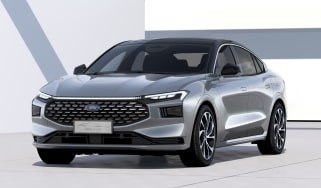
The sleek front is similar to the latest Ford Focus and Fiesta, complete with an Aston Martin-style grille, while the rear end has a clean and smart appearance. The shape looks – and is in fact – more aerodynamic, thanks to an arching roofline. Ford claims the new profile, active grille shutters and underbody panels contribute to a 10% reduction in drag. ST-Line models look even smarter thanks to 10mm lower suspension, a neat bodykit, honeycomb grille and tinted windows.
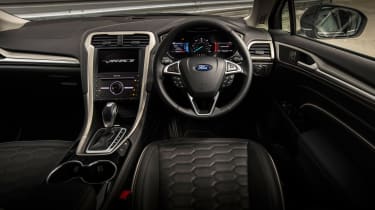
Inside, the Mondeo is not only a major improvement over the fussily styled old car, but better than the US-spec Fusion too. Sober (but solid) materials lend it a mature, premium look and feel. It's a shame that the centre console plastics let it down a bit, but the rest of the touch points are nicely soft to the touch.
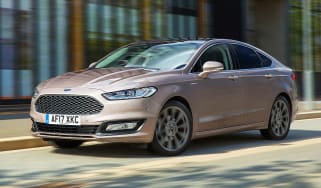
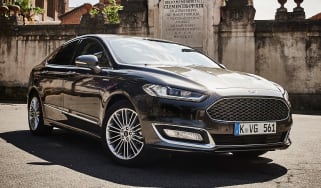
The range-topping Vignale version adds chrome detailing on the outside, unique alloy wheels and a bespoke leather dash. It’s certainly plusher than the standard model, but not yet plush enough to see off the likes of the BMW 3 Series and Mercedes C-Class with which the Vignale competes at this price point.
Sat-nav, stereo and infotainment
The touch-sensitive climate control panel fitted to the Mondeo in America has been ditched in favour of a far more user-friendly physical button set-up. You still get a large eight-inch central touchscreen for things like the radio and sat-nav, but the climate control and heated seats are now controlled via conventional buttons.
Sat-nav and a DAB radio/CD system is standard, or a premium 12-speaker system is optional. Two USB connectivity ports are provided, while the latest SYNC3 voice-activated connectivity system enables you to make hands-free phone calls and hear text messages. It also lets you control music by using your voice, and allows wireless connections to your devices. Connectivity features such as Apple CarPlay and Android Auto are also included.
Practicality, comfort and boot space
The Mondeo’s rakish looks don’t compromise its interior functionality, thanks to the fact the car is so big. There’s plenty of space for five adults and a big boot. A deep centre armrest, big cupholders and extra space behind the floating centre console mean oddment storage in the cabin is another Mondeo strong suit. The optional panoramic sunroof makes the car feel much more spacious inside, too.
The large exterior dimensions make this a cumbersome beast, and the hatchback’s narrow rear screen limits visibility and makes parking tricky. You might therefore consider the optional Active Park Assist, which can steer you into parking spaces at the push of a button. Having located a suitable space as you drive past, it then automatically steers you in.
Dimensions and size
At 4,871mm long and 1,852mm wide, the Ford Mondeo is definitely among the largest cars in its class – although surprisingly, the estate is fractionally shorter than the hatchback (at 4,867mm). Overall the Mondeo range comfortably outsizes its main rivals like the Vauxhall Insignia (4,842mm long), Skoda Superb (4,861mm), and VW Passat (4,767mm).
Leg room, head room & passenger space
Getting into the Ford Mondeo is very easy thanks to its wide-opening doors. And because of its large dimensions, it comfortably accommodates five adults. Even tall people will enjoy lots of space in the back, although headroom can be tight for the centre rear passenger. The Titanium X Pack model gives you 10-way adjustable heated electric front seats, which are very comfortable indeed.
Boot space
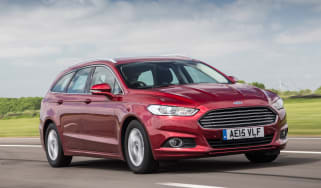
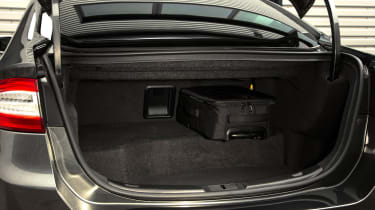
The standard hatchback boasts a whopping 541-litre boot, which expands to 1,437 litres with the seats down. It has the distinct advantage over saloon car rivals like the VW Passat and Mazda 6 that the tailgate opening is huge, so it’s very easy to load. The estate has slightly less room with the seats up, at 500 litres, but it offers more seat-down capacity at 1,605 litres. The boxier shape proves more practical in day-to-day use, too.
However, the Hybrid disappoints – it has only 383 litres of boot space because the massive battery pack sits bang in the middle of the load area, eating up space. Even worse, the rear seats can’t be folded away. It’s a real shame that the batteries aren’t hidden under the floor.
Do also be aware that, while the diesel Mondeos and the Hybrid Estate have a hatchback tailgate, the Mondeo Hybrid saloon’s boot lid hinges from below the rear window. This means the saloon has a narrower boot opening than the hatchback and estate versions, and therefore makes it a bit harder to fit larger and more cumbersome items in the boot.
Towing
The Mondeo has decent towing capabilities, helping it appeal to caravanners and hobby sailors alike. With the limits starting at just 400kg and going all the way up to 2,000kg in terms of braked trailer towing capacities, you are going to want to check the small print for the model you are buying.
As a guide, in its various power outputs, the 2.0-litre EcoBlue diesels will allow you to pull the most mass. Also, the optional self-levelling rear suspension is worth considering if you’re towing or carrying heavy loads regularly, while four-wheel drive is also available on some models.
Reliability and safety
Ford has work to do with the Mondeo, as evidenced by your feedback to us in the Auto Express Driver Power survey. The Mondeo has never placed very well in the car ranking, and has struggled to remain relevant in a changing market that now includes a huge number of popular family crossovers, SUVs and fully-electric competition.
The Mondeo makes a better showing for safety, though. It scored a maximum five stars in its 2014 Euro NCAP crash test, thanks to a plethora of passive and active safety systems on board, plus a stiff body structure. Its adult occupant protection score was 86%, children 82% and pedestrians 66%.
Lane keeping alert and automatic emergency braking are standard across the Mondeo range, and can be complemented by additional optional safety features. These include adaptive cruise control and blind spot monitoring, which can be specified on all Ford Mondeo grades bar the entry-level Zetec trim.
Warranty
Ford is very much middle-of-the-road with its three-year, 60,000-mile warranty. It’s possible to extend the warranty, at extra cost, to either four years/80,000 miles or five years/100,000 miles. Some rival brands do offer more generous standard cover, like Toyota (five years), Hyundai (five years) and Kia (seven years).
Servicing
The Mondeo range has a service interval of 12,500 miles, which is about the industry average, but you do need to have a service at least once a year to keep the warranty intact.
Optional ‘Protect Premium Plan’ service schemes can spread the cost of servicing; Ford offers two years/two services over 80,000 miles or three years/three services over 100,000 miles.