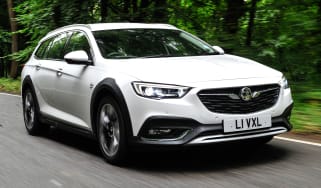
Vauxhall Insignia (2017-2022) review
The Vauxhall Insignia is a practical, well-equipped family hatch, but lacks excitement

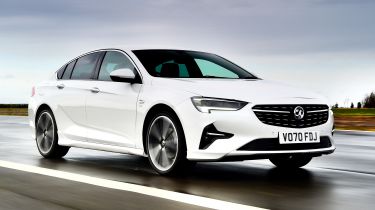

The Vauxhall Insignia is practical, good to drive and quiet on the move - so it’s a decent choice if you’re after a large family car.
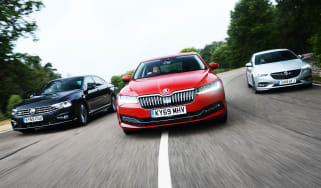
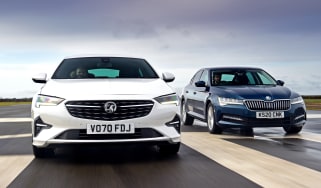
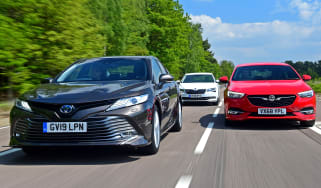
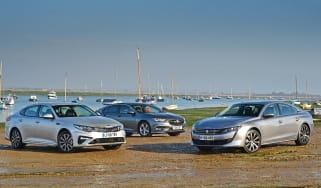
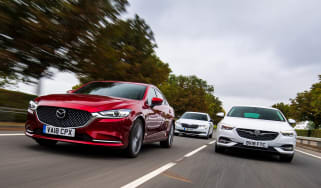
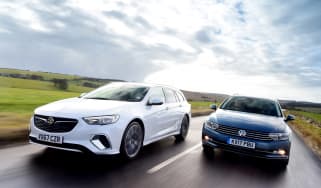
However, the market for these cars is shrinking. As more people flock to SUVs and premium cars such as the BMW 3 Series and Audi A4, it leaves the Insignia with few direct rivals. One is the Skoda Superb, which is a tough competitor and one of our favourite family cars - but the Vauxhall is a close match for interior quality and practicality - two key areas for a family.
Buy at a good price and the Insignia is still a good choice - it doesn’t have the trendy looks of an SUV, but it beats those heavy, high-riding cars on ride comfort, handling and refinement.
About the Vauxhall Insignia
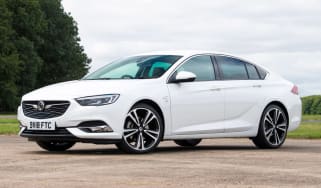
A change of name to Vauxhall Insignia Grand Sport signified a big change for Vauxhall's family hatchback when it arrived in 2017. As well as being a replacement for the near-decade old Insignia Mk1, the new model went on sale as a bigger, more spacious and more upmarket family car. In fact, because the family car market is in such poor health, Vauxhall has rebranded the model as an executive choice, in the hope of stealing sales from cars such as the BMW 3 Series and Mercedes C-Class.
Used - available now

2013 Mazda
MX-5
46,315 milesManualPetrol1.8L
Cash £9,450
2022 Peugeot
e-Traveller
18,439 milesAutomaticElectric
Cash £21,990
2023 Citroen
e-C4 X
1,153 milesAutomaticElectric
Cash £16,476
2022 Peugeot
2008
18,926 milesManualPetrol1.2L
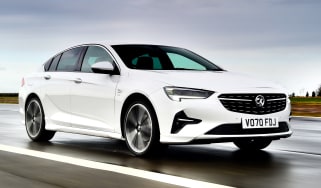
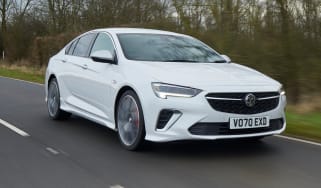
Cash £14,629A facelift in 2020 saw the Grand Sport moniker dropped, while slight exterior changes included a wider grille, a redesigned front bumper and slimmer headlights. A new entry-level diesel engine option was also introduced to the range, along with improved levels of safety kit.
Really, the Insignia treads the middle ground between these executive models and traditional family cars. It's more upmarket than cars such as the Ford Mondeo, Mazda 6, Hyundai i40 and Kia Optima, and is on a par with cars like the Skoda Superb and Volkswagen Passat.
The Insignia has good interior space and plenty of legroom in the back. That gives passengers room to stretch out, while cabin quality has been improved to add to the sense of space and comfort. In terms of pure size, the Insignia is also comparable to more upmarket offerings, such as the BMW 5 Series and Mercedes E-Class. Like before, it comes as a five-door hatchback, although the extended roof line gives it more of a fastback look.
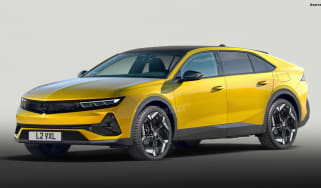
Vauxhall has hinted at plans that the next-generation Insignia will be a higher-riding SUV, featuring all electric and plug-in hybrid powertrains. The new model should be available from 2024, so it perhaps makes sense that the manufacturer has pared back the current Insignia range to a choice of just two trim levels: Design and GS Line. Prices start from around £26,500 and climb to almost £36,000.
Standard kit is pretty generous and includes 18-inch alloys, LED headlights, front and rear parking sensors, a touchscreen infotainment system, navigation with traffic sign recognition, Apple CarPlay and Android Auto connectivity, dual zone climate control and cruise control. The sporty GS Line features 20-inch wheels, rear privacy glass, keyless entry, upgraded upholstery and a wireless smartphone charging function.
The engine lineup has been equally simplified, with diesel power making up the bulk of the range: a 120bhp 1.5 litre unit, or a 172bhp 2.0-litre oil-burner, both available with either a six-speed manual or eight-speed automatic gearbox. A single 197bhp 2.0-litre petrol engine is also offered, using a nine-speed auto 'box.
Engines, performance and drive
Vauxhall has worked hard on the Insignia to improve its ride and handling over the old model, and it really has paid off. It’s smooth at low speed, and while you’ll notice bigger bumps when moving a bit faster, the compliant suspension set-up keeps things impressively composed overall.
Experience the FlexRide adaptive dampers fitted to the petrol models, and you'll notice the Insignia's ability is broadened even further. In Tour mode the chassis set-up is soft and compliant, absorbing corrugations over bad surfaces with a smooth edge, even on cars with wheels of 18 inches and more. Switch to Sport and you don’t lose too much of this welcome suppleness from the set-up, because the suspension’s fluidity remains. You get a little more body control for faster driving on country roads, but the Insignia is at its best in the most comfort-orientated setting.
Even on the motorway, road and wind noise isn’t intrusive - it’s great at long distance travel, in fact, and will suit company car buyers who do a lot of miles. However, we found the 120bhp 1.5-litre diesel a little underpowered and unrefined - noisy at startup and, in manual form, you have to work the six-speed 'box tin order to get up to motorway speeds.
That said, the Insignia is good fun on a twisty road, with tidy and enjoyable handling. The steering is well weighted and there’s enough feel to place the car on the road in confidence. There’s a bit of body roll, but weight savings over the previous model mean it’s more agile than you’d expect for a car of its size.
While it’s more fun than a Mondeo or Passat, the Skoda Superb is better in other ways, including the slicker manual gear change and more comfortable driving position.
Engines, 0-60 acceleration and top speed
The 120bhp diesel version is possibly one to avoid as it's particularly slow - only capable of 0-62mph in 10.7 seconds as a manual and 11.5 seconds in auto form. There's not much going on below 2,500rpm, while it seems to run out of puff above 3,500rpm, and it's every bit as lethargic as the numbers suggest. The 172bhp version is a better bet with the power boost and extra 81Nm of torque helping to improve the sprint time to a more respectable 8.2 seconds.
You'll see faster acceleration times if you choose either of the petrol models: the 197bhp car manages 7.2 seconds and a 146mph maximum, although the (now discontinued) 227bhp variant is only two tenths quicker and adds just 1mph onto the top speed.
MPG, CO2 and running costs
With no plug-in hybrid technology on offer, the Insignia diesel models offer the most efficient option for buyers. Vauxhall claims the same fuel economy figure for both the 120bhp and 172bhp versions: the six-speed manual cars return a maximum of 61.4mpg, while the auto versions manage 56.5mpg on the combined cycle. On our own test with the lower-powered manual variant, we saw just 41mpg, so you'll need to have a light right foot and spend a lot of time at cruising speeds to meet the manufacturer's figures.
CO2 emissions are from 121g/km for the diesel manual car, which gives a Benefit-in-Kind rate of 28%, while switching to the auto brings a slight increase to 130/131g/km and a BiK rate of 30%.
The 2.0-litre petrol models don't really stack up as being particularly efficient options, offering around 35-38mpg with high CO2 emissions that will attract the highest rate of tax for business users.
Insurance groups
Entry-level diesel SE Nav models are in groups 16-17, moving up to group 25 for SRi VX-Line Nav and Ultimate Nav cars. Petrol versions are again more expensive to run, with the 197bhp and 227bhp variants in groups 27 and 30 respectively.
Depreciation
According to our data on residual values, the Insignia won’t hold its value as well as most of its rivals, although the facelifted model fares a little better than the pre-2020 lineup. It should hold onto around 42% of its original value over a typical three-year/36,000-mile ownership period, which is around 5% down on its Skoda Superb rival.
To get an accurate valuation on a specific model check out our free car valuation tool...
Interior, design and technology
In an effort to compete against the growing group of SUVs, Vauxhall has redesigned its Insignia large family hatchback, offering buyers something that’s a little more stylish, without sacrificing the car’s trademark practicality.
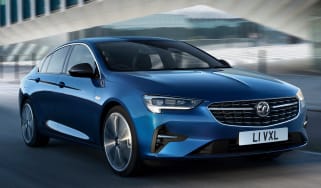
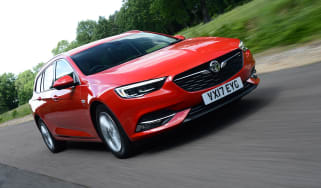
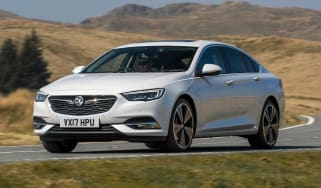
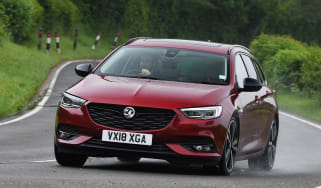
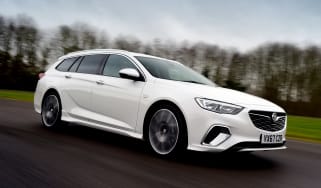
The Insignia is quite different from what came before, with a large, flat grille on the front, stylised daytime running lights and sculpted doors at the sides. The long bonnet features a crease right in the middle, and the boot lid has a subtle spoiler. A facelift in 2020 brought in a redesigned front bumper, wider grille and slimmer headlights.
It’s an understated look, but more elegant than the previous Insignia and undeniably more eye-catching than most of its rivals. The only thing that can really spoil the look is the ugly rear wiper, which sticks out of the boot lid like something from the 1970s.
Material quality is good, and the fit and finish is even a match for the Skoda Superb – but some hard plastics and a generally dull design mean the Insignia will never beat a compact executive saloon for perceived quality.
SE Nav trim is well-equipped with 17-inch alloys, LED headlights, front and rear parking sensors, cruise control, climate control and sports seats, while moving through the range brings luxuries such as heated seats, a massage function for the driver's seat, a heated steering wheel, a wireless smartphone charger and leather upholstery.
Sat-nav, stereo and infotainment
The entry-level SE Nav specification includes a 7-inch touchscreen with sat-nav and Apple Carplay and Android Auto connectivity. SRi VX-Line Nav versions and above have a bigger 8-inch display with a voice control function and an upgraded Bose audio system.
Practicality, comfort and boot space
At the heart of the Insignia appeal is its usability. The latest car is significantly longer and wider than the last model, with the wheelbase increased by almost four inches. There’s decent visibility from the large window area, although the high sides do make tight parking spaces a pain. Standard front and rear parking sensors go someway to alleviating this issue, however.
There’s plenty of cabin storage front and rear, as the Vauxhall is spacious enough to allow extra room for water bottles and snacks. A front centre armrest is standard, while the steering column adjusts for reach and rake, so the driver should be able to find a comfortable position.
Dimensions and size
The Insignia is 4,897mm long, 1,863mm wide and 1,455mm high, which makes it slightly longer than the Skoda Superb's 4,861mm. The two rivals have virtually the same width (Skoda: 1,864mm), while the Insignia is not quite so tall as the Skoda's 1,468mm.
Leg room, head room & passenger space
The Insignia has a more flowing roofline than its predecessor, and that means access to the rear is slightly more compromised. But once aboard headroom is plentiful and even taller passengers won’t brush the roof.
Legroom is good, too, with plenty of space to the seat in front, so longer journeys shouldn’t be a problem for four adults. That’s thanks in part to the Insignia’s controlled, but forgiving, ride.
Boot space
A one-touch release for the rear seats makes the Vauxhall’s 40:20:40-split bench easy to fold. There’s plenty of usability here, too, thanks to the Insignia's decent packaging. With 490 litres of luggage capacity with the seats up (underneath the load cover), there’s masses of space in the Vauxhall. The Vauxhall also offers a total of 1,450 litres with the back seats folded.
In comparison, the Skoda Superb hatch has 1,760 litres of space. However, there’s more than enough luggage and passenger space for most. The huge hatch gives great access to the boot, just like with the Superb, but there’s no power tailgate available to help improve usability. However, this boot space doesn’t come at the expense of room inside the cabin.
Reliability and safety
Vauxhall hasn't fared particularly well in our Driver Power customer satisfaction surveys over the past few years, although there was some improvement in the latest 2021 poll, with the manufacturer moving up to 24th place (up from 29th spot) - ahead of Ford, Fiat and Citroen.
Although the Insignia didn't feature in the Driver Power Best cars to own survey, Vauxhall did have some strong performances, with the Grandland X SUV in 7th position and the Corsa supermini in 29th (on a 75-car list).
In 2017 the Insignia scored five stars for crash safety from Euro NCAP, with strong scores in every category. The 93 per cent rating for adult protection is excellent, while 78 per cent for pedestrian safety is nearly twice as good as the previous-generation car’s score.
Standard safety kit is good and includes cruise control with a speed limiter, a forward collision alert, a lane departure warning with lane assist, auto emergency braking and traffic sign recognition.
Warranty
Vauxhall offers the industry-standard three-year warranty with the Insignia, limited to 60,000 miles in the last year of cover. You also get six years of rust coverage for the bodywork.
Servicing
Vauxhall offers fixed-price service plans that you can pay for monthly alongside your PCP deal, if you choose to buy the car that way. There’s even a free Vauxhall Service Club you can join that gets you money off the services if you don’t have the fixed-price plan.
Used and nearly new
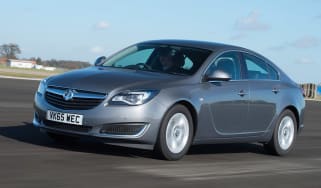
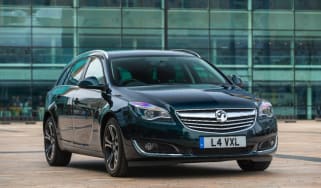
The Insignia replaced the Vectra as Vauxhall’s chief rival to the Ford Mondeo. Never the most exciting choice in the family car segment – although the hot VXR version was certainly rapid – the Insignia majored on comfort, low running costs and fuel efficiency, especially from the diesels. The Mk1 Insignia enjoyed nearly a decade of production before a new and more upmarket version arrived in 2017.
Vauxhall Insignia history
Vauxhall Insignia Mk2: 2017-2022
A change of name to Vauxhall Insignia Grand Sport signified a big change for Vauxhall's family hatchback when it arrived in 2017. As well as being a replacement for the near-decade old Insignia Mk1, the new model went on sale as a bigger, more spacious and more upmarket family car. This move up market edged the Insignia ahead of its more mainstream rivals.
Vauxhall Insignia Mk1: 2008-2017
The Vauxhall Insignia was the long-awaited replacement for the old Vectra – one of the least-liked cars of all time. The Insignia came along in 2008 and improved on its predecessor in almost every way. But it still scored in Vauxhall's traditional territory of value for money. The Insignia, like its predecessors, is big, spacious and well equipped as standard, and became a favourite in the company car park. Read our full Mk1 Vauxhall Insignia buyer’s guide here...
If you're looking to buy a Vauxhall Insignia, why not check out our Find a Car service for the latest deals...
More reviews