Hyundai Santa Fe CDX+
Good standard equipment on the Hyundai, but some touches lose it points

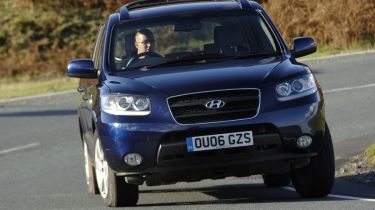
The original Santa Fe, launched in 2001, was an acquired taste. However, the new car has much more of a sense of style – although you can still spot one or two characteristic Hyundai hallmarks that have been carried over.
To our eyes, it owes a debt of gratitude to the Toyota RAV4, but the smooth and sophisticated lines mean the new Santa Fe is a very desirable machine. In fact, the newcomer is so well sculpted that it’s easy to ignore how big it is. While Honda has shrunk the CR-V slightly, Hyundai has made the second-generation Santa Fe so much bigger it nearly belongs in the class above.
It’s the longest car here by 145mm, and has the highest roof. Better still, Hyundai has learned some lessons about packaging, and given the Santa Fe the biggest cabin by miles.
Drop all the seats and the resulting 2,213-litre load area is the largest here by nearly 400 litres. Even with the middle row in place, the boot has the most floor space and raising the optional rear seats is effortless. In fact, that’s true of all the chairs; each has a simple one-handle operation. While access to the rear row can only be gained from the passenger’s side, the Hyundai has the best-designed seating layout, plus the unique selling point of offering space for seven. This model really is an alternative to compact MPVs such as the Vauxhall Zafira.
Used - available now

2026 BMW
3 Series
10,005 milesAutomaticPetrol2.0L
Cash £27,990
2026 Peugeot
e-208
1 milesAutomaticElectric
Cash £19,495
2026 PEUGEOT
PARTNER
12,803 milesAutomaticElectric
Cash £15,995
2023 Peugeot
408
23,267 milesAutomaticPetrol1.6L
Cash £18,250As with models in that class, the rearmost seats are best suited to children, but elsewhere adults have room to stretch out and enjoy the fine cabin design. The wood trim and grey leather/red piping in our test car isn’t the most tasteful combination, yet we like the subtle blue instrument lighting, good stowage solutions and user-friendly controls.
What’s more, while the plastics are less tactile than those in the Land Rover, everything feels just as well put together. However, it’s a shame the electric driver’s seat isn’t more supportive and can’t be adjusted lower. Still, we have few complaints about the Hyundai’s 2.2-litre Variable Turbine Geometry engine. One gripe is the noise at cold start – and that’s only notable as the common-rail unit is so refined and smooth when warm.
It’s better insulated than the Honda diesel, and although it’s not as punchy, with 335Nm of torque at 1,800rpm, the unit doesn’t struggle, even if the Santa Fe is carrying its huge maximum payload of 687kg (over 130kg more than the Freelander’s).
The trouble is, it’s easy to spot where Hyundai has cut corners – and the gearbox is a case in point. It offers only five ratios when rivals have six, while first and second gears are too short, and the shift is a touch notchy. Refinement is superb, though. Our 66dB reading at 70mph means the Santa Fe is as quiet as an executive saloon. The ride also impresses. On smooth roads the Hyundai is very relaxing to drive thanks to its soft suspension. However, rough tarmac reveals some deficiencies. The Korean SUV lacks rigidity, so there’s more body shake, taking the edge off comfort.
Meanwhile, the cushioned suspension means it rolls in bends and feels ponderous compared to the Honda. At least it remains well controlled and stable, and with 203mm of ground clearance, copes well off-road. This well equipped CDX+ has a roof-mounted DVD system, but Hyundai doesn’t offer xenon lights, parking sensors or a sunroof. Will these oversights spoil the Santa Fe’s chances?
Details
Price: £26,630
Model tested: Hyundai S Fe 2.2 VGT CDX+
Chart position: 2
WHY: As Hyundai is the world’s sixth largest car firm, it had plenty of financial muscle to completely revamp the Santa Fe. Prices for the five-strong range start at £20,995, while taking the seating capacity from five to seven adds £1,000.
Economy
A lack of a sixth gear is undoubtedly a drawback for the Santa Fe, meaning higher revs on the motorway. But it topped 30mpg, and thanks to the massive 75-litre tank, is the only car to offer a 500-mile range.
Residuals
Want proof that Hyundai is becoming a desirable brand? Look no further than the Santa Fe’s 50.3 per cent retained figure. However, avoid the petrol car – the V6’s residual value is nearly 10 per cent worse.
Servicing
Hyundai and Nissan offer similar quotes; both are less than £700 for three checks. The Korean firm’s dealers came 11th out of 33 in Driver Power, and no other maker offers a standard five-year warranty.
Tax
The VGT engine may be smoother than the CR-V’s, but it’s not as clean. It puts out 3g/km less CO2 than the Freelander, yet is in the same 28 per cent bracket, and a lower list price means you’ll pay far less to the taxman.