Mercedes C220CDI Sports coupe
The Merc's showing its age but still competitive. And pricey

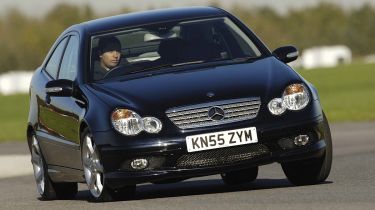
Launched in 2001, the C-Class Sports Coupé – to give it its full (and rather long-winded) title – is the oldest of our trio. Its styling is far more aggressive than the C-Class saloon’s. Gone is the bonnet-mounted three-pointed star, replaced by a larger Mercedes emblem on the slatted grille, which itself gets an aluminium finish rather than a plastic one.
But is it actually better looking than the four-door? We don’t think the proportions of the Sports Coupé work that well. Viewed side-on, the three-door seems nose heavy and stunted at the back. What’s more, the spoiler cutting across the tailgate glass is fussy, and hampers rear visibility.
It does have a sporty, coupé-like stance, however. The low roofline and smooth curves contrast with the chunky looks of the A3 and C30, but the design is beginning to show its age.
As the Mercedes is the longest car tested, and has the largest wheelbase, it’s a surprise the boot is the smallest with the seats in place, at 310 litres. It’s blighted by a narrow opening, but it’s still more practical than the C30’s, with a big tailgate and, when the chairs are folded, a maximum volume that matches the Audi’s. Rear passengers benefit from the extra length of this car. The Merc led the way for seat space, and offered the easiest access to the back, too, thanks to the clever sliding and lifting front chairs. The rear offers excellent head and legroom, and although getting three adults in is a bit of a squeeze, short journeys are bearable. Forward visibility is also good.
Used - available now

2026 BMW
3 Series
10,005 milesAutomaticPetrol2.0L
Cash £27,990
2026 Peugeot
e-208
1 milesAutomaticElectric
Cash £19,495
2026 PEUGEOT
PARTNER
12,803 milesAutomaticElectric
Cash £15,995
2023 Peugeot
408
23,267 milesAutomaticPetrol1.6L
Cash £18,250The driver is well catered for, too – legroom is excellent and the seating position spot-on. While electric adjustment of the chair is a pricey £665 option, it brings a wide range of movement and includes an electric steering column.
The Sports Coupé’s cabin design and quality is as good as rivals’. The two instrument dials are backlit white at night, and positioned in between them is a multifunction screen which is controlled via buttons on the steering wheel. We were surprised by the amount of blank switches on the centre console, given that this model costs more than £23,000, but fit and finish are superb and the interior has a stylish feel that’s missing from the more functional Audi cabin.
It’s a pity the engine isn’t up to the same standard. The 2.1-litre four-cylinder is noisy at start-up, and lacked the urgency of its opponents’ smaller oil-burners. This wasn’t helped by the slack £1,025 auto box. The five-speeder can be shifted manually, but it doesn’t have steering wheel paddles and even in manual mode has a tendency to change up too early. What’s more, while the unit is the largest and most powerful here – and consequently has the highest CO2 emissions and worst economy – the Sports Coupé was the slowest car at the test track. However, the blame for that can be laid at the door of its heavy 1,515kg kerbweight.
Nevertheless, the Merc handles well thanks to its rear-wheel-drive set-up. There’s plenty of grip, minimal body roll and it’s precise in corners, but the steering is too light and the ride much firmer than its rivals’ – although our Sport Edition model has lowered suspension and big wheels.
Yet the biggest stumbling block is the Sports Coupé’s price. At £23,770, it costs around £4,400 more than either rival. And that’s before you add any options – something most buyers will do given that standard equipment isn’t very generous.
Details
Price: £23,770
Model tested: Mercedes C220 CDI Sport Coupé 2.2 litre/148bhp
Chart position: 3
WHY: The Sports Coupé targets younger customers than the C-Class it’s based on. There are five petrol units and two diesels, plus four trims. Both oil-burners are 2.2s, but we’ve plumped for the higher-output 148bhp version in Sport Edition spec.
Economy
The fact that the Merc has the oldest, dirtiest engine here indicates that economy might not be a strong point – and so it proved. The C220 CDI has the worst claimed figures, and in our hands managed only 36.2mpg. However, we have little doubt that the manual car would happily top 40mpg.
Residuals
Mercedes has a good reputation in the used market, and it’s the diesels which perform best. So it’s no shock that the Sports Coupe CDI retains its value well. After three years, it will be worth 51.3 per cent of its list price, or £12,194. But its running costs are the highest, at 56.8ppm.
Servicing
Given the manufacturer’s reputation for expensive labour rates, we were surprised the Mercedes cost the least of our test trio to service. The first three trips to the garage will set you back £950 – that’s £145 cheaper than the A3, and more than £350 less than the C30.
Tax
Because of its larger engine and higher CO2 emissions, the Mercedes sits in the 25 per cent tax bracket. It also has the highest list price – so it’s little wonder that this is the most costly company car. Even drivers qualifying for the lower band face an annual bill of £1,303.