Audi A3 2.0 TDI 140
Beautifully finished and fun to drive, Audi's A3 is a serious contender here

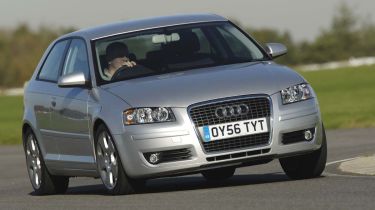
The A3 was Audi’s first premium hatchback, and its launch in 1996 was perfectly timed. Superbly built and highly desirable, it quickly captured the imagination of young executives who were desperate to step up from a Volkswagen Golf.
The factors that made the original such a hit are still clearly evident in the latest model. The A3 simply oozes quality, despite the fact that it looks rather run-of-the-mill when lined up alongside the C30 and C-Class Sports Coupé.
Video: watch CarBuyer's video review of the Audi A3
[[{"type":"media","view_mode":"content_narrow","fid":"69227","attributes":{"alt":"","class":"media-image"}}]]
With its archetypal hatchback proportions and square tail, it’s nowhere near as funky as the Volvo or sleek and sporty as the Mercedes. Yet it’s clean and unfussy nevertheless, with a strong waistline and muscular poise. Our test car had an aggressive edge thanks to the chunky 17-inch alloys fitted as standard on Sport variants.
The A3’s underpinnings are proven, and shared with a host of VW Group products, so the good packaging is no surprise. It’s the shortest car here and features the most compact wheelbase, but still has a decent 350-litre boot. The capacity increases to 1,100 litres when the rear seats are folded flat – that’s as big as the Sports Coupé and 90 litres more space than the C30 has to offer. However, the short wheelbase is noticeable if you are sitting in the rear. The chairs are set higher than those in the front, yet headroom suffers as a consequence. Legroom is better, though, and access to the back seats easier than in the C30.
Used - available now

2027 Volkswagen
Taigo
47,404 milesManualPetrol1.0L
Cash £12,500
2025 SEAT
Ibiza
18,158 milesManualPetrol1.0L
Cash £14,100
2023 Audi
Q4 e-tron
27,270 milesAutomaticElectric
Cash £18,920
2024 Nissan
Ariya
14,524 milesAutomaticElectric
Cash £21,420Up front, Audi quality is evident in the elegant, user-friendly dash design. Neither competitor is as solidly put together – the A3’s cabin feels as if it will stand the test of time. But that’s not to say it’s perfect; the cup-holder is rather flimsy, while the handbrake, when pulled up, hits the underside of our model’s optional centre armrest.
The rest of the Audi interior is better executed. High-quality switchgear is used throughout and the leather-trimmed, three-spoke steering wheel is good to hold. The sports seats also offer decent lateral support, although they aren’t quite as comfortable as those in the C30.
The proven 2.0-litre diesel engine is the best in this test. Its 320Nm of torque peaks at only 1,750rpm, and that means the Audi is ideal for overtaking. The six-speed transmission is excellent and maximises the TDI’s power, so it’s punchy and urgent low down in the range. At high revs the powerplant runs out of puff (this is also an issue in both the Volvo and Mercedes), but nevertheless the A3 felt the quickest of our trio.
And at the test track, this proved to be the case. The Audi’s 9.1-second 0-60mph sprint time was marginally slower than the C30’s, but it was by far the fastest from 30-70mph, taking only 8.3 seconds. What’s more, the A3 has the best handling. Admittedly, the competition here isn’t fierce, but in Sport trim it corners precisely and is responsive, although the steering could be more involving.
Yet while the Audi has better grip and body control than the Volvo, the ride isn’t as smooth and gets caught out by sharp bumps. So the Volvo has a better all-round balance for most buyers.
The A3 is also comparatively expensive and not especially well equipped. Simply specifying this Sport version to the same level as the standard Volvo would push its price up to £21,840 – which is £2,545 more than the Swedish offering. As a result, the Audi doesn’t look great value.
Details
Price: £20,080
Model tested: Audi A3 TDI 140 Sport 2.0 litre/138bhp
Chart position: 2
WHY: There are five petrol engines and three diesels in the A3 line-up, as well as five trim levels. Add in gearbox variations and the quattro all-wheel drive, and the choices are baffling. However, it’s the mid-range diesel in Sport spec that we test.
Economy
Although the 2.0-litre TDI powerplant is rather noisy and unrefined, it knows how to save money at the pumps. With long gearing and good aerodynamics, the Audi stretched 43.9 miles out of each gallon, making it the only car here to be able to travel more than 500 miles on a tankful.
Residuals
The standard A3 doesn’t tend to perform as strongly as the five-door Sportback, yet its residuals are still good, and diesels lead the way. After three years, it is worth 48.2 per cent of its original cost, or £10,438. But if you want to minimise your losses, the entry-level 1.9-litre TDI is a better bet.
Servicing
While Audi has the smallest network in this company, its dealers have an excellent reputation for customer relations. The first three services for the A3 come to £1,095, but thanks to its variable schedule, this 2.0-litre TDI model can travel up to 30,000 miles between check-ups.
Tax
Emitting 149g/km of CO2, the Audi’s diesel is the most environmentally friendly, and so the A3 sits in the 19 per cent tax category. Lower-band owners will shell out £839 every year – that’s over £450 cheaper than the C-Class Sports Coupé, but a mere £10 less than the Volvo.