Ford S-MAX 2.0 TDCi Titanium
Has the innovative S-MAX got the upper hand in the company of VW's Passat estate and Hyundai's Santa Fe?

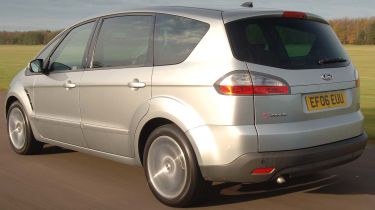
Designers try hard to make MPVs appear cool and stylish, but it’s a very difficult task. However, we think Ford has done a fantastic job with the S-MAX. The company says it aimed for a sporty interpretation of the people mover, and the model certainly fits the bill in that regard.
Admittedly, there’s no hiding its bulky MPV proportions, but the raked windscreen, curved roofline and pronounced wheelarches combine to create an athletic profile. Good design is now becoming a decisive factor when choosing a new car, and the S-MAX scores well here.
But do these looks come at the expense of space? Not a chance! While the S-MAX is 69mm lower and 50mm shorter than its Galaxy brother, it still has a generous 2,000-litre maximum luggage capacity. It’s not quite as large as the Santa Fe’s 2,213-litre area, but the much lower load height means access is easier. With all the seats flat, the space is longer and wider than the Korean SUV’s, while in five-seat mode the boot totals 755 litres – more than 200 litres up on the Passat Estate.
The S-MAX shares the same seating layout as the Galaxy. Called the Fold Flat System, it creates a level area without the need to remove heavy chairs – and stowing all five away individually is easy; a single pull of a handle is required, and the mechanisms are robust. The three middle seats are a touch narrow and firm, but are spacious, and even when fully pushed back, legroom for third row passengers is more generous than in the Santa Fe.
Used - available now

2022 Toyota
Corolla Touring Sports
50,035 milesAutomaticPetrol1.8L
Cash £15,510
2023 BMW
X5
28,356 milesAutomaticDiesel3.0L
Cash £49,991
2021 BMW
X3
46,045 milesAutomaticDiesel2.0L
Cash £26,850
2019 Mercedes
GLA
67,000 milesManualPetrol1.6L
Cash £11,600What’s more, the outer pair of seats tilt and slide to give good access to the rearmost chairs. Although headroom isn’t as generous as in the Hyundai, overall the S-MAX has the edge on both of its rivals for passenger accommodation.
Quality also impresses, with high-class dashboard materials, tight-fitting trim and solid switchgear. The driving position is designed to be car-like, and while it can’t match the Passat’s low-slung environment, it’s still a strong point, thanks to the thin A-pillars and good visibility. There’s plenty of stowage, too. We counted 26 separate cubbyholes, including large door pockets, a decent glovebox and drawers under the front seats.
Despite its size, the S-MAX turns in sharply, and steering feel is excellent – over a twisty road it’s every bit as controlled as the Passat.
A long wheelbase helps, and body roll is kept in check. Yet while the S-MAX’s ride isn’t quite as smooth as the Santa Fe’s, it absorbs bumps well, and it’s quiet and relaxing at motorway speeds. The Ford is also only slightly heavier than the VW, yet it has a power disadvantage. Only 15Nm separates our test trio’s torque outputs, but the 141bhp S-MAX lags 27bhp behind the VW. That means it doesn’t provide the mid-range punch of the more powerful VW, although the smoother delivery and slick six-speed gearchange mean the Ford is the easier car to drive.
Pricing is another trump card for the S-MAX. MPVs have always offered better value for money than off-roaders, and at £21,495 this Titanium is the cheapest car here – and a considerable £4,000 less than the Santa Fe. However, it isn’t as well equipped as its Korean rival, and is also lacking compared to the Passat. But that small shortfall aside, this is one impressive family all-rounder.
Details
Price: £21,495
Model tested: Ford S-MAX Titanium 2.0 TDCi 2.0 litre/141bhp
Chart position: 1
WHY: Shunning the boxy looks of traditional MPVs, the S-MAX has been designed to be more sporting and offer the enhanced street cred of an SUV. It’s the only model here to have seven seats as standard, and shares a platform and engines with the slightly larger Galaxy.
Economy
With 714 outlets, Ford has the UK’s largest dealer network. This mass-market approach pays dividends for owners – the S-MAX has the lowest servicing costs, with the first three visits totalling £565. The 12,500-mile intervals aren’t that impressive, though, and the one-year recovery is poor.
Residuals
When it comes to used values, the Ford is a strong performer, retaining 46.7 per cent of its price – or £10,038 over three years. However, the 2.0 TDCi isn’t the best model in the range; that’s the 1.8 TDCi LX, which holds on to 49.5 per cent of its list price.
Servicing
The Ford’s claimed figures are virtually identical to the Passat’s, but the S-MAX didn’t perform quite as well in our tests. However, 38.7mpg is reasonable given that our test car had covered only around 1,000 miles. Good aerodynamics help achieve a cruising range close to 600 miles.
Tax
It’s the cheapest car to buy, and the S-MAX also has the lowest emissions, putting out 169g/km of CO2. So it’s no surprise that it’s the best option for company drivers. Lower-band owners will face an annual bill of £1,088 a year, although that’s before options are added, and our test car had £4,400 of extras.