VW Passat Estate SEL 2.0 litre
Superb build quality and a torquey engine are Passat hallmarks, but options are dear

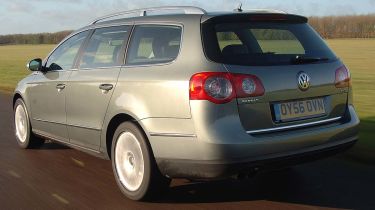
Representing the traditional estate car class in this test, you couldn’t describe Volkswagen’s sixth-generation Passat as old-fashioned. The looks are a case in point. As with its predecessor, the model appears more upmarket than every sector rival, and thanks to cues such as the chrome grille and circular LED rear lights taken from the firm’s flagship Phaeton saloon, it’s both stylish and distinctive.
The tailgate is neat, and considering the car’s 4.7-metre length, the low roofline hides its size well. However, it also serves to cut down interior room. With a maximum load volume of 1,641 litres, the Passat offers the smallest boot here, lagging 572 litres behind the Santa Fe.
When it comes to width and height, the VW also falls behind, but the load area is still practical and features a clever optional ‘cargo management’ system. This uses straps and bars clipped into parallel rails to prevent luggage sliding around.
However, the Passat loses out on the passenger carrying front, too. Unlike both rivals, there’s no seven-seat option, so if you have more than three children, you need to look elsewhere. On the plus side, it’s the only car here that can be specified with integrated child seats, while the chairs themselves are the best on offer. This SEL model gets heated leather as standard, and the seats provide excellent comfort and support. Even so, legroom is at a premium with three adults in the back, and there is less passenger space than in either rival.
Used - available now

2024 Volkswagen
Golf
45,880 milesManualPetrol1.5L
Cash £15,995
2023 Tesla
Model 3 Performance
80,710 milesAutomaticElectric
Cash £13,295
2021 Renault
Zoe
18,010 milesAutomaticElectric
Cash £9,195
2023 Tesla
Model Y Performance
29,420 milesAutomaticElectric
Cash £27,995At least the airy cabin has excellent fit and finish, while the textured plastics and silver centre console give a quality feel. The driving position is easily the best on test, with plenty of seat and steering adjustment. And although the VW can’t match the S-MAX for cubbyholes, storage is good, with deep door pockets and a useful central bin.
Access to this is made easier by the absence of a traditional handbrake – instead, the Passat has an electric version. Although this can take a little getting used to, it gives the VW a sophisticated edge. Our test car also came with the £35 optional Auto Hold function, which automatically applies the handbrake when you come to a stop on a hill and then releases it as you pull away.
The Passat’s suspension set-up is a little firmer than either rival’s, but it still rides very well and is comfortable on long journeys. Body control is the best here, and although twisting roads can unsettle the rear suspension, the VW has the finest handling of the three, and never loses its composure.
It’s not a particularly entertaining car to drive – the S-MAX is more fun – but it’s capable and comfortable. Yet the engine is a real talking point. An impressive 168bhp has been squeezed from the manufacturer’s 2.0-litre diesel unit, and with 350Nm it also has the most torque in this test. But while it makes for effortless motorway cruising, the extra turbo pressure required to boost power means the engine’s delivery isn’t as linear as the lower-output Ford’s. A long second gear doesn’t help, either, and makes the Passat tricky to drive smoothly at lower speeds.
In our acceleration tests, it was the quickest from 0-60mph, but despite the extra torque, in-gear performance was not that far ahead of the S-MAX’s – and it was also noisier at speed.
At £22,885, our Passat SEL test model is competitively priced. Can that help the estate steal victory from its SUV and MPV rivals?
Details
Price: £22,885
Model tested: VW Passat Estate SEL 2.0 litre/168bhp
Chart position: 3
WHY: While it can’t be specified with seven seats, the Passat is our current family car class leader. It offers a great blend of comfort, low running costs and build quality, and the estate is very versatile. As with all our contenders, we test the flagship model; here, that’s the SEL.
Economy
The Volkswagen is the most expensive option when it comes to servicing, but a variable schedule decides when the Passat needs attention – and the diesel can potentially travel for 30,000 miles or two years without a major check-up. We were quoted £710 for the first three visits.
Residuals
Surprisingly, the Passat is the worst residual performer on test. That’s because there are plenty of examples on the used market, and prices are suffering as a result. After three years, it holds on to only 41.3 per cent of its price new – but the saloon version fares even worse.
Servicing
We were impressed by the fuel efficiency of the Passat given the high output of the 2.0-litre diesel. It has the most horsepower and torque here, but returned 43.5mpg over our test route – that’s only 0.6mpg short of the claimed combined figure, and nearly 13mpg better than the Santa Fe.
Tax
Once again, the conventional estate scores well, with CO2 emissions of 173g/km. That means it sits only one tax bracket higher than the S-MAX. Lower-band owners will pay £1,208 a year, but with all the options fitted to our test car, this figure would rise to £1,434.