Volkswagen Eos 2.0 TDI Sport
Our current coupé-cabrio champ is a stern rival for Ford’s newcomer

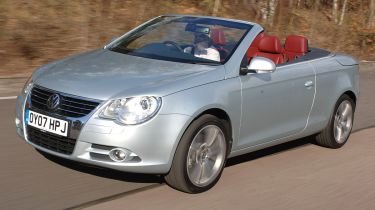
Meet the world’s first CSC. That’s VW’s rather grand claim for the Eos, which it says features a five-part electric top. In reality, CSC merely stands for coupé-sunroof-cabrio, and refers to the glass section over the front seats, which tilts and slides separately from the main mechanism. Really there are only three moving parts to the hood itself.
But this is still an innovative folding hard-top. The sunroof slides back over the centre section and the rear glass stacks on top of that, forming a tightly packed sandwich which then stows into the load bay. It’s the quietest and best mechanism to watch, although when retracted it’s hard to access your luggage, because the gap between the roof and boot lip is narrower than the Ford’s.
It makes up for that by having the most upmarket design of these three. VW has tried hard – and succeeded – in differentiating the Eos from the Golf; it’s easily distinguishable, thanks to its handsome front end and carefully crafted profile.
We particularly like the line that runs from the roof down into the bootlid – even if the panel gap isn’t consistent the whole way along. Although it’s 200mm longer than the Golf, the Eos looks neat, well executed and has an air of quality. As far as desirability goes, the Eos wins hands down.
And VW hasn’t overlooked the interior, either. Although it takes some cues from the Passat, others from the Golf and uses generic VW parts, it’s far better designed and detailed – plus more robustly constructed from superior quality materials – than either the Ford or Vauxhall.
The cubbies are big and it’s the best here for rear passengers – although that’s not saying much, since two adults will still find it a squeeze. There’s a host of useful features, too. We particularly like the single button that drops all four windows. It’s evidence of real attention to detail.
Unfortunately, nothing has been done to improve the 2.0 TDI engine. In terms of economy, power and performance there’s nothing to complain about – it matches the Focus in every way with strong in-gear thrust and reasonable sprinting ability. But the unit is rather coarse, power comes in suddenly, and the Eos isn’t easy to drive as smoothly and precisely as the Ford.
And around town, the excessive noise isn’t in keeping with the VW’s handsome looks. Things improve at speed. Engine intrusion dies away, and VW obviously spent time perfecting airflow, because it was the quietest with the roof up (although there was some whistle from the join between the side windows) and created the least buffeting around occupants with the top down.
Possessing a fast, positive gearchange, strong brakes and meaty steering, the Eos looks a promising driver’s car, and on the whole it is. True, the controls and suspension don’t have the finesse of the Focus’s, while the Ford’s smoother, gentler road manners are more in keeping with this type of car, but the German drop-top has a trick up its sleeve.
And that’s its bodyshell, which is by far the stiffest of these three cars’. VW claims it has been designed as a convertible from the ground up, rather than a Golf with a chopped top, but whatever the truth of the matter, it certainly comes across as tough and safe. That’s just as well, given the overly firm ride which becomes pattery on rough roads – not helped by the fact our car was wearing optional 18-inch alloys. They increase the price of what’s already comfortably the most expensive car here.
Details
Price: £22,630
Model tested: Volkswagen Eos TDI Sport
Chart position: 1
WHY: Launched last July, there are seven models in the Eos range, and this is the top-spec diesel.
Economy
The Ford has marginally better claimed economy figures and longer gearing, but it was the lighter Eos that emerged slightly ahead. It was the only car to top 40mpg here, and a 500-mile range is possible, thanks to a 55-litre fuel tank.
Residuals
The hugely desirable Eos has the best second-hand values here at 53.0 per cent. However, as it’s more expensive to buy in the first place, it actually loses nearly as much money as the Ford – £10,636 in total.
Servicing
The VW isn’t much more expensive to fix than the Focus, according to our quotes. And in reality it’s likely to prove cheaper, since it runs on a self-diagnosing variable servicing schedule rather than needing annual checks.
Tax
With CO2 emissions only 2g/km above the Ford’s, the VW falls into the same 21 per cent tax bracket. However its higher list price drives up tax costs, so even lower-rate payers will be faced with a four-figure bill.