Audi Q7 3.0 TDI S Line
King-size 4x4 offers performance that belies its massive proportions

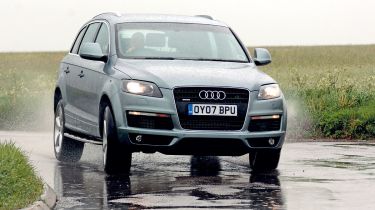
Size matters. Or at least that seemed to be Audi’s philosophy when it came to developing its first off-roader. The Q7 is massive: 250mm longer and 68mm wider than the Discovery with a wheelbase of more than three metres. It only looks small when parked next to the Land Rover in our group shot because it’s comparatively low at 1,737mm.
Trouble is, unlike most other Audis, which tend to be neat and handsome, the Q7 isn’t particularly well executed. The heavy flanks and tall nose make it look big, bulky and cumbersome, while its sheer size means the styling comes across as clumsy – BMW’s decision not to follow suit and build an equally large machine seems to be a clever move.
But can the Q7 win back points inside? There’s no denying it’s spacious – not even the Land Rover could match the Audi’s 2,040mm maximum load length, while the X5 fell 155mm short. The one-piece tailgate makes the area more accessible, too – were it not for the high load sill. Even with the air-suspension lowered, the boot floor is 830mm above the road, and when you combine this with the low roofline, the height of the cabin is limited. That hampers maximum load volume, and is also bad news for headroom.
The rearmost seats are standard in the Q7, and they undoubtedly offer more knee clearance than the X5’s – although adults will still be sitting with their legs splayed. Access is awkward, too, but more puzzlingly the middle row features a shorter, narrower and harder centre chair, which quickly becomes uncomfortable.
The front seats aren’t particularly well padded, either – this S line model features sports chairs that increase support, but aren’t so cosseting. As with the X5, there are few reminders that you’re sitting in an off-roader – the layout is similar to the A6’s – yet Audi hasn’t overlooked its legendary construction standards while building the cockpit.
Unfortunately, it didn’t put enough thought into the view out. The combination of swept-back A-pillars and vast door mirrors means forward visibility is a real weak point. This, combined with the Q7’s sheer size, makes it extremely tricky to manoeuvre around town.
Urban settings don’t exactly give the engine much space to breathe, either – and the 3.0-litre V6 diesel is at its best when allowed to stretch its legs. At low speeds, there’s too much noise intrusion and the sluggish throttle response is more noticeable, but with 500Nm of torque at 1,750rpm, the Q7 has impressive overtaking ability – provided the road is wide enough.
Yet the engine isn’t as cultured and well mannered as either rival’s, and similar criticisms can be aimed at the suspension set-up, too. Equipped with 20-inch alloys and low-profile tyres, it’s no wonder the Q7 has a lumpy, thumpy ride. Even with the air-suspension in comfort mode, it’s not very cosseting.
The well insulated cabin and raised seating does a decent job of distancing you from the world outside, but the suspension undoes that good work. It’s not as if the Q7 handles brilliantly, either. Admittedly, it’s far more responsive than the Disco, with limited roll and precise turn-in, but it feels skittish – unlike the BMW, it doesn’t seem to have a proper grip on the tarmac.
The Q7 range starts from £37,285, so it undercuts the X5. But both models have costly and extensive options lists – the extras added
to our Audi raised the price by nearly £7,000.
Details
Price: £41,380
Model tested: Audi Q7 3.0 TDI S line
Chart position: 3
WHY: Launched less than a year ago, the X5’s most direct rival has standard adaptive air-suspension.
Economy
All these cars have massive fuel tanks, but none is bigger than the Q7’s 100-litre reservoir. It achieved less than 25mpg during its time with us, so you’ll be stopping every 548 miles to put in nearly £100 worth of diesel.
Residuals
We were so surprised by the Q7’s residual forecast that we had it rechecked. It loses only £16,718 – about the same as a £25,000 family car. Audi’s image and reputation has undoubtedly given the 4x4 a boost.
Servicing
All these SUVs will tell you when they need to be serviced, but expect to travel around 20,000 miles between check-ups in the Q7 TDI. That means 60,000 miles of motoring will set you back around £1,000 in maintenance.
Tax
Even dirtier than the Land Rover, the Q7 pumps out 279 grams of CO2 every kilometre – or nearly half a kilogram per mile. Start adding options on top of the £41,380 list price, and you’ll be looking at a £6,000 annual tax bill.