Land Rover Discovery TDV6 HSE
No-nonsense workhorse is more than a match for illustrious rivals

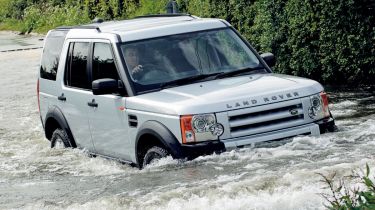
Meet the odd one out. It’s British, unashamed of its off-road roots, isn’t even on speaking terms with the concept of sportiness and is squarer than a breeze block. So what is it about the Land Rover Discovery – winner of the 4x4 Off-Roader class at Auto Express’s New Car Honours for two years in a row – that makes it so good?
Part of the reason for its success has to be its honest approach. This isn’t a car that tries to deceive buyers. From its cliff-like nose to its flattened tail, what you see is what you get with the third-generation Discovery. Neither rival would be dare be spotted with black plastic body mouldings or door handles, yet this car wears them with pride – an early indication of the big Brit’s utilitarian approach.
For further proof of that, simply open the asymmetric two-piece tailgate. No matter how much luggage space you need, the Land Rover will cope. Even with all seven seats in position there’s room for nearly 300 litres of kit, while those occupying the last pair of seats enjoy palatial accommodation – there’s virtually as much legroom as in the middle row, where the three individual chairs all slide independently.
Unlike in its opponents, you see a lot of bare metal while operating the seat mechanisms, and the handles aren’t as simple to use. But once you are familiar with it, the seating can be dropped flat quickly and easily to create a concert hall-sized load area 808 litres bigger than the BMW’s.
Step up into the driver’s seat – and make no mistake, it really is a step up – and you’re struck by three things: the panoramic view out, the endless amounts of stowage space and the relatively unsophisticated design.
This is no luxury SUV – it has an almost military layout with squared-off edges and bare plastics, plus a driving position a tank commander would be happy with. What’s more, the thin pillars,
vertical sides and visible bonnet make the Land Rover very easy to place on the road, so urban driving is not as intimidating as you might expect.
It helps that the TDV6 engine is immaculately behaved. The surprisingly soft engine note is barely audible, there are no vibrations and the gearbox is faultlessly smooth. But there are two major downsides. The 2.7-litre powerplant has only 189bhp and 440Nm of torque, which has to push along 2.7 tonnes of 4x4.
Its weight means the Discovery is slow and inefficient, even by SUV standards. But it makes no pretence at offering strong performance, and you soon find yourself adapting to the Land Rover’s more relaxed driving style.
OK, the engine is relatively lazy and lethargic, but don’t forget this is a versatile family car, not a hot hatch. So you shouldn’t be surprised to learn that after the German pair, it feels ponderous when changing directions, leans heavily around corners and has inert steering.
However, we’d argue comfort and refinement are of far more importance – and in those areas, the Discovery is peerless. Although the 0.41Cd aerodynamics mean it barges through the air, very little wind noise filters into the cabin, and the air-suspension does a great job of covering up the worst surfaces British roads can throw at it.
Although the Land Rover has the highest list price, the range-topping HSE model is generously equipped. And let’s not forget that when it comes to off-road ability, the Discovery is unstoppable.
Details
Price: £43,800
Model tested: Land Rover Discovery TDV6 HSE
Chart position: 1
WHY: Chunky and tough, the Disco will test the X5’s claims of enhanced practicality to the limit.
Economy
The Discovery’s vast kerbweight and slabby 0.41Cd aerodynamics ensure that, no matter how gently you drive it, the TDV6 diesel will never be efficient. At least its more relaxed approach encourages gentler progress.
Residuals
You’ll pay the most to own the Discovery in the first place, but three years down the line, it will be worth the least. The Land Rover still holds on to more than half its value – which proves that there’s plenty of life in the SUV sector.
Servicing
Land Rover was voted 17th out of 32 in our Driver Power 2007 dealer survey, with Audi 16th and BMW 11th. The British firm was criticised for its high prices, and our research backed up your findings – the first three checks came to £1,075.
Tax
With higher-band owners shelling out more than £6,000 a year in tax costs, the Discovery is not a cheap option. But it’s very well equipped – both rivals had around £7,500 of extras, which pushes tax costs up by around £1,000 each.