Smart ForTwo passion
Can the two-seat city slicker pick up where its predecessor left off?

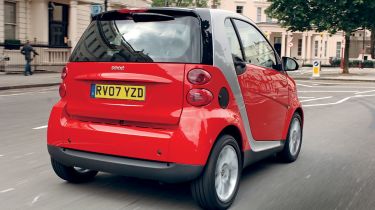
Smart was never going to take a risk by changing the basic ForTwo concept too much, so it’s no surprise you have to look hard to spot that this is the new version. But each detail and panel is subtly different. New lights front and rear, plus a slightly more muscular stance, are the biggest giveaways. Fans of the old car’s cheeky charm won’t be disappointed – the newcomer still has lots of kerbside appeal.
Video: watch CarBuyer's video review of the Smart ForTwo
[[{"type":"media","view_mode":"content_narrow","fid":"69259","attributes":{"alt":"","class":"media-image"}}]]
The Smart is larger than the car it replaces; the wheelbase has gained 55mm and it’s 43mm wider. This makes it nearly as wide as the Panda, although it’s the best part of a metre shorter than either rival here.
The robust build quality of the original car hasn’t been compromised either. The cabin benefits from an even more expensive feel, while the integrated stereo and switches have a real Mercedes stamp of quality. Trademark Smart features such as the pod clock and rev counter, plus carpeted dash and centrally mounted key slot, remain. And there’s still the same sensation of space when seated inside, although it’s a shame some steering wheel adjustment wasn’t engineered into the new design.
Boot space has grown from 150 to 220 litres and the front passenger seat folds forward to carry long loads. Clearly the Smart can’t compete with its four-seat rivals in the space stakes, but city friendly ideas such as the split tailgate that aids access in tight spots mean it will offer enough practicality for many.
There’s just enough performance, too. Top speed is limited to 92mph, but more importantly the normally aspirated 71bhp engine, combined with a low 750kg kerbweight, helps it reach 0-60mph in 13.8 seconds, just over a second faster than the i. It can’t match the diesel Panda for in-gear response, though – it’s more than 10 seconds slower in fifth from 50-70mph, for example.
As with the old car, the automated manual gearbox has hesitant shifts, and there’s a pause between gears that causes the car to lurch back and forth as you change up. This is a trait we really hoped Smart would sort out, and isn’t the only familiar characteristic from the original model.
The steering is heavy at low speeds, which, added to the jerky throttle, makes manoeuvring difficult – a real problem for a city car. True, the large windscreen means visibility is good, and the tight turning circle and tiny dimensions make the Smart easy to park. But its width makes it no easier to slot through small gaps than either rival, and it lacks their responsive drivetrains, too.
Out of town, the short wheelbase and stiff ride mean the ForTwo is nervous and jarring on anything other than smooth surfaces. In corners, the inert steering weights up, but feels numb. While there’s plenty of grip, the stability control kicks in way before the tyres even begin to push wide. And despite recording the shortest stopping distances in our tests, the brake pedal is as stiff as its
predecessor’s, making it hard to slow progressively.
Other elements of the Smart experience that remain are more welcome. There’s an extensive range of options and colours available, for example, and with an expected four-star Euro NCAP rating, the ForTwo’s strong safety reputation stays intact.
Passion trim features standard alloy wheels, air-con and electric windows, making it better equipped than the Panda. It’s cheaper to buy than the Mitsubishi, too. But has the Smart really moved on enough to win this test?
Details
Price: £8,540
Model tested: Smart ForTwo Passion
Chart position: 3
WHY: Still oozing charm, the second-generation Smart goes on sale in the UK in mid-September.
Economy
With its tiny 999cc engine and 750kg kerbweight, the Smart’s frugal economy came as no surprise. We averaged 43.3mpg, giving a range of 314 miles. But this trails the official 60.1mpg figure by some way, and isn’t the best here.
Residuals
As the new ForTwo isn’t due in showrooms until September, residuals have yet to be calculated. But the original car still retains 46 per cent of its price, which is far better than the Fiat Panda. The new model should perform similarly well.
Servicing
Smart hasn’t released servicing costs for the new car, but based on prices for the technically similar outgoing ForTwo, it’s likely to be the most costly model to maintain. We hope the intervals are longer than the current 9,000 miles, too.
Tax
The Smart’s basic colours use water-soluble paints, while the moulded body panels are recyclable, and the instrument panel is partly made of a renewable material called flax. Fuel consumption has been reduced over the outgoing model, too.