Mitsubishi i
Tall, narrow and futuristic, the K-car certainly carves a unique niche

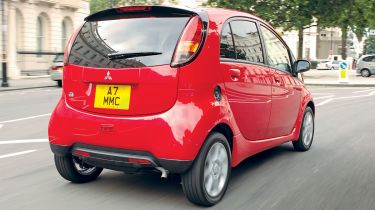
With only 300 examples coming to the UK this year, the Mitsubishi i is going to be a rare sight on our roads – yet with its futuristic looks and unique dimensions, it certainly stands out. But is the styling really that original? From some angles, especially nose-on, it looks a bit like a four-door version of the ForTwo.
Measuring 3,395mm, the i is 143mm shorter than the Fiat, yet it has a wheelbase 251mm longer, which helps rear passenger legroom no end. True, the boot floor is high due to the engine underneath, and the narrow cabin means sitting three abreast isn’t possible. Up front the Mitsubishi doesn’t feel quite as special as the Smart, although the quality of plastics is better than in the Panda.
The dash looks modern, and the high-mounted audio controls are well placed. There’s a glovebox, plus a pair of cup-holders, and the cabin is inoffensive and functional. The driving position is high and it lacks any steering wheel adjustment, but overall the i doesn’t give the impression that you are driving a really tiny car.
Nevertheless, the Mitsubishi is immediately at home in town. Light steering and a tight turning circle make it easy to manoeuvre, and the auto gearbox doesn’t suffer the jerky low-speed movement of the Smart’s automated manual.
The upshifts are smoother, too, but in kickdown the Mitsubishi sounds harsh as the revs rise. The 660cc turbocharged engine has a tiny 57bhp output and only 85Nm of torque, so it’s no surprise the i takes 15 seconds to get from 0-60mph. When you take into account that the Panda has an extra 60Nm, the Fiat’s more responsive acceleration is easy to understand.
However, the Mitsubishi has enough power to buzz along happily in city traffic, and out of town it can maintain a reasonable motorway pace. Inclines are best taken with a run-up, though, and the Smart has a sharper throttle response.
With its narrow track, the Mitsubishi is also unsettled by side winds – even more so than the ForTwo, and it doesn’t feel as stable at speed, either. This means it’s even less at home away from the city centre than the German two-seater, but at least it has a more forgiving ride than the ForTwo. In fact its softer suspension set-up makes for a far less jarring experience on all roads.
Once into corners, the tiny front tyres soon scream in protest, and there’s plenty of body roll, but while the steering doesn’t weight up at speed, it has a more natural feel than the Smart’s heavy wheel. Admittedly the i isn’t as reassuring
in bends as a conventional small car, but the handling doesn’t throw up any nasty surprises.
However, with no stability control, those thin tyres and a narrow track, any high-speed lane change is more dramatic than in the
stability control-equipped Smart. The brakes also suffered from fade after only a couple of hard stops, and with such a small footprint on the road it took a rather lengthy 54.5 metres to stop from 70mph. The ABS is over-active in low-speed emergency stops, too.
Only one model is being imported, and standard equipment includes alloy wheels, air-conditioning, power fold mirrors, ISOFIX child seat mountings and remote central locking. It’s better equipped than the Panda, but the £9,084 price tag places the i into entry-level supermini territory. Is Mitsubishi getting ideas above its station?
Details
Price: £9,084
Model tested: Mitsubishi i
Chart position: 2
WHY: Only 300 Mitsubishis will be imported this year to see how UK customers react to the new city car.
Economy
The i is heavier than the ForTwo, and Mitsubishi quotes an official combined figure of 54.6mpg. We averaged a very impressive 48.8mpg in the new car– one of the best figures we’ve ever got from a petrol engine.
Residuals
Given that only 300 cars will be available to British buyers in 2007, the Mitsubishi isn’t exactly going to be a common sight on our roads. Until it becomes more established, second-hand values are difficult to work out.
Servicing
A fixed-priced service deal is offered on the i – £150 covers the first three checks so, added to a three-year recovery deal, the Mitsubishi is the cheapest car to own and maintain. And the 142-dealer network is bigger than Smart’s.
Tax
There’s an obvious environmental impact to the fact that the i has to be shipped from Japan, but with recyclable parts and frugal economy, it’s certainly a green car. It emits 2g/km more CO2 than the Smart, though.