Chevrolet Captiva 2.0 VCDi LT
Can the seven-seater transform Chevy’s image in the UK market?

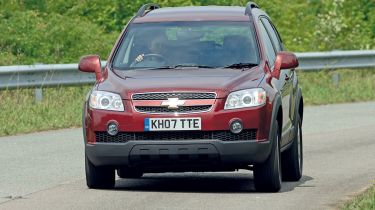
As brands go, Chevrolet is up there among the most recognised in the world. But you are most likely to associate it with mammoth American pick-ups or sports cars such as the Corvette. In the UK, the firm has yet to make much impact – which is why the Captiva is such a crucial car.
The flagship for the brand has been designed to appeal in every market, so it’s no surprise to see a European influence in the styling. It’s well proportioned, with a rising waistline and sloping roof helping to provide a sporty feel. But while it’s neatly executed, the shape is far from memorable or cutting edge, and there are echoes of several other SUVs in the look. The result is a fairly generic and unassuming car.
Inside, the interior does little to inspire, either. It has a Vauxhall feel – not surprising, as the Captiva’s sister car is the Luton brand’s Antara. All the controls are logically placed and quality is acceptable, but the stereo in our test car seemed unable to stay tuned to one station for very long.
Our main gripe concerns the centre console; this is dominated by a large storage cubby, which looks unsightly. Even if you specify the optional satellite navigation system, the cubby remains in place, with the screen sitting on top of the dash.
There’s better news when it comes to the driving position, as the seat provides a wide range of adjustment. But you will need those large wing mirrors, as rearward visibility is poor.
Passengers in the middle bench are well looked after; legroom is generous and three adults fit in easily – something that would be a squeeze in the CR-V. But this level of comfort isn’t carried over to the rearmost seats, which feel cramped.
Annoyingly, when they are in place, you have to remove the parcel shelf, and there is nowhere to store it on board. Yet we’re impressed with the chairs’ simple folding mechanism. And there are plenty of positives about the 2.0-litre VCDi engine. While it’s a little noisy at start-up, once on the move it feels strong and urgent, and with 148bhp it matches the Hyundai for power. There’s minimal diesel clatter, even under hard acceleration, although it’s still not as smooth as either rival’s powerplant – which just shows the quality of Hyundai and Honda’s engineering.
The biggest letdown, however, is the Captiva’s five-speed manual gearbox. The notchy change and vague nature, combined with a springy clutch, make for a far from relaxing experience. What’s more, a short first ratio and long second mean town driving is very frustrating.
However, at the test track, the Chevrolet did manage to outperform the equally heavy Santa Fe; despite a 15Nm torque deficit, the Captiva sprinted from 0-60mph in 11 seconds – that’s half-a-second quicker than the Hyundai.
On the road, the Captiva is hampered by its slow, lifeless steering, along with poor body control. Of the three cars here, it inspires the least confidence, especially on twisting roads, and isn’t as composed or planted to the road. The brakes were the least effective, too – they brought the Chevy to a halt from 70mph in 55.6 metres, and the pedal lacks feel.
Then again, the Captiva represents great value. Even though it doesn’t match the other cars for equipment – neither leather nor climate control is fitted as standard – the seven-seater diesel costs £21,140. So you’re getting a lot of SUV for your money. That could be the deciding factor here!
Details
Price: £21,140
Model tested: Chevrolet Captiva VCDi LT
Chart position: 3
WHY: It gets Chevrolet’s first diesel engine, but the Captiva will have to be good to succeed in the UK.
Economy
Compared to rivals, the Captiva’s 33.8mpg is disappointing. However, our car was fresh off the production line and had covered barely any miles. With a bit of running in, we would expect the newcomer to match both the Honda and Hyundai.
Residuals
We’re amazed by the Captiva’s residuals. According to our experts, it will retain 50.4 per cent of its list price after three years. However, it’s important to bear in mind that new cars usually have initially strong figures.
Servicing
Chevrolet’s fixed-price servicing package is one of the best deals around. For £299, Captiva owners get three years or 30,000 miles of servicing. An extra £100 extends this to 60,000 miles, plus the cover can be transferred if you decide to sell.
Tax
While the Captiva is the least eco-friendly car of our quartet – emitting 197g/km of CO2 – a low price tag means that it’s cheaper than the Santa Fe to run as a company car. Lower-band owners will pay £1,424 a year in tax.